
 By Cong Updated
Compare Walgreens heated neck wrap formats across electric shoulder wraps and microwavable gel or bead packs, with tips on sizing and daily care.
Overview
Browsing pharmacy retail aisles or searching online health catalogs for a heated neck wrap walgreens option brings consumers face-to-face with a wide variety of personal care thermal products. Whether you are managing upper body muscle tightness after long hours at an office workstation, looking for portable warmth during winter errands, or seeking a cozy option for evening relaxation, pharmacy shelves offer several distinct appliance formats. Understanding how these formats function in real-life usage scenarios helps you choose a product that seamlessly aligns with your daily routine.
Selecting the right warming product involves looking beyond brand packaging or promotional banners. Because thermal wraps range from plug-in electric pads to rechargeable battery units, single-use air-activated patches, and microwavable gel packs, shoppers benefit from comparing product categories objectively. This buyer's guide explores key feature differences across warming formats, examines an independent case study of rechargeable technology, reviews health and editorial evidence, and outlines essential safety guidelines for daily home use.
Comparing Warming Formats by Real-Life Usage Scenarios
Pharmacy retailers like Walgreens showcase a diverse assortment of thermal relief products within their personal care catalogs. When evaluating options displayed on a retail category page like Walgreens Heated Neck Wraps, buyers will find that warming products fall into four primary physical formats, each suited to different daily scenarios:
Format A: Mains-Powered Corded Electric Heating Wraps
Corded electric heating pads connect directly to household wall outlets via electrical power cables.
- Best Usage Scenario: Stationary desk work, reading in an armchair, or relaxing on a couch near a wall outlet.
- Functional Characteristics: Corded devices do not require battery recharging. Compare their listed shapes and coverage.
- Shopping Considerations: Corded operation requires sitting close to an electrical outlet and routing power cables safely to avoid tripping hazards or catching cords under office chair wheels.
Format B: Rechargeable Battery-Operated Heating Wraps
Rechargeable cordless wraps use a battery to power the device.
- Best Usage Scenario: Sitting away from an outlet or changing rooms, within the conditions described in the product instructions.
- Functional Characteristics: Battery power provides complete freedom of movement, freeing you from tethered wall sockets. Many cordless wraps incorporate built-in fabric pockets to store the battery pack securely while worn.
- Shopping Considerations: Sessions must be planned around battery charge cycles. Power packs add slight localized weight, and batteries require periodic charging according to manufacturer instructions.
Format C: Single-Use Air-Activated Thermal Heat Patches
Some disposable wraps activate on exposure to air; follow the label for the specific product.
- Best Usage Scenario: Outdoor winter activities, commuting, travel, or situations where electrical power is unavailable.
- Functional Characteristics: Placement and application vary by product. Follow the package directions for where and how to wear it.
- Shopping Considerations: These wraps are single-use, disposable items. While highly portable and discreet, they do not offer adjustable temperature controls or reusable eco-friendly operation.
Format D: Reusable Microwavable Wraps and Hot/Cold Gel Packs
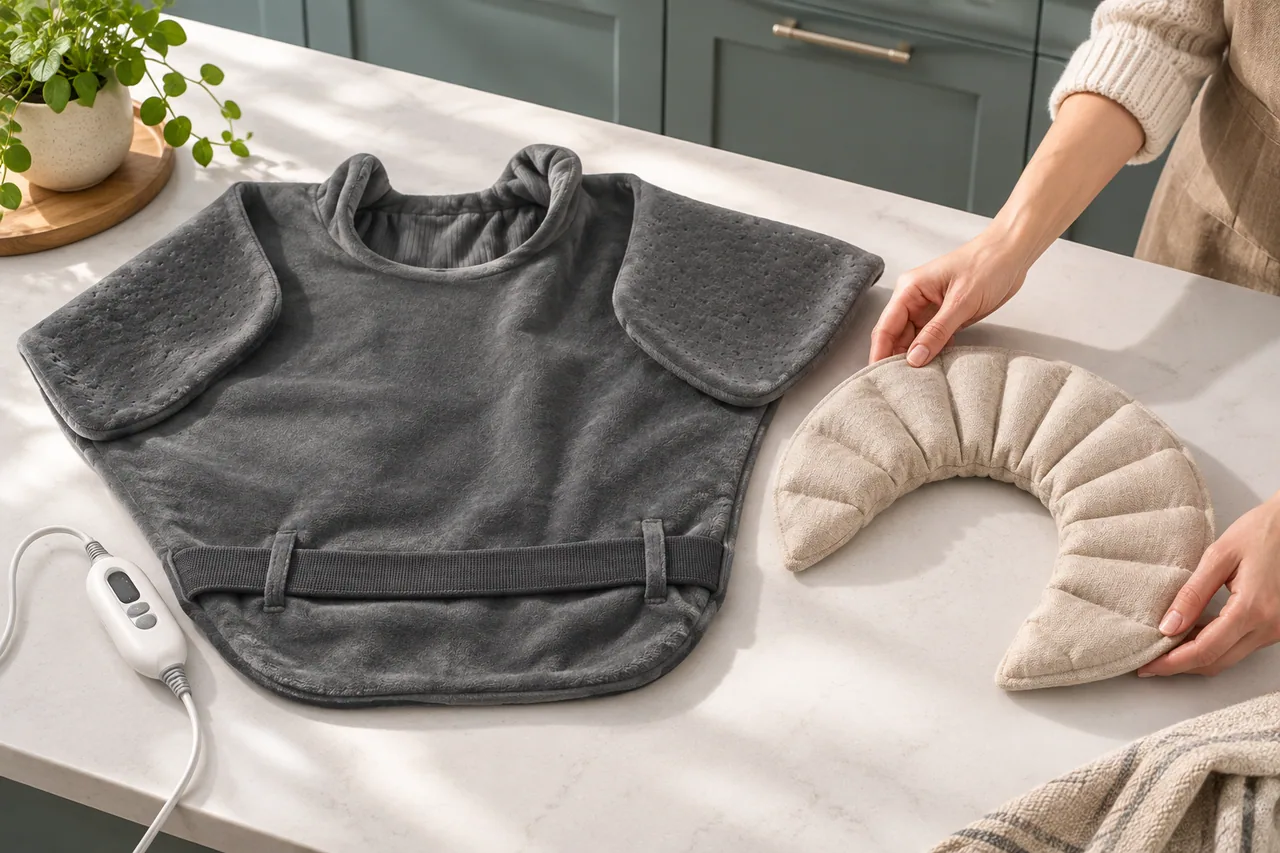
Microwavable wraps contain natural organic grains or gel cores enclosed within soft fabric covers.
- Best Usage Scenario: An awake rest break or a situation where a product specifically designed for both hot and cold use is useful.
- Functional Characteristics: Preparation differs across products. Heat or cool only when the label explicitly permits that method.
- Shopping Considerations: Microwavable wraps lose thermal energy gradually as they cool down, requiring reheating for extended sessions. Follow the specific product’s cleaning instructions.
Independent Product Case Study: Rechargeable Cordless Features
While pharmacy retailer catalogs feature various brand listings, shoppers looking for cordless battery technology often encounter independent specialty brands online. To understand how rechargeable features are specified in an actual appliance, consider the official manufacturer listing for the Pure Enrichment PureRelief Cordless Neck and Shoulder Heating Pad.
Stated Specifications of PureRelief Cordless
Official product documentation for this specific Pure Enrichment model details several documented design parameters:
Rechargeable Battery Architecture: The wrap includes a rechargeable battery pack that stores inside a built-in pocket sewn into the pad's fabric shell, enabling cordless operation.
Four Heat Settings: The listing describes 4 heat settings.
Weighted Glass Micro-Bead Fill: The pad incorporates weighted glass micro-beads as weighting.
Machine-Washable Fabric Shell: The plush micro-plush cover is described as machine washable, with the manufacturer specifying that users must follow the instruction manual for exact preparation steps before laundering.
Product Specification Qualifier: It is essential to note that the features detailed above—including the 4 heat settings, weighted glass beads, built-in battery pocket, and machine-washable fabric—represent manufacturer-published specifications for the Pure Enrichment PureRelief Cordless model. They do not represent hands-on lab test results conducted by our editorial staff, nor should buyers assume that retail category pages like Walgreens carry this specific model.
Furthermore, because official documentation for battery-operated devices often provides varying runtime figures depending on the heat level selected and ambient room temperature, buyers should avoid relying on fixed runtime numbers and instead follow the operating instructions provided in their product manual.
Practical Buying Checklist: Fit, Coverage, Controls, and Maintenance
Choosing the right warming product requires evaluating how specific physical features align with your body shape and daily maintenance preferences.
Neck and Shoulder Coverage Options
The human cervical spine features a natural inward curve. Standard flat rectangular heating pads lay horizontally across a surface, which can leave open air spaces around the back of the neck when placed over the upper body.
- High-Collar Contoured Wraps: Some products have a raised collar and shoulder panels. Look at their shape and compare it with the coverage you prefer.
- Fastening Mechanisms: If a product has a clasp or straps, consider whether its position and adjustment suit you.
- Weighted Perimeter Edges: If a product is weighted, consider whether that weight feels comfortable for you.
Control Systems and Operational Simplicity
Evaluate how temperature settings are managed during use:
- Inline Controllers: Check whether the controller features clear, backlit buttons or simple push-button controls that are easy to operate while wearing the wrap.
- Setting Adjustability: Devices offering multiple heat settings allow you to adjust warmth based on ambient room temperature and personal comfort preferences.
Fabric Care and Maintenance Requirements
Proper fabric care preserves material softness while protecting internal electrical wiring:
- Always Disconnect Power Supplies: Always unplug corded models or remove rechargeable battery packs from storage pockets before cleaning.
- Follow Sewn-In Care Labels: Never assume all heating pads share identical cleaning rules. Check your specific model's care tag. For example, while some fabric covers permit machine washing after controller detachment, others specify surface spot-cleaning only with a damp cloth.
- Water Safety Rules: Never submerge active electrical wiring, plugs, or non-detachable inline controllers in water. Never apply water to electric pads or attempt to improvise moist heat unless the product manual explicitly permits it. Ensure all fabric components are completely dry before reconnecting to power.
Appliance Comparisons: Localized Pads vs. Whole-Bed Warmers
Shoppers evaluating home comfort products often compare targeted heating pads against broad bedding appliances. Understanding how these categories differ ensures you choose the correct appliance for your needs.
Concentrated Surface Heating Pads
As explained in commercial comparison guides from Bedsure, localized electric heating pads focus thermal energy over specific, targeted body areas:
- Targeted Application: A cervical heating pad electric wrap delivers concentrated warmth directly across tight neck, shoulder, or upper back muscles.
- Ergonomic Mobility: Localized pads are compact, lightweight, and easy to use while seated upright at an office desk, sofa, or armchair.
Whole-Bed Warming Textiles: Electric Blankets and Mattress Pads
By contrast, broad bed-warming appliances—such as electric blankets and heated mattress pads—serve a completely different function:
- Broad Surface Warmth: Electric blankets and mattress pads are designed to warm large bedding surfaces, providing diffuse pre-warming for an entire bed before sleep.
- Not Designed for Localized Trapezius Relief: Bedding products cover a larger area; a neck wrap is designed for a smaller region. Follow each product’s intended-use instructions.
Health Context, Workstation Ergonomics, and Essential Safety Protocols
Understanding how surface warmth interacts with muscle tissue helps establish practical self-care expectations for home use.
Posture Awareness and Daily Ergonomics
While personal warming products offer pleasant home relaxation, addressing daily posture habits is essential for long-term neck and shoulder comfort:
- Screen Elevation: Place your screen at a comfortable height that avoids a prolonged downward head tilt.
- Taking Regular Movement Breaks: Take brief breaks during extended desk sessions to stand up, gently roll your shoulders, and turn your head from side to side. Short physical breaks help relieve static muscle load across your trapezius muscles.
- Important Clinical Limitation: While health authorities explain the physiological benefits of surface heat and vasodilation, general health principles do not constitute clinical proof of product-specific treatment outcomes or medical cures. A heating pad for neck stiffness is a supportive home self-care tool for everyday muscle relaxation, not a medical cure for underlying spine disorders, structural joint damage, or chronic medical conditions.
STRICT SAFETY WARNING: NEVER MICROWAVE ELECTRIC APPLIANCES
Never place any electric heating pad, corded wrap, or battery-operated device inside a microwave oven. Electric appliances contain internal metal wiring, copper elements, and electronic components that are not suitable for microwave heating. Microwaving is strictly limited to specially labeled organic grain or gel packs.
Avoid Sleeping With a Heating Pad
Never use an electric heating pad or battery-powered heating wrap while sleeping or napping.
Falling asleep with an active electric heating pad can prevent you from noticing excessive heat and removing the device, increasing the risk of burns. Always power off, unplug, and remove any heating device before lying down to sleep or nap. Integrated automatic shut-off timers function strictly as secondary safety safeguards and do not replace turning off the device manually before sleep.
Active Skin Monitoring and Medical Precautions
Inspect your skin periodically during every warming session. If a heating wrap feels uncomfortably hot at any point, stop using the device immediately and turn off the power supply. Do not attempt to cushion an uncomfortably hot pad with extra towels or fabric layers to force continued use.
If you experience severe neck pain, sudden numbness, tingling radiating down an arm or hand, or pain resulting from physical trauma, seek immediate professional medical evaluation rather than relying on self-care warming products.
Cong
Cong draws on years of experience in electric heating product processing and manufacturing, together with market research, to explain personal heating products in practical terms.
View author profile