
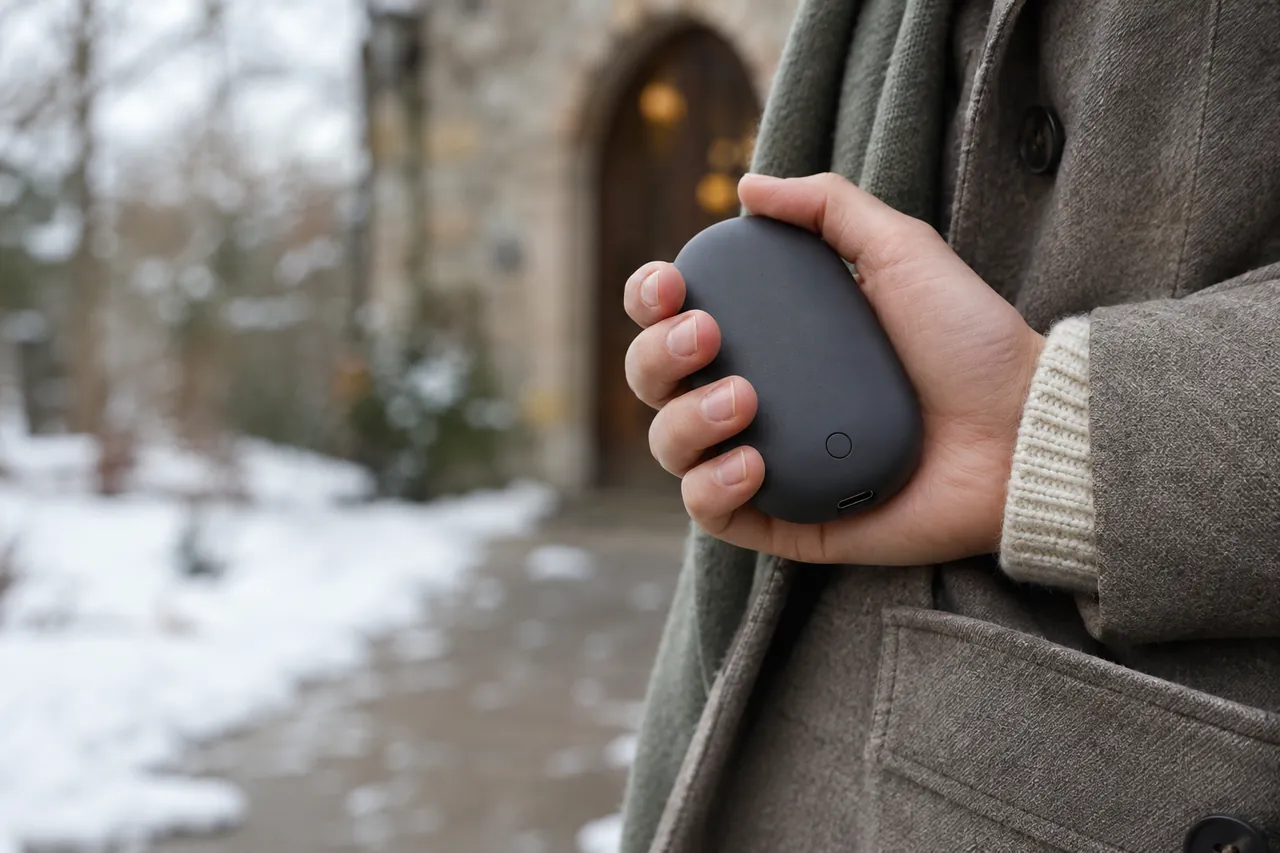
An “auto hand warmer” search can mean a warmer for a car or a device advertised with an automatic function. Those are different questions. A product name alone does not establish that a warmer connects to a vehicle, switches itself off or regulates its temperature. Check the actual model’s power source and controls, then decide where it fits in a winter travel kit.
Introduction
A pocket-sized rechargeable warmer may be useful before setting out or during a safe stop. Keep the driver’s hands free for driving and make adjustments only when safely parked. A small hand warmer is one part of preparation, alongside suitable clothing, a charged phone and the vehicle’s emergency supplies.
If the vehicle stops in winter weather
The U.S. National Highway Traffic Safety Administration recommends keeping items such as blankets, water, non-perishable food, a flashlight and a charged phone in the vehicle. In an emergency, it advises staying with the vehicle and making it visible. These supplies cover more than a pocket warmer can and help prepare for delays as well as ordinary trips.
Carbon monoxide is a serious risk when a vehicle is running. NHTSA advises keeping the exhaust pipe clear of snow and running the vehicle only sporadically, just long enough to stay warm; do not run it for long periods with the windows up or in an enclosed space. Follow current local emergency guidance and call for help when needed.
What “automatic” means on the actual model
A product name containing “auto” does not, on its own, establish an automatic temperature setting, shutoff, or vehicle connection. Look for a clear description of the controls and power source in the listing and instructions. If a feature matters to you, check that it is identified for the exact model and configuration you are considering.
Some rechargeable warmers have more than one heat setting; their number and operation vary. Choose a device with markings you can read and a switch you can operate comfortably. Learn how to turn it off before putting it away, and follow the stated directions for use and charging. The most elaborate controls are not necessarily the easiest to use while wearing gloves.
Battery-life figures and warm-up claims are also model-specific. Compare the conditions attached to any stated figure rather than treating the largest number as a promise for every setting and situation. GearJunkie’s guide reviews different hand-warmer formats and describes practical tradeoffs, making it useful background when comparing a rechargeable device with a disposable alternative.
A disposable warmer has a different use and disposal routine from a rechargeable one. Read its own instructions for activation, placement, and disposal. Do not assume that directions for an air-activated packet apply to an electronic device, or that a hand warmer should be placed inside a shoe.
Choose a format for stops and short breaks
A rechargeable hand warmer is made to be held or carried, depending on the design and its instructions. It concentrates on your hands; it is not a heated sock or a way to warm your whole body. Some products come as a single unit, while others are sold as a pair. OCOOPA’s collection illustrates the range of portable hand-warmer designs; compare the listing for the exact model instead of assuming every item works the same way.
Consider how you use your hands. If you alternate between holding a phone, carrying a bag, and putting your hands in pockets, shape and controls may matter as much as size. A pair may be convenient for someone who wants one unit for each hand; a single unit may be simpler to carry. Check whether the device fits your pocket comfortably and whether its buttons are easy to find.
Before a winter trip, keep gloves, a blanket and other emergency supplies where they can be reached during a safe stop. If you carry a rechargeable warmer, switch it off for storage and keep it with its instructions. Arrange the device and any charging cable so they cannot obstruct the pedals, steering or other controls. Make any adjustments only when parked safely.
Prepare hands and feet before leaving
Start with the moments when your hands and feet are exposed. A short walk to the station, a morning at a cool desk, and an afternoon outdoors call for different amounts of preparation. Keep gloves where you can find them before leaving, choose socks and footwear appropriate to the conditions, and add clothing layers that suit the weather and activity.
For someone who experiences Raynaud’s, the NHS recommends keeping the home warm, wearing warm clothes in cold weather—especially on hands and feet—and avoiding sudden temperature changes. A hand warmer can be one item in a wider routine; it does not replace gloves, footwear, or clothing for the rest of the body.
Plan transitions too. Going from a warm building into cold air can be uncomfortable, so put on your gloves and outer layer before stepping outside. At a desk, move away from a draft where practical and keep a layer nearby. These small preparations do not depend on buying a particular device and can help you work out where additional warmth would be useful.
Keep the device ready
A charging routine is easier to maintain when it fits the way you use the warmer. Store the cable with the device, check that the connector is clean and undamaged, and use the power equipment specified in its instructions. Charge and store the warmer in the conditions described for that model. Keep it away from water unless the product is explicitly designed for that exposure.
At the end of the day, switch the device off and let it cool as directed before putting it away. If the casing is cracked, swollen, unusually hot, or otherwise damaged, stop using it. A quick check before the next outing is more useful than discovering a problem after you have already left home.
Check an existing warmer against recall notices
The U.S. Consumer Product Safety Commission announced an OCOOPA Direct recall on July 30, 2026, because batteries in affected rechargeable hand warmers can overheat and ignite. The notice lists models UT3053, UT3056, ZLS-118, ZLS-118S, ZLS-118D, H01, and H01(PD). The model and three-digit batch number are printed on the underside.
If your OCOOPA warmer matches a listed model, stop using it immediately and follow the CPSC recall process for a refund. In October 2026, the CPSC also announced separate recalls for HotHands rechargeable model H163650 and Gobi Heat model UT3053. Check the brand and model on the device and follow the matching notice. Do not put a recalled device in household trash, ordinary recycling or retail battery collection boxes; follow the notice and local hazardous-waste guidance for defective lithium-ion batteries.
Recognize numbness and cold injury
Cold fingers are common, but color changes or recurring numbness are worth recognizing. The NHS describes Raynaud’s as a circulation condition in which fingers or toes can change color in response to cold, anxiety, or stress. Symptoms can also include pain, numbness, and pins and needles. The appearance of color changes differs between skin tones, and not everyone experiences the same pattern.
The NHS recommends seeking medical advice if symptoms are severe, worsening, affect only one side, or interfere with daily life. Its guidance also identifies other circumstances that warrant assessment. A hand warmer is a comfort tool; do not rely on it to diagnose a condition or promise that it will stop an episode.
If hands are numb, avoid applying intense heat directly to the skin. Great Ormond Street Hospital notes that numbness can make the temperature of water difficult to judge when rewarming hands. Use gentle warmth, follow the directions for any warming product, and stop if you feel discomfort or notice skin irritation. Do not rub severely cold or injured skin.
If you suspect frostbite after cold exposure, get medical help. Seek emergency care for hard or frozen skin, swelling with loss of feeling, blisters, or signs of hypothermia such as persistent shivering, confusion or slow breathing. Move to shelter and wrap the person in a dry blanket while waiting for help. Do not rub the affected area or warm it directly with a fire, radiator, hot-water bottle or hand warmer. The NHS describes body warmth or warm, not hot, water as measures while help is on the way.
Put the plan together
For an everyday commute, look for a shape that fits your pockets and controls you can use without fuss. For time spent at a desk, consider where you will keep the device when typing and how you will remember to turn it off. For outdoor use, bring appropriate gloves and clothing rather than relying on a small heat source alone.
Before purchase or use, review the exact model’s intended placement, charging directions, controls, and any warnings. Inspect an existing device for damage, and stop using it if it behaves abnormally. Then put the hand warmer in the context of the rest of your kit: comfortable layers and warm footwear are useful whether or not you decide to carry one.
Sources
NHTSA, Winter Weather Driving Tips
Great Ormond Street Hospital, Raynaud’s phenomenon
GearJunkie, The Best Hand Warmers of 2026
OCOOPA, Rechargeable Hand Warmers and Raynaud’s
Pure Enrichment, WeightedWarmth
U.S. Consumer Product Safety Commission, OCOOPA Direct Recall