
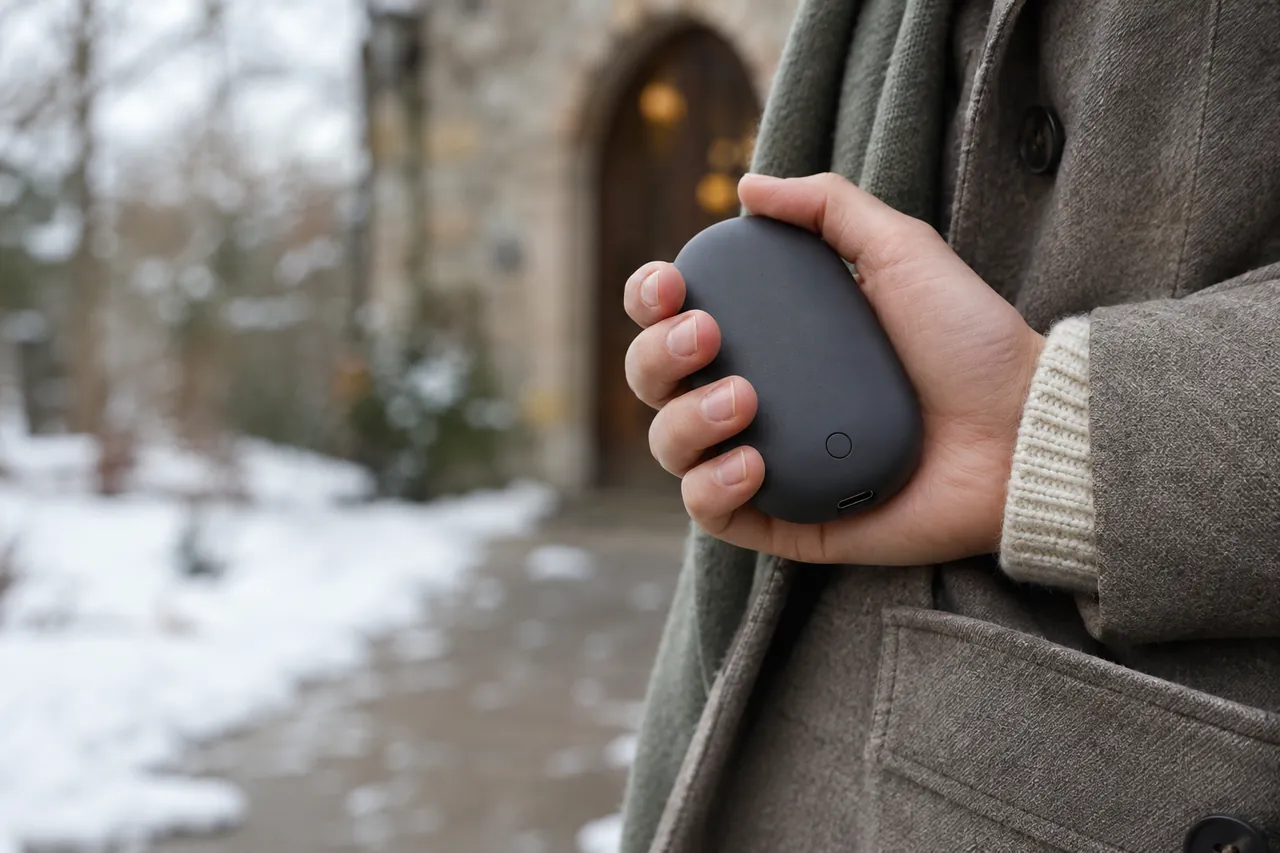
Looking for an electric hand warmer in Japan? The Japanese phrase 充電式カイロ means “rechargeable hand warmer” and is a useful term when reading product descriptions. You may also see disposable kairo alongside reusable electronic models. The right choice depends on how you plan to carry it, recharge it, and use it during your trip.
Introduction
Before buying or packing one, check three separate things: the warmer’s own instructions, the input rating of the charger you intend to use, and the current baggage rules for your specific flight. A hand warmer, a spare battery, and a power bank can be treated differently in travel rules.
Rechargeable or disposable kairo?
A rechargeable warmer is used again after its battery is charged. Depending on the model, it may have adjustable settings, a cover, or a feature that supplies power to another device. Those features are not universal; read the listing for the exact item. A compact electronic model can suit a routine where you have time and a suitable place to recharge between outings.
A disposable kairo follows its own activation and disposal instructions. Some packs are designed for a particular placement, while others are held or carried differently. Read the package rather than assuming a pack for clothing can be used directly on skin or inside a shoe. A disposable pack does not require charging, but each use requires a new pack.
For a short trip, consider how much space you have, how long you will be outdoors, and whether you are willing to maintain a charging routine. Gloves, warm socks, and suitable outerwear remain useful regardless of the warmer you choose. A hand-sized device supplies local warmth; it is not a replacement for clothing that protects the rest of your body.
How to read one Japanese product listing
Life on Products’ LCAEA009 is a rechargeable hand warmer with a cover and a mobile power-bank function. When checked on November 10, 2026, the manufacturer marked this model as discontinued. Its listing remains a useful example of how to read Japanese specifications, rather than a recommendation that it is currently available. The listing describes a double-click power action intended to reduce accidental activation, three heat settings, a USB-C cable, and a dedicated cover. These are features of that model, not a checklist that every rechargeable kairo will meet.
The manufacturer lists approximate surface settings of 45°C, 50°C, and 60°C, with a stated tolerance, and provides different estimated operating times for those settings. These temperatures are product specifications, not recommended treatment temperatures. Read the product’s warnings carefully, avoid prolonged contact that feels too hot, and stop use if you notice discomfort or irritation.
The LCAEA009 measures 115 × 54 × 29 mm and weighs 140 g, according to its listing. The manufacturer lists a charging time of approximately four hours. Its stated operating times after a full charge are approximately 1.5 hours on high, 2.5 hours on medium and 3.5 hours on low. The package includes the warmer, a USB Type-C cable, a dedicated cover and instructions. Those details help a traveler judge both pocket space and the charging routine for a day out.
Use the supplied cover as directed, and compare battery life at the setting you expect to use. A power-bank function is an explicit feature of this model; a charging port alone does not establish that another warmer can supply power to a phone.
A Japanese listing can contain several useful labels: 充電式 indicates rechargeable, 温度 means temperature, and 付属品 refers to included items. The numbers and warnings next to those terms matter more than the product category alone. Keep the instructions and model number with the device so that you can find the correct guidance later.
Charging in Japan: check the charger’s input label
The Japan National Tourism Organization states that Japan uses 100-volt AC electricity and two flat parallel pins. Its guidance also notes a regional frequency difference: 50 Hz is used in eastern Japan and 60 Hz in western Japan. A charger’s input label tells you whether it is designed to accept the local supply.
For example, a charger marked for an input range that includes 100 V and the relevant frequency can accept that supply as far as its stated input rating is concerned. A plug adapter changes the physical shape of a plug; it does not convert voltage. Do not assume a charger is compatible merely because the warmer uses a USB cable.
Check both ends of the arrangement: the charger’s input must suit the wall supply, and its output and connector must match the warmer’s instructions. Use the equipment specified for the device. If the label does not cover the local supply, do not connect it directly. Keep chargers and cables dry and discontinue use if they are damaged.
Before a flight, identify the battery and the device
Air travel is a separate question from electrical compatibility at your destination. A rechargeable warmer can contain a battery, while a detachable power bank or spare battery may fall under a different part of an airline’s baggage rules. The exact device design, battery rating, carrier, route, and current rules all matter.
ANA publishes separate guidance for power banks, spare batteries and certain heat-producing articles. Under its rules effective April 24, 2026, power banks cannot be checked; up to two per passenger may be carried on, each rated no more than 160 Wh and subject to combined-battery limits. Protect their terminals against short circuits. ANA prohibits charging a power bank from an aircraft outlet and asks passengers to refrain from using one to charge other devices on board. These power-bank rules do not by themselves determine how every rechargeable hand warmer is classified. Consult the current rules for the particular device and flight.
Keep the device’s model information and battery label accessible for that check. Protect the switch from accidental operation as directed and do not travel with a damaged battery. Fuel-powered hand warmers are a different category: ANA’s international-flight guidance prohibits oil-fueled hand warmers in both carry-on and checked baggage because they use flammable liquid. For a connection, check the applicable rules for each airline and departure point, since requirements can change.
If you purchase a warmer in Japan and plan to use it after returning home, make the same input check in reverse for the charger and destination. Retain the instructions and packaging where the model and battery details are shown. Consider whether the controls are understandable to everyone who will use the device, and avoid treating a travel adapter as a substitute for the device’s specified power requirements.
A recall check for an existing OCOOPA device
The U.S. Consumer Product Safety Commission announced an OCOOPA Direct recall on July 30, 2026 because batteries in affected hand warmers can overheat and ignite. The listed models are UT3053, UT3056, ZLS-118, ZLS-118S, ZLS-118D, H01, and H01(PD). The notice says the model and three-digit batch number are on the underside.
If your device is one of the listed models, stop using it immediately and follow the recall notice. This is a U.S. recall for specified models; do not assume every warmer with the same brand name is affected. Check the model you actually have, rather than relying on its color or shape.
Comfort and cold sensitivity
Cold hands can have different causes. The NHS explains that Raynaud’s can make fingers or toes change color and feel painful or numb in response to cold or stress. It recommends keeping warm, wearing warm clothing on the hands and feet, and avoiding sudden temperature changes. A warmer is a comfort product; it should not be sold as a cure or a guaranteed way to stop an episode.
If your fingers are numb, take care with direct heat: reduced sensation makes it harder to notice that a surface is too hot. Follow the product warnings, stop if you feel discomfort, and seek medical advice for severe, worsening, one-sided, or disruptive symptoms. Do not increase a setting to compensate for a loss of sensation.
A short pre-trip checklist
Search for 充電式カイロ when comparing rechargeable products and read the model-specific details. Check what comes in the box, how the warmer switches off, and the stated care and charging directions. Compare the charger’s input with Japan’s supply, then review the current flight rules for the actual device and any separate battery.
Finally, put the warmer in the context of your whole trip: where you will recharge, which pockets you will use, and what gloves and clothing you will wear. Those practical details make the purchase easier to evaluate than a single headline about heat or battery life.
Sources
Japan National Tourism Organization, Plugs and Electricity: https://www.japan.travel/en/plan/plug-and-electricity/
Life on Products, LCAEA009: https://lifeonproducts.co.jp/product/lcaea009/
ANA, Restricted and Prohibited Items: https://www.ana.co.jp/zh/cn/travel-information/baggage-information/restricted-prohibited/
NHS, Raynaud’s: https://www.nhs.uk/conditions/raynauds/
U.S. Consumer Product Safety Commission, OCOOPA Direct Recall: https://www.cpsc.gov/Recalls/2026/OCOOPA-Direct-Recalls-1-5-Million-Rechargeable-Hand-Warmers-Due-to-Risk-of-Serious-Injury-or-Death-from-Fire-and-Burn-Hazards-One-Death-Reported-Imported-by-Shenzhen-Street-Cat-Technology