
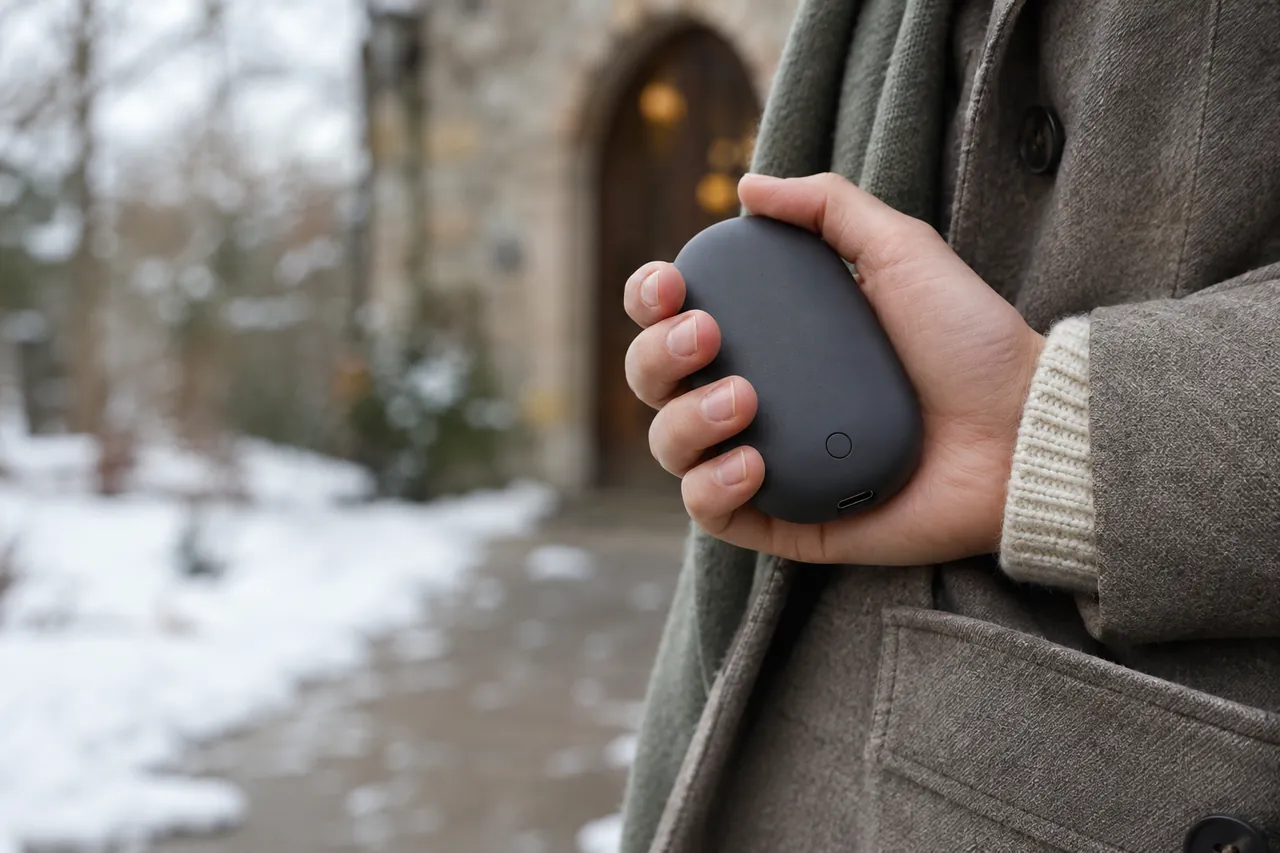
A magnetic pair looks simple in a product photo: two pieces join for storage and separate for your hands. In use, the details can feel quite different. One reviewer liked the convenience of a Lifesystems pair on cold outings; another found the magnets on an OCOOPA pair weaker than expected. Neither observation describes every dual warmer, but together they show what to look for.
Introduction
We read The Mud Life’s Lifesystems review alongside Outdoor Life’s comparison of rechargeable hand warmers. The observations below belong to those reviewers and their specific samples; this article is not a hands-on test.
The Lifesystems experience: a pair for an outing
The Mud Life describes the Lifesystems Dual-Magnetic Hand Warmers as two rechargeable pieces that join together or separate so each hand can hold one. The reviewer says Lifesystems provided the product for testing. That disclosure is useful context when reading the review alongside the product’s own instructions and other sources.
The review describes four adjustable heat settings and a power-bank function for that pair. It also reports a stated six-to-nine-hour range dependent on the selected setting. These are details attributed to the reviewed product and its description, not a guarantee that every magnetic set has the same settings or endurance.
The reviewer found the magnetic connection reassuring and liked being able to keep the warmers together in a large front pocket or separate them for individual use. Each unit is listed at 109 grams and 3.2 by 10 by 2.8 centimeters. Those measurements give you a more useful starting point for judging pocket space than a product photo alone.
The Outdoor Life experience: the strength of the join
Outdoor Life tested several pairs of rechargeable warmers and described an OCOOPA pair with a magnetic coupling. The tester found its magnets comparatively weak and suggested the pieces could come apart in storage. The review also appreciated covers over the charging ports while noting that the reviewed product was not rated as weatherproof. The review does not state a complete model number, so its observations alone cannot establish whether a particular unit falls within a safety campaign.
That observation is a reminder to look beyond the fact that a pair attaches. If the pieces separate easily in a crowded bag, you may still want the storage arrangement recommended for the product. A port cover is a physical detail; it is not the same thing as a verified water-resistance rating for the whole device.
Outdoor Life also discussed nonmagnetic latching pairs. Its tester found the latching arrangement on one model more reliable for joining the pieces, although another tested set had a problem with one end of its supplied charging cable. Those are observations from particular samples, not guarantees about every unit sold. They show why a review’s drawbacks can be as useful as its top pick.
What the two accounts do—and do not—compare
The Mud Life’s article is a review of a named Lifesystems pair. Outdoor Life compares several rechargeable sets, including an OCOOPA pair. The reviewers used different products and reported their own experiences; their accounts are not a controlled head-to-head test of the same two models under identical conditions.
GearJunkie provides another point of reference: it describes an OCOOPA UT3 Pro pair and says its rigid units do not fit in gloves or boots like thin disposable packets. A later Polish consumer-authority notice describes a Kolba safety campaign involving model UT4102, identified in reporting as UT3 Pro, because its battery may overheat or ignite. Do not use or charge a unit covered by that campaign. Match its model and sales channel to the notice; a review is not a current safety clearance.
The test methods make the runtime figures easier to interpret. Outdoor Life says it charged five pairs, then ran one warmer from each pair on low and the other on high indoors at 70°F. Its tested OCOOPA units lasted 8.7 hours on low and 5.4 hours on high. The Mud Life instead reports using the Lifesystems pair on mixed settings and finding the stated six-to-nine-hour range consistent with that experience. These are observations from different products and methods, not a controlled comparison of the two pairs. Keep the setting and test environment beside each number when deciding which result matters to you.
Five questions to take to the product page
First, how many independent pieces are included? A photograph of two halves does not explain whether each has a control, how it is charged or whether both are intended to operate independently. Read the listing and instructions for the exact model. If you plan to share the set, each person needs to know how to use their piece.
Second, how do the pieces stay together? Magnetic attachment can make storage neat, but the Outdoor Life account shows why the strength of the join is a practical issue. A latching pair is another design. Compare the method with the way you carry equipment and follow the manufacturer’s storage directions.
Third, look closely at the charging arrangement. The Lifesystems pair in The Mud Life review comes with a lead that splits to recharge both warmers; each warmer also has its own integrated USB-C cable for charging a phone or other small device. The reviewer notes that the supplied lead has a USB-A connection, so a car with only USB-C sockets calls for an adapter or a separate USB-C cable used on one warmer at a time. These are useful distinctions when comparing a dual set with the cables you already carry. The Lifesystems 42467 manual says to switch the warmer off before connecting it to a power source or plugging in another device.
Fourth, how will each piece fit? Compare dimensions with a coat pocket and consider whether the controls can be reached with gloves on. A unit that is comfortable cupped in a hand can still be awkward in a small pocket. A reviewer’s description is a starting point; your clothing and intended activity determine the fit you need.
A fifth question is how the set will be carried when it is switched off. Two separate pieces can fit into different pockets, while a joined set may be easier to find in a bag. Check the combined thickness and the individual dimensions, then decide whether the supplied storage accessories suit that plan.
Check a model-specific recall before use
The U.S. Consumer Product Safety Commission announced a recall of OCOOPA rechargeable hand warmers identified as models UT3053, UT3056, ZLS-118, ZLS-118S, ZLS-118D, H01 and H01(PD). The agency says the battery in affected units can overheat and ignite. Owners should stop using the recalled products immediately and follow the notice’s refund process.
The CPSC notice explains where the model and batch numbers appear and how to submit the requested information. It also provides disposal guidance for defective lithium-ion batteries: do not put the recalled device in household trash, ordinary recycling or retail used-battery boxes. Follow the local hazardous-waste directions in the notice.
A separate Polish consumer-authority notice describes a Kolba safety campaign involving UT3201, UT3053, UT4102, UT3056, UT3042, UT3043 and UT3057. Its scope and return arrangements belong to that campaign; the U.S. notice has its own model list. Match the complete identifier and sales channel to the relevant notice. Outdoor Life does not provide a full model number for its tested OCOOPA pair, so the review alone cannot determine whether that sample was included in either action.
Cold hands and appropriate use
Mayo Clinic describes Raynaud’s as a condition in which fingers or toes can feel numb and cold in response to cold or stress. A hand warmer is a comfort accessory; the selected sources do not establish that a specific pair treats Raynaud’s or prevents an episode. Avoid placing a hot device against numb skin, where excessive heat may be harder to notice.
Comfort is personal. The Mud Life reviewer found the low setting of the Lifesystems pair comfortable to hold, but described the middle setting as too warm for continuous direct holding. That experience concerns one person and one model; it does not establish a comfortable setting for everyone. Learn the controls before heading out, follow the product directions, and stop using the device if it feels uncomfortably hot or causes irritation. Switch it off when finished and do not use it if it is damaged.
Choose the trade-off that matters to you
The Lifesystems account highlights a particular pair and its charging setup. Outdoor Life highlights the feel of a magnetic connection and the variety of joining mechanisms. Together they suggest a practical shortlist: check independent operation, the strength and purpose of the join, included charging equipment, pocket fit and exact model safety information. Use the current listing and instructions for the version you choose.
Sources
The Mud Life — Lifesystems Dual Magnetic review
Outdoor Life — Rechargeable hand warmers tested
GearJunkie — Hand warmer reviews
Mayo Clinic — Raynaud’s symptoms and causes
Cleveland Clinic — Heat or ice for arthritis