
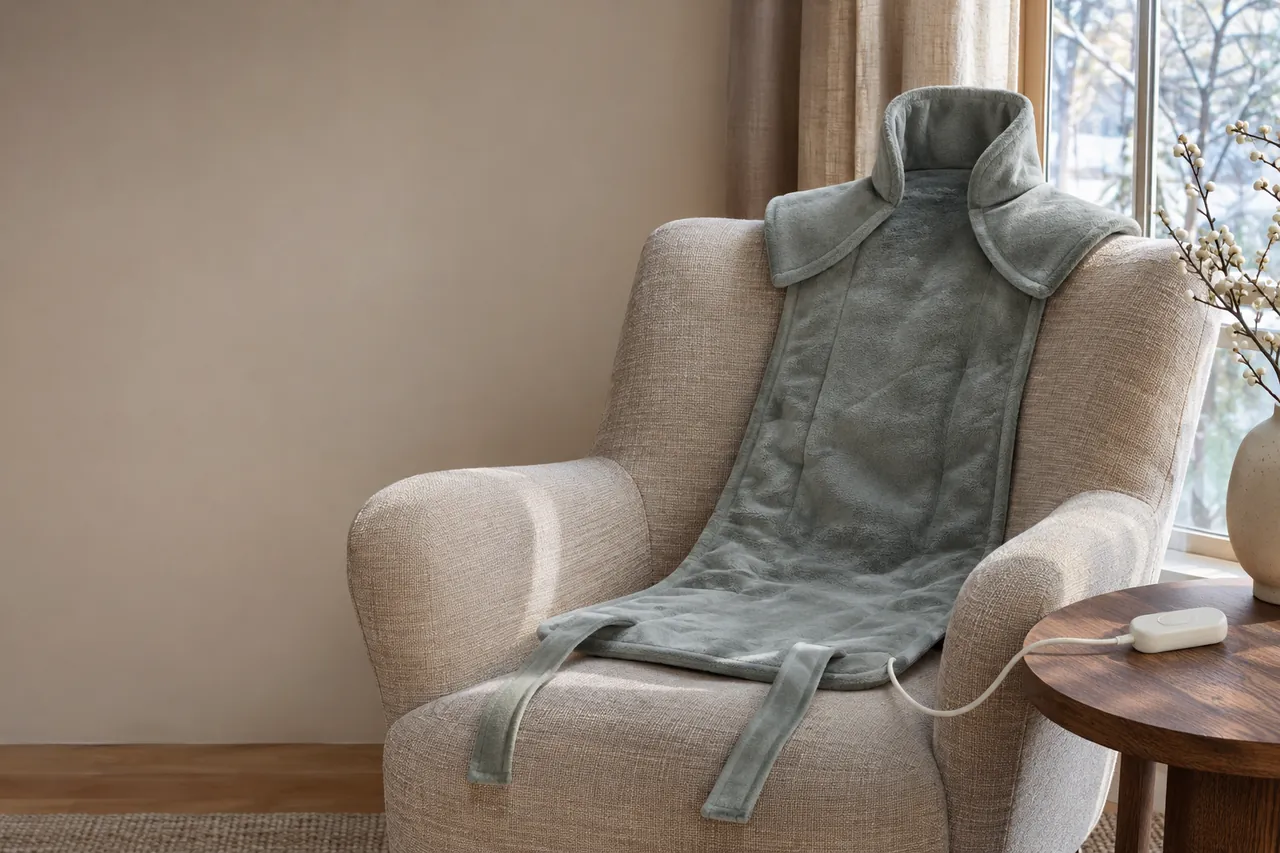
A recliner moves, bends and supports your back, so the first step is to look at the chair as carefully as the heating product. Where will the cord run when the footrest opens? Can the controls be reached? Most importantly, is the item meant to support your weight, or is it an ordinary pad that must stay free of pressure?
Introduction
For anyone choosing a back heating pad for a recliner, this guide starts with those practical setup questions. It then compares a localized pad with a chair-specific heated lumbar cushion, explains skin safety, and identifies symptoms that need urgent care. Warmth can provide temporary comfort; it does not address every cause of back pain.
Recliner Mechanics, Cord Safety, and Positioning Guidance
Operating an electric warming device within a reclining armchair requires paying careful attention to furniture mechanics, power cord placement, and physical positioning.
1. Preventing Power Cord Pinching in Recliner Mechanisms
A moving recliner can catch or pinch an electrical cord. Arrange the cord away from hinges, moving parts and walking paths before using the chair.
Moving parts: Keep the cord clear of hinges and the footrest mechanism to avoid pinching it.
Cord routing: Before plugging in, move the chair through its normal range and check that the cord stays slack and clear of moving parts.
Unplug Before Standing: Always turn off and unplug the heating pad or cushion before rising from your recliner to prevent tripping over trailing cords or pulling the appliance off the chair.
2. Sitting Posture and Reclining Angles
Adjusting your seating angle affects how warmth interacts with your back:
Ordinary pads: Keep an ordinary pad free of body-weight pressure, including pressure from the chair back.
Chair-specific cushions: Use a cushion designed for chair support only according to that model’s instructions.
Localized Heating Pads vs. Heated Lumbar Support Cushions: A Vital Difference
The product’s intended placement changes the setup. An ordinary flexible pad may need to stay clear of the chair back; a heated lumbar cushion is built as a support for the chair. Read the instructions for the exact item before settling in.
1. Ordinary Localized Heating Pads (Flat and Strapped Formats)
Ordinary electric heating pads—such as flat rectangular pads or wearable fabric wraps featured in personal wellness catalogs like the Comfytemp heating pad collection—are lightweight, flexible appliances designed to lay loosely across sore muscles.
Do not sit or lie on an ordinary localized heating pad or press it between your back and the chair. Follow that pad’s instructions for positioning.
Understanding why body-weight compression is prohibited on ordinary heating pads explains the physical hazards involved:
Trapped warmth: Compressing a pad can increase the risk of overheating and burns.
Pad care: Avoid crushing or sharply folding the pad, and inspect it for damage before use.
Choose a position where the ordinary pad is not trapped between your body and the recliner. If the chair makes that impossible, use the pad elsewhere in a suitable position.
2. Chair-Specific Heated Lumbar Support Cushions
A heated lumbar cushion designed for chair support is a different product category. Follow the instructions for its specific model and intended placement.
As a concrete commercial example, the Drive Medical Comfort Touch™ Heated Lumbar Cushion illustrates how a dedicated chair cushion is constructed:
Chair support: The Comfort Touch is a shaped lumbar support cushion intended for use on a chair.
Heating: The product listing describes an on/off switch for the heat.
Cover: Its removable velour cover is intended for cleaning.
Drive lists the Comfort Touch at 12.8 by 13.2 by 4.1 inches, with a strap to secure it to a chair back. Its user guide says to check that the heating pad lies flat inside the cover, use the pad together with the cushion and cover, and unplug the unit when it is not in use. That assembly is specific to this product; a loose heating pad is not a replacement for the cushion.
After use, switch off and unplug the Comfort Touch; allow it to cool before storing it without anything stacked on top.
Compare the Product With Your Chair
Before choosing a cushion, compare its shape and stated dimensions with the width and contour of your chair. Consider whether its fastening strap can reach around the chair back and whether the control is easy to reach once seated. A moving footrest or reclining back changes the space around a cord, so plan the route before plugging in the device. Keep the instructions nearby and use only the placement specified for that model.
Dermatological Safety, Active Monitoring, and Daily Use Rules
Operating an electric heating pad or heated cushion safely in your home requires practicing active skin monitoring, placing protective barriers, and respecting dermatological safety rules.
1. Use the pad while awake
The most critical safety rule when using a back heating pad for recliner rest is simple: never sleep or nap while using an active electric heating pad, battery-powered wrap, or heated cushion.
A recliner can make it easy to doze off. Finish the warming session while you are awake, switch off and unplug the device before sleeping, and check your skin during use. Keep the control within reach so you can stop the heat promptly if it feels uncomfortable.
2. Heightened Burn Risk for Vulnerable Groups
Comfytemp notes that reduced skin sensation can make excess heat difficult to notice. Do not use a heating pad on skin where you cannot feel heat normally.
3. Checking your skin during use
For the Comfort Touch, Drive’s guide calls for checking your skin every 20 minutes during use. Stop using it if you feel discomfort or excessive heat.
Skin protection: Follow the specific product’s directions for a fabric barrier.
Active Skin Monitoring: Inspect your skin underneath the pad frequently during every session. If the pad feels uncomfortably hot, or if skin shows redness or irritation, stop using the device immediately and turn off the power supply.
4. Fabric Care and Hygiene Maintenance
The Drive Comfort Touch user guide gives separate care instructions for its cover, foam and heating pad. Unplug the cushion before disassembly. The removable cover can be washed on a cold gentle cycle with mild soap, then dried on low or air-dried. The foam and heating element must not go in the washer or dryer; if needed, clean their surfaces with a moist cloth and allow them to dry completely. Reassemble the cushion with the heating pad flat, never folded.
5. STRICT MICROWAVE SAFETY WARNING
Never put an electric heating pad, cord, controller, cushion component or battery in a microwave. Heat a separate non-electric pack only if its instructions permit it.
Comfort, Heat and Cold
Understanding how surface warmth interacts with lower back tissue helps set realistic expectations for evening home self-care.
How Surface Warmth Soothes Muscle Tightness
Spine-health discusses heat for lower-back discomfort. NHS guidance also lists a wrapped heat pack as an option for stiffness or muscle spasms.
Choose a comfortable warmth level and follow the device’s instructions.
For a recliner, placement depends on the product: keep an ordinary pad out from between your back and the chair, and use a chair-specific cushion as its guide directs.
The NHS recommends staying active and continuing daily activities where possible.
Deciding Between Heat and Cold Therapy
Healthline and the NHS discuss both heat and cold for different kinds of discomfort.
Cold packs: Use a fabric covering and follow the specific pack’s instructions.
Heat: Use a comfortable temperature and check your skin during the session.
Some devices offer dry or moist warmth. Use moisture only where the product instructions permit it.
Recommended Session Timing vs. Automated Timers
Follow the product’s instructions for session length and use it while awake. Stop if your skin becomes uncomfortable or irritated.
An automatic shutoff is a device feature, not a recommended duration for uninterrupted skin contact.
When back pain needs urgent attention
A comfortable chair cannot determine the cause of back pain.
The NHS advises emergency care for back pain accompanied by any of these signs:
Bladder or Bowel Changes: Sudden loss of bowel or bladder control, difficulty urinating, or sudden inability to pass urine.
Saddle Area Numbness: Sudden numbness, loss of feeling, or a pins-and-needles sensation around your genitals, buttocks, or back passage (anus).
Symptoms in Both Legs: Pain, tingling, weakness, or numbness in both legs.
These symptoms require emergency assessment rather than home self-care. NHS guidance also calls for emergency help when back pain occurs with chest pain, changes in sexual sensation or function, or follows a serious accident. Sudden severe pain, pain that is worsening quickly, or back pain with feeling hot, cold, shivery or generally unwell warrants urgent medical advice.
A suitable setup begins with the chair and the product instructions. Keep the cord clear of moving parts, leave ordinary pads free of pressure and stay awake during use.
Sources
Comfytemp — Electric Heating Pads for Pain Relief & Muscle Relaxation https://comfytemp.com/collections/heating-pad
Spine-health — Benefits of Heat Therapy for Lower Back Pain https://www.spine-health.com/treatment/heat-therapy-cold-therapy/benefits-heat-therapy-lower-back-pain
Spine-health — How to Apply Heat Therapy for Pain Relief https://www.spine-health.com/treatment/heat-therapy-cold-therapy/how-apply-heat-therapy
Healthline — Treating Pain with Heat and Cold https://www.healthline.com/health/chronic-pain/treating-pain-with-heat-and-cold
Comfytemp — Heating Pad Safety Burn: Who's Most at Risk at Home https://comfytemp.com/blogs/news/heating-pad-safety-burn-risk
National Health Service (NHS) — Back pain - NHS https://www.nhs.uk/conditions/back-pain/
Drive Medical — Comfort Touch Heated Lumbar Support: https://drivemedicalathome.com/products/comfort-touch-heated-lumbar-support