
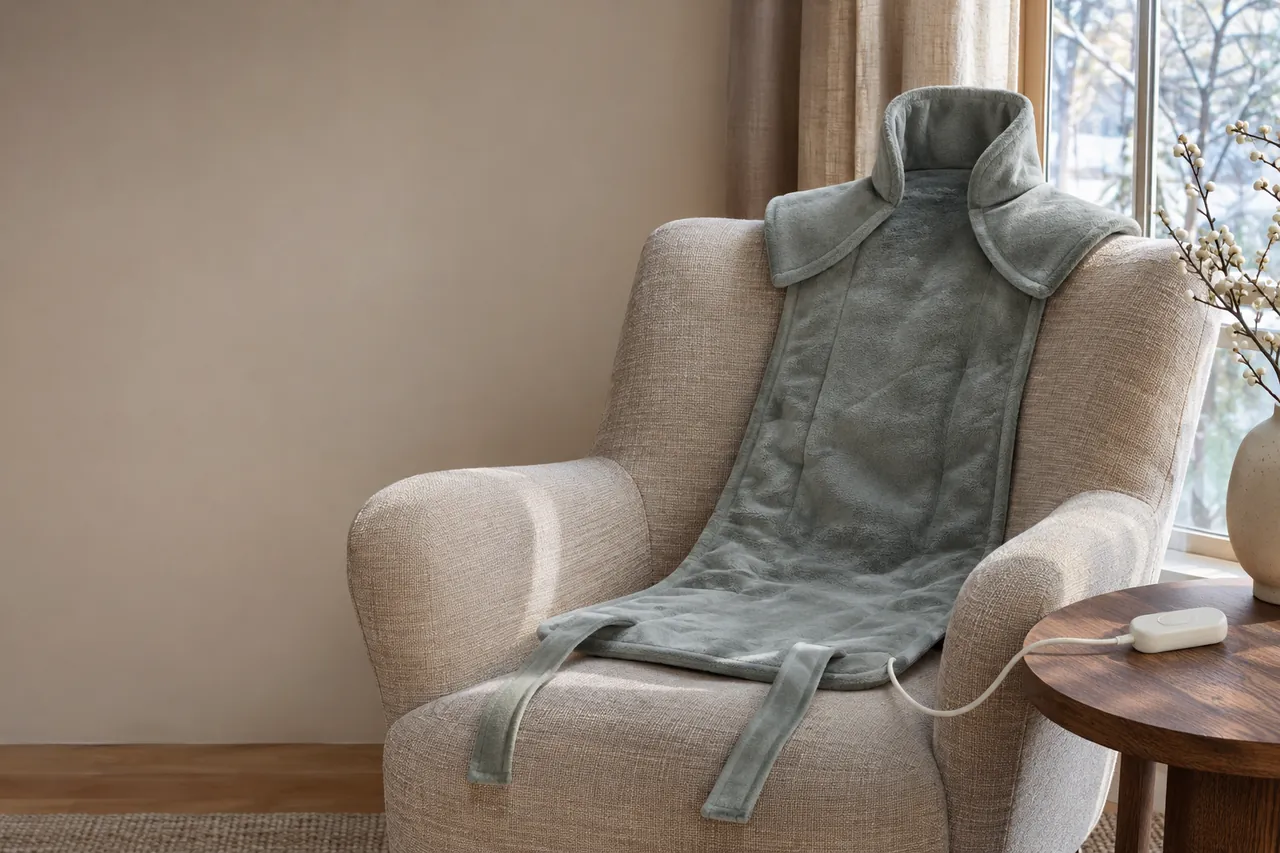
A warm back can feel inviting at bedtime, but an ordinary localized heating pad is not designed to be left on while you sleep. Burns can develop when a person cannot notice or respond to excessive heat. If you use one before bed, stay awake, follow its placement and timing instructions, then switch it off and remove it before sleeping.
Introduction
Cleveland Clinic warns against falling asleep with a heating pad in place, and the Sunbeam GoHeat 2000-825 manual gives the same warning for that model. A heated mattress pad is a different bedding product with its own instructions; its permitted use cannot be assumed from a localized pad’s directions.
A practical routine before bed
For an awake pre-bed routine, use your specific pad according to its directions:
Choose a position permitted by your pad’s instructions. For example, the GoHeat 2000-825 manual says not to sit on or lean against the pad.
Use the setting and duration described in the instructions for your device. A timer does not establish a suitable treatment duration.
Power Off and Remove Before Sleep: Once the session ends, turn off the controller, disconnect power leads, and move the pad away from your bed before closing your eyes.
Stop using the pad if the heat feels uncomfortable or your skin becomes irritated. Keep the control within reach and remove the pad before going to sleep.
A real manual: positioning and who should not use it
Published specifications and safety directions in the Sunbeam GoHeat Cordless Heating Pad (Model 2000-825) user manual outline explicit physical and medical restrictions:
Positioning: The GoHeat 2000-825 manual says not to sit on, lean against, crush or fold this pad. Follow its specific placement directions.
Medical Contraindications: The manual explicitly warns against use by persons with diabetes, poor blood circulation, or insensitivity to heat.
These warnings come from the GoHeat 2000-825 manual. Other devices have their own instructions; read and follow the warnings for the exact model being used.
What an automatic shutoff does
Some heating pads switch off automatically after a set interval. For example, Sunbeam lists a two-hour automatic shutoff for the GoHeat 2000-825; its manual separately recommends 20 minutes on high or two hours on low. These are details for that model, and other devices have different settings and directions.
An automatic shut-off is not a recommended continuous-use duration. Turn off and remove a localized heating pad before sleep.
A heating pad and a heated mattress pad have different jobs
Localized heating pads are intended for a specific body area. Heated mattress pads are bedding products intended for a mattress; the model’s instructions specify how they are placed and used.
The Sleep Foundation reviews heated mattress pads as a bedding category. Check the directions for the exact model: do not assume that instructions for a mattress pad also apply to a localized heating pad, or that every bedding product is intended for overnight operation.
Set up the bed for comfort
Bedding warmth: If using a bed-warming appliance, follow that product’s placement and operating directions, and switch it off when its instructions require.
Passive Thermal Layering: Combine breathable cotton fitted sheets with insulating flannel or fleece top blankets to trap natural body heat without electrical wiring.
Pillows: Arrange pillows in a position that feels comfortable and supports your preferred sleeping posture.
Choosing a pad for awake use
A pad that fits your evening routine should be easy to position, control and remove while you are awake. When comparing options, look at the shape of the pad as well as the instructions for the position in which you plan to use it:
Pad Sizing and Contouring: Compact pads (such as 9.5-by-12-inch formats) provide targeted lumbar contact, while larger contoured pads offer broader back coverage.
Controller Settings and Adjustability: Multi-stage heat settings allow users to select low surface warmth for gentle pre-bed relaxation.
Straps and Fastening: Adjustable fabric straps help hold wearable wraps loosely against the lower back without requiring users to lean back against cushions.
Care: Check whether the model has a removable cover and follow its particular cleaning instructions. A detachable controller alone does not establish that a pad is washable.
How warmth fits into care
Pre-Bed Comfort for Dysmenorrhea: As outlined in health guides from Verywell Health regarding period cramp remedies (15 Things to Help With Period Cramps on Pain Days), applying gentle surface warmth across the lower abdomen or lower back is a widely recognized method for soothing menstrual cramp discomfort before rest. However, articles discussing period cramps address menstrual discomfort, not commercial product testing or guarantees of overnight sleep improvement.
Clinical Hot Packs in Physical Therapy: As detailed in educational resources from Verywell Health regarding physical therapy modalities (Hot Packs Used in Physical Therapy), clinical hot packs are applied in clinic settings for short 15-to-20-minute intervals to warm tissue before active exercise. Note that clinical physical therapy modalities represent professional pre-exercise treatments, not proof of home heating pad specifications or overnight sleep safety.
Surface warmth provides comforting, temporary relaxation for tight muscle fibers during awake rest; it is not a medical cure, a structural spine fix, or a guarantee of deep sleep cycles.
A practical plan for the end of the evening
Decide where the pad will go after use before you turn it on. Choose a spot away from your bedding where the cord and controller can rest without being pulled or covered. Keep the controls within reach while using it, and check that you can switch it off and remove it without changing position in a way the product instructions prohibit.
When comparing products, read the complete instruction booklet as well as the short product listing. Check intended placement, warnings, cleaning instructions and the controls. Keep those instructions with the pad so you can refer to them later. A convenient shape or automatic shut-off does not replace a routine for turning the device off before sleep.
When back pain needs medical attention
Heat can be a comfort measure, but it does not explain the cause of back pain. The NHS advises emergency care if back pain comes with loss of feeling around the genitals or bottom; changes in bladder or bowel function; pain, tingling, weakness or numbness in both legs; changes in sexual sensation or function; chest pain; or if it began after a serious accident. Do not wait for a heating session to work before seeking help. Do not drive yourself to emergency care.
Seek urgent medical advice if pain is severe and starts suddenly or gets worse quickly, or if you feel feverish or generally unwell. Arrange an assessment if the pain is stopping daily activities, is worse at night or is not improving after several weeks. These details help a clinician understand the pattern and decide what care you need.
The NHS also recommends staying active and continuing usual activities as far as comfortable rather than remaining in bed for long periods. Gentle movement during the day, supportive pillows at night and a short awake comfort routine can serve different purposes. If a position or activity worsens pain, change it and take note of what happened.
Keeping a brief record can make an appointment more useful: write down when the pain started, whether it wakes you, where it travels and any change in movement or sensation. Mention what you have already tried. A heating pad is one choice for temporary comfort, while persistent or changing symptoms call for attention to the broader picture.
If discomfort wakes you, give yourself time to change position and rearrange your pillows. Keep the route beside the bed clear in case you need to get up, and avoid reaching for an electric pad if you are too sleepy to monitor it and remove it afterward. If back pain is worse at night or interferes with daily life, the NHS recommends arranging an assessment. Note any accompanying symptoms and seek urgent or emergency help when the signs above apply.
A bedtime routine can be simple: choose a comfortable position, use warmth only while awake and according to the device instructions, then remove the pad before sleep. Keep track of pain that repeatedly interrupts rest, rather than extending the heating session or leaving the appliance running overnight.
References
Sunbeam — GoHeat 2000-825 manual:
Sunbeam GoHeat 2000-825 and 2003-825 manual (PDF)
Cleveland Clinic — Stiff Neck Remedies: https://health.clevelandclinic.org/do-you-have-a-stiff-neck-try-these-simple-remedies
NHS — Back pain: https://www.nhs.uk/conditions/back-pain/
Sleep Foundation — Best Heated Mattress Pads: https://www.sleepfoundation.org/best-mattress-pads/best-heated-mattress-pad
Good Housekeeping — Heating pad review: https://www.goodhousekeeping.com/health-products/g30647898/best-heating-pads/
Verywell Health — 15 Things to Help With Period Cramps on Pain Days: https://www.verywellhealth.com/what-helps-with-period-cramps-8413517
Verywell Health — Hot Packs Used in Physical Therapy: https://www.verywellhealth.com/hot-packs-physical-therapy-modalities-2696130