
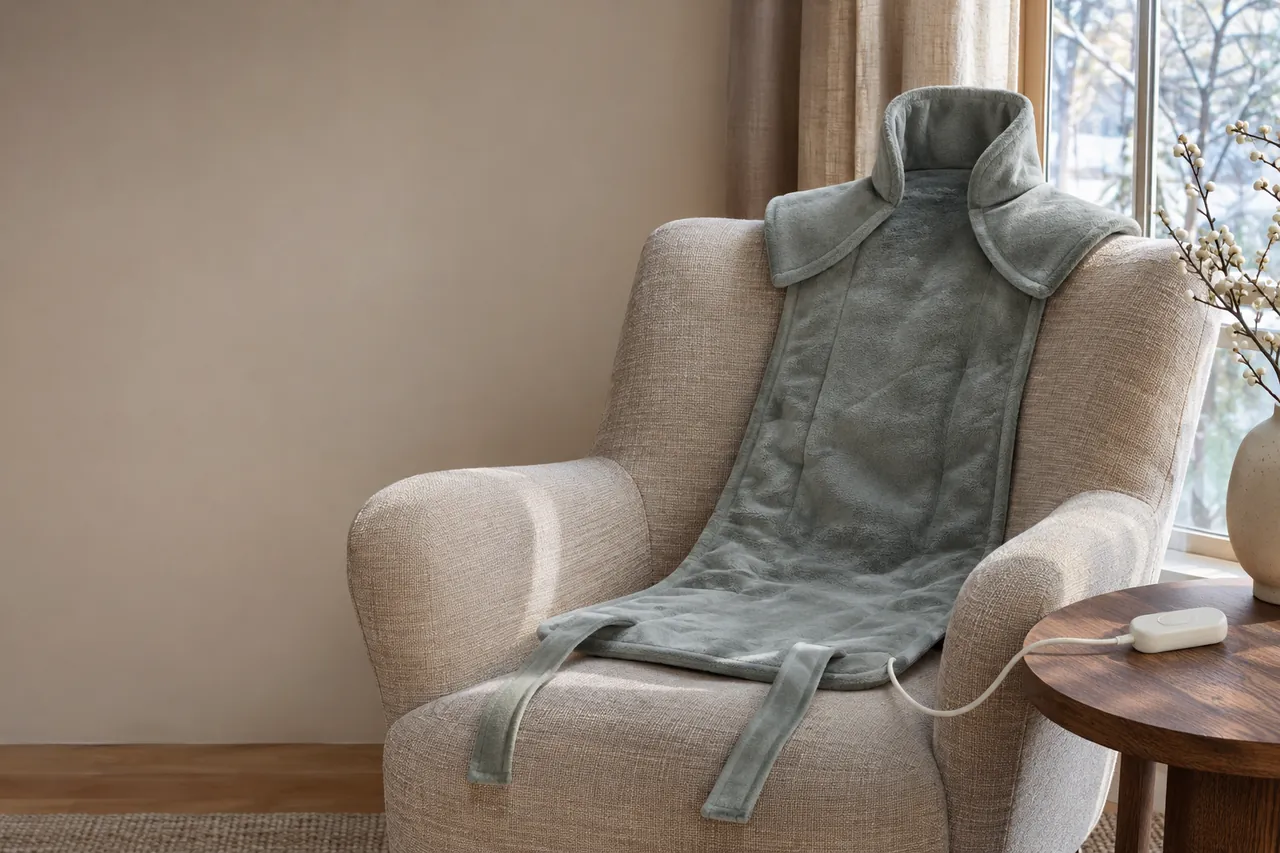
A back heating pad with a strap has two measurements that answer different questions: the belt must reach around your waist, while the heated panel needs to cover the area where you want warmth. Start with those dimensions, then check whether you can reach the controls and release the fastening without twisting. Follow the actual model’s placement instructions; a longer strap does not mean a larger heated surface.
Introduction
A good fastening stays in place without squeezing as you change position. Check that the warmed panel remains flat and clear of a seat or cushion, then see how the adjustment works on the model you are considering.
Measure, position, and adjust
Separate belt reach from heated area
Measure around the part of your waist where the strap will fasten and compare that number with the stated adjustment range. Then check the dimensions of the pad itself: a belt that reaches around the body does not heat along its whole length. Think about where the panel will sit on your back and whether its shape covers the area you have in mind. Fasten it snugly without restricting breathing or circulation, and check that you can undo it easily. Follow the individual product’s directions for skin contact and clothing; for Sunbeam GoHeat, the instructions say not to cover the pad with clothing or other insulating material while it is in use.
Positioning the Pad Without Body-Weight Compression
Position the pad where the instructions indicate, keeping it free from body-weight compression. Avoid leaning heavily against it or placing it between your back and a cushion. Stay awake and make sure you can remove it easily.
Evaluating Controls, Fabric Care, and Power Options
Reviewing controller layout, cleaning requirements, and power sources helps you select an appliance tailored to your daily schedule:
Accessible Controls: Select wraps featuring intuitive inline digital controllers or accessible belt-mounted buttons that allow you to adjust heat settings easily while wearing the wrap, eliminating the need to twist your torso uncomfortably during a session.
Fabric maintenance: Check which components can be washed, remove the battery or controller as directed, and let the washable parts and connectors dry fully before reconnecting.
Corded vs. cordless: A corded pad suits a stationary break near an outlet. A rechargeable model removes the trailing wall cord during use, but needs charging and a place to store its battery.
When the strap shifts or feels too tight
A belt can feel different as you change from standing to sitting. Try fastening it while awake, then change position slowly and check that the heating panel has not folded or been pressed against a chair. If the fastening pulls or pinches, loosen it or remove the pad. A secure fit should not restrict breathing or make the controls hard to reach.
Check the strap and fasteners during ordinary care. Lint, wear, or damage can affect how a fastening holds, so follow the care instructions for the actual product and avoid using a damaged wrap. Keep the pad easy to remove and check the skin underneath during use.
Choosing how the wrap is powered
Strapped pads may be corded or battery-powered. A corded model needs an outlet nearby, while a battery-powered model does not need a wall cord during use. Comfytemp’s collection shows several heating pad formats; the features of any one model should be checked individually.
Some cordless wraps use rechargeable batteries and adjustable straps. A heated massager adds mechanical movement and may have a different shape or weight; compare its dimensions and intended use before choosing between the two.
One example: Sunbeam GoHeat
The Sunbeam GoHeat (model 2000-825) offers a useful example of why strap length and heated area deserve separate checks. Sunbeam lists an adjustable, removable strap and a compact pad, with the battery controller held in a pocket. Here are the details to compare with your own measurements and preferred place of use:
Compact Pad Footprint: A flexible pad provides targeted placement on the back, arms, legs or shoulders.
Cordless Battery Power: Powered by a removable, rechargeable lithium-ion battery pack stored inside a dedicated fabric pocket, supplying wireless thermal warmth without wall cords.
Up to 4 Hours of Battery Runtime: Sunbeam lists up to four hours on Low from a full charge. The removable strap holds the pad in position, while the battery unit in its pocket carries the controls. Check that you can release the strap and reach those controls without twisting.
Three Selectable Heat Settings: Sunbeam lists three heat settings, controlled by the battery unit that fits in the pad’s pocket. Check that you can reach the control and release the strap comfortably while the pad is positioned as directed.
Adjustable Waist Strap: Incorporates an adjustable fabric strap extending up to 55 inches to secure comfortably around the waist.
Machine-washable pad: Sunbeam says to remove the battery and disconnect the pad cable before washing. The pad and connector must be completely dry before reconnection.
Automated Safety Shut-Off: Features an integrated 2-hour automatic shut-off timer for electrical safety.
These figures describe the GoHeat model, so use them as a way to compare rather than as a standard for every wrap. The strap’s stated reach describes how far it fits around the body. The product’s outer pad dimensions describe its footprint, so look at the heating-area details separately when comparing coverage. The two-hour automatic shutoff and up-to-four-hour battery figure describe different things: the first is a timer, while the second is the maximum runtime listed for the low setting. Neither replaces the instructions for checking your skin during use.
For an awake session, place GoHeat’s lighter fabric side against the body. Fasten the strap’s tab to the darker outer fabric, then use the slider to make the fit snug without squeezing; do not overlap the heated area. Keep the controller within reach and leave the pad uncovered. The manual recommends 20 minutes on high or two hours on low for this model.
Using warmth comfortably
Spine-health describes heat as a way to help with some lower-back discomfort and stiffness. The NHS also lists a wrapped heat pack among options for stiffness or muscle spasms.
Comfort: Choose a warmth setting that feels comfortable and follow the instructions for your pad.
Movement: The NHS recommends staying active and continuing everyday activities where possible. Stop an exercise if it makes pain worse.
A heating wrap is a comfort tool rather than a cure for a spinal condition. Use it as directed and observe these basic precautions:
Keep body weight off the pad: Do not sit or lie on a localized heating pad. Compression can trap heat and increase burn risk.
NEVER Use While Driving: Users should never wear or operate an electric heating pad while driving an automobile. Adjusting digital controls or responding to thermal discomfort while operating a motor vehicle creates dangerous driving distractions.
Use While Awake Only: Never wear or operate any electric heating pad or battery-powered wrap while sleeping or napping. Reduced sensory awareness during sleep prevents you from detecting thermal discomfort or rising skin temperatures.
Never microwave an electric heating pad, cord, controller or battery. Heat a separate non-electric pack only if its own instructions permit that method.
Check your skin and care for the wrap
Comfytemp notes that reduced skin sensation can make it harder to notice excessive heat. Do not use a heating pad on skin where you cannot feel heat normally. The GoHeat manual also says the pad must not be used by people with diabetes, poor circulation or heat insensitivity, or by children; it should not be used on someone who is sleeping or unable to respond. Inspect the pad, cord and battery controller for wear before use, and do not use a damaged unit. The manual specifies the supplied battery controller and charger for this model.
Follow the product directions for a fabric barrier and inspect your skin during use. If the pad feels too hot or skin becomes red or irritated, turn it off and stop using it.
Follow the specific product’s care instructions. Remove the battery or controller as directed before washing, and allow washable parts and connectors to dry completely before reconnecting.
Red Flag Symptoms: When Back Pain Requires Emergency Medical Care
According to NHS guidance, seek immediate emergency assessment if back pain occurs with any of the following symptoms:
Bladder or Bowel Changes: Sudden loss of bowel or bladder control, difficulty urinating, or sudden inability to pass urine.
Saddle Area Numbness: Sudden numbness, loss of feeling, or a pins-and-needles sensation around your genitals, buttocks, or back passage (anus).
Symptoms in Both Legs: Pain, tingling, weakness or numbness in both legs.
These symptoms require emergency assessment rather than home self-care. NHS guidance also calls for emergency help when back pain occurs with chest pain, changes in sexual sensation or function, or follows a serious accident. Sudden severe pain, pain that is worsening quickly, or back pain with feeling hot, cold, shivery or generally unwell warrants urgent medical advice.
Sources
Sunbeam — GoHeat™ Cordless Heating Pad https://www.sunbeam.com/pain-relief/general-muscle-pain/sunbeam-goheat-cordless-heating-pad/SP_438956.html
Comfytemp — Heating Pad Safety Burn: Who's Most at Risk at Home https://comfytemp.com/blogs/news/heating-pad-safety-burn-risk
Comfytemp — Electric Heating Pads for Pain Relief & Muscle Relaxation https://comfytemp.com/collections/heating-pad
Spine-health — Benefits of Heat Therapy for Lower Back Pain https://www.spine-health.com/treatment/heat-therapy-cold-therapy/benefits-heat-therapy-lower-back-pain
National Health Service (NHS) — Back pain - NHS https://www.nhs.uk/conditions/back-pain/