
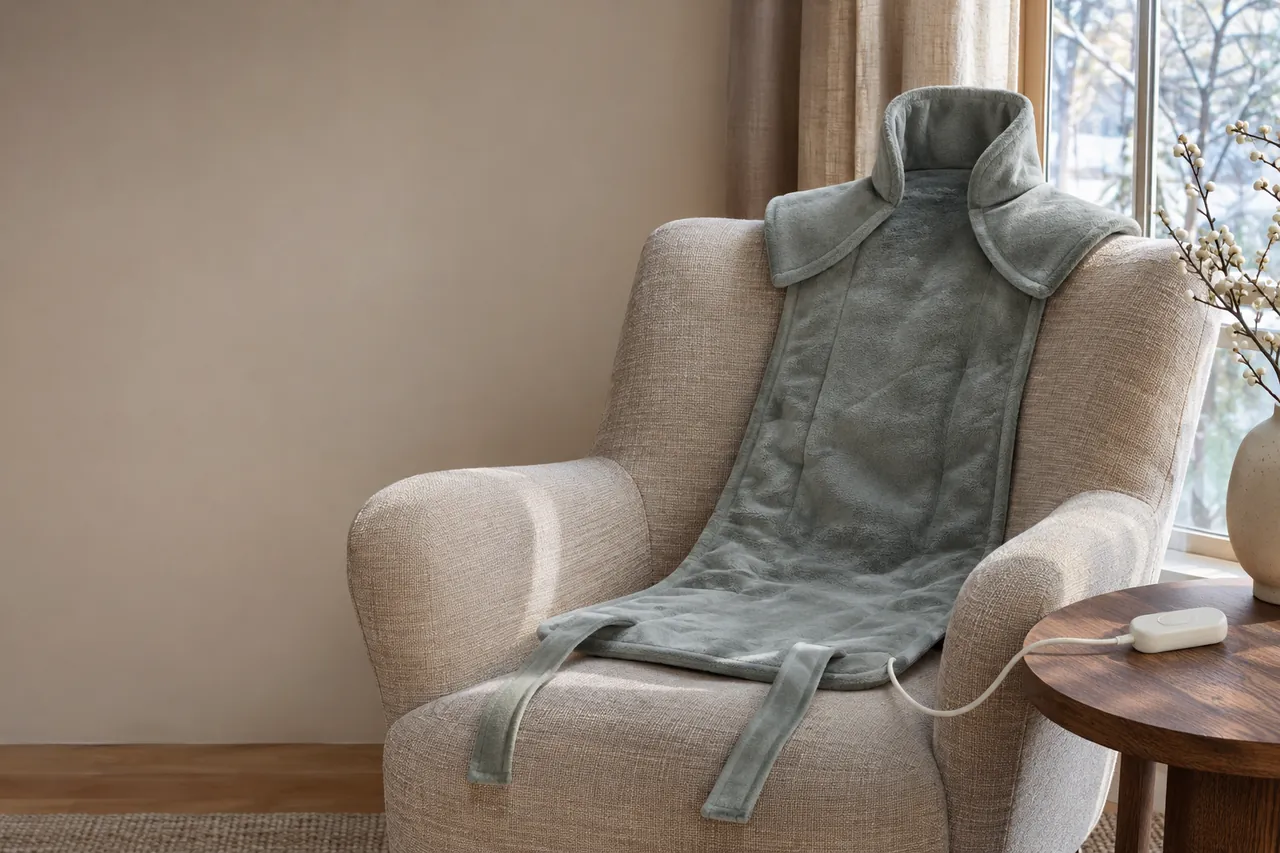
A back heating pad with Velcro needs enough overlap to stay closed without squeezing your waist. The useful test begins with a tape measure and the clothes you intend to wear—not a product photo.
Introduction
Start with fit and movement, then look at how the closure is maintained and which heat source the wrap actually uses. A secure strap holds a pad in position; it does not change that product’s safety or care instructions.
Start With Your Waist Measurement and Fit
Selecting a strapped heating pad that stays positioned securely requires measuring your waist correctly and understanding how fabric overlap affects holding power.
To determine your required belt size, measure your torso circumference using a flexible measuring tape directly over the actual clothing layers you plan to wear during use—such as t-shirts, lounge pants, or flannel shirts. Measuring over your intended clothing captures the space that layer takes up and helps you compare the result with the published fit range.
Once you have your measurement, evaluate the product's published fit range and hook-and-loop overlap area:
Ensuring Sufficient Overlap: Hook-and-loop closures require adequate surface contact to maintain holding power. Look for enough overlap to keep the closure secure while you sit and move, following any fit guidance provided with the product. If a strap is stretched to its absolute limit with only a fraction of an inch overlapping, the fastener may pop open when you sit down or take a deep breath.
Adjusting Belt Tension: The belt should fit snugly enough to press the heating surface flat against your lower back curve without constricting your abdomen or restricting breathing. A strap that is pulled too tightly can cause discomfort when sitting, while a loose strap allows the heating pad to sag downward away from sore paraspinal muscles.
Two examples show why the measurements matter. Comfytemp lists a waist fit of up to 48 inches for its reusable hot-and-cold gel wrap; Sunbeam lists a removable adjustable strap that fits up to 55 inches for its GoHeat Cordless pad. The first uses a separate gel pack, while the second uses a rechargeable battery. Compare your measurement with the stated range of the model you are considering, allowing enough room for the fastening surfaces to meet comfortably.
Check the Fit While You Change Position
Evaluating how a strapped heating pad performs in different physical postures ensures your device supports your daily routine effectively.
A strap can feel different when you change position. Before starting a session, fasten the wrap without pulling it tight, then check whether it shifts or bunches as you stand or sit. Keep the release easy to reach. If the product’s instructions prohibit sitting on or leaning against it, choose a position that keeps pressure off the pad.
Try the fit both seated and standing. The strap should feel comfortable in each position and leave you able to remove the pad easily. Follow the specific product instructions about pressure: do not sit on or lean against a pad when its manual prohibits it.
Keep the Closure Working
Preserving the holding grip of hook-and-loop fasteners requires simple fabric maintenance and proper laundering habits.
Over time, loose fabric fibers, pet hair, and lint can accumulate in the loop pile or hook teeth, reducing the fastener's holding power. Gently clear visible debris in the manner recommended by the product’s care instructions.
Always review the care instructions for your specific product before laundering. If the instructions permit washing, follow their steps for removing any components and closing the fastening tabs. Keep the fastener from catching on delicate fabrics.
What Hook-and-Loop Actually Means
When browsing personal heating pads, consumers frequently encounter the term Velcro used as a shorthand for adjustable waist straps. It is helpful to clarify that Velcro is a registered brand name owned by Velcro Companies, whereas "hook-and-loop" is the generic engineering term describing the two-part fabric fastening system. Recognizing this distinction helps buyers evaluate products accurately regardless of how a manufacturer labels their strap closures.
The mechanical operation of a hook-and-loop closure relies on two complementary fabric surfaces:
The Hook Surface: A firmer surface covered with small hooks.
The Loop Surface: Composed of soft, fibrous pile loops engineered to catch and hold the tiny hooks.
Press the two surfaces together where the strap reaches comfortably. Before turning on a pad, try opening the closure with one hand and check that it is easy to release. The hold depends on the amount of overlap, the condition of the fastening surfaces and how the belt fits your body. If it shifts as you move, readjust the strap without pulling it tight.
Crucially, buyers should distinguish the fastening mechanism from the underlying source of heat. The strap and hook-and-loop closure serve purely as an ergonomic positioning system that holds the garment against your body; the thermal warmth itself is generated separately by a warmed gel pack or an electric heating element powered by a cord or battery.
The Fastener Does Not Tell You the Heat Source
A central step when shopping for a heating pad for back tightness is choosing the thermal technology housed within the strapped fabric garment. Personal warming wraps utilize three primary heat sources:
1. Reusable Gel Pack Systems
Reusable gel wraps—such as the Comfytemp Reusable Gel Back Ice Pack with Strap—contain flexible thermal gel sealed within a durable pouch that slides into a fabric wrap. Gel systems operate as dual-purpose hot and cold therapy tools. For heat therapy, the gel pack is warmed according to the specific product’s instructions; the Comfytemp listing describes microwave heating for its gel pack.
When using a microwavable gel pack, users must strictly follow the heating times and power limits printed on the product packaging. Never generalize the microwave heating time of a gel pack to electric heating pads or other gel brands, as different gel formulations absorb microwave energy at distinct rates.
2. Cordless Battery-Operated Electric Heating Pads
Cordless electric heat wraps—such as the Sunbeam GoHeat™ Cordless Heating Pad—utilize internal lithium-ion battery packs and flexible heating elements to deliver active thermal warmth. The Sunbeam GoHeat model incorporates an adjustable fabric strap that secures around the waist for mobile use around the home or office.
For GoHeat model 2000-825-000, Sunbeam lists three heat settings and up to four hours of battery life on low. It also specifies a two-hour automatic shutoff, which is separate from the battery-life claim. Remove the battery/controller before washing the pad and strap, and reconnect only after the pad and connector are completely dry. Never microwave the electric pad, battery or controller.
3. Motorized Massagers
Motorized massagers—such as products in the RENPHO neck and back massagers collection—combine electric surface heat with mechanical vibration motors or rotating Shiatsu kneading nodes. Designed as structured cushions or collar-style wraps, massagers serve individuals seeking active mechanical compression alongside surface heat.
Skin Safety Comes With Every Closure
Understanding how surface warmth interacts with lower back tissue helps establish realistic expectations for everyday home self-care, whether you choose a gel pack or an electric heating wrap.
Warmth can provide temporary comfort for sore or tight muscles. The Sunbeam guide discusses heat therapy; follow the directions for your own device and avoid treating a secure strap as proof that a session is safe.
However, operating any warming appliance safely requires practicing active skin monitoring and adhering to essential dermatological precautions:
Increased Burn Risk from Reduced Sensation: Comfytemp’s safety guide notes that reduced sensation can make heat injuries harder to notice. Diabetes, neuropathy and nerve damage can affect sensation; people who cannot reliably feel heat should not use a pad on that area. Follow the product’s specific warnings for reduced sensation and circulation.
Active Skin Monitoring: Inspect your skin underneath the warming pad frequently during every session. If the pad feels uncomfortably hot, or if skin shows redness or irritation, stop using the device immediately.
Prohibition on Sleeping with Active Heat: Never wear or use any active electric pad, battery-powered wrap, or hot gel pack while sleeping or napping. Reduced sensory awareness during sleep prevents you from detecting rising skin temperatures.
Preventing Toasted Skin Syndrome (Erythema Ab Igne): As documented by dermatological experts at the Cleveland Clinic, repeated, prolonged exposure to low-level heat can cause toasted skin syndrome, resulting in reticulated skin discoloration. Limit warming sessions to short, discrete periods and allow skin to cool naturally between applications.
Always follow the specific operating directions, heating guidelines, and safety precautions printed on your individual product's packaging.
References
Comfytemp — Reusable Gel Back Ice Pack with Strap
https://comfytemp.com/products/reusable-gel-back-ice-pack-with-strap
Sunbeam — GoHeat™ Cordless Heating Pad
Sunbeam — Pain Relief with Heat Therapy
https://www.sunbeam.com/pain-relief-education.html
Comfytemp — Heating Pad Safety Burn: Who's Most at Risk at Home
https://comfytemp.com/blogs/news/heating-pad-safety-burn-risk
RENPHO — RENPHO Neck and Back Massagers with Soothing Heat
https://renpho.com/collections/neck-back-massagers
Cleveland Clinic — What Is Toasted Skin Syndrome (Erythema Ab Igne)?
https://my.clevelandclinic.org/health/diseases/toasted-skin-syndrome