
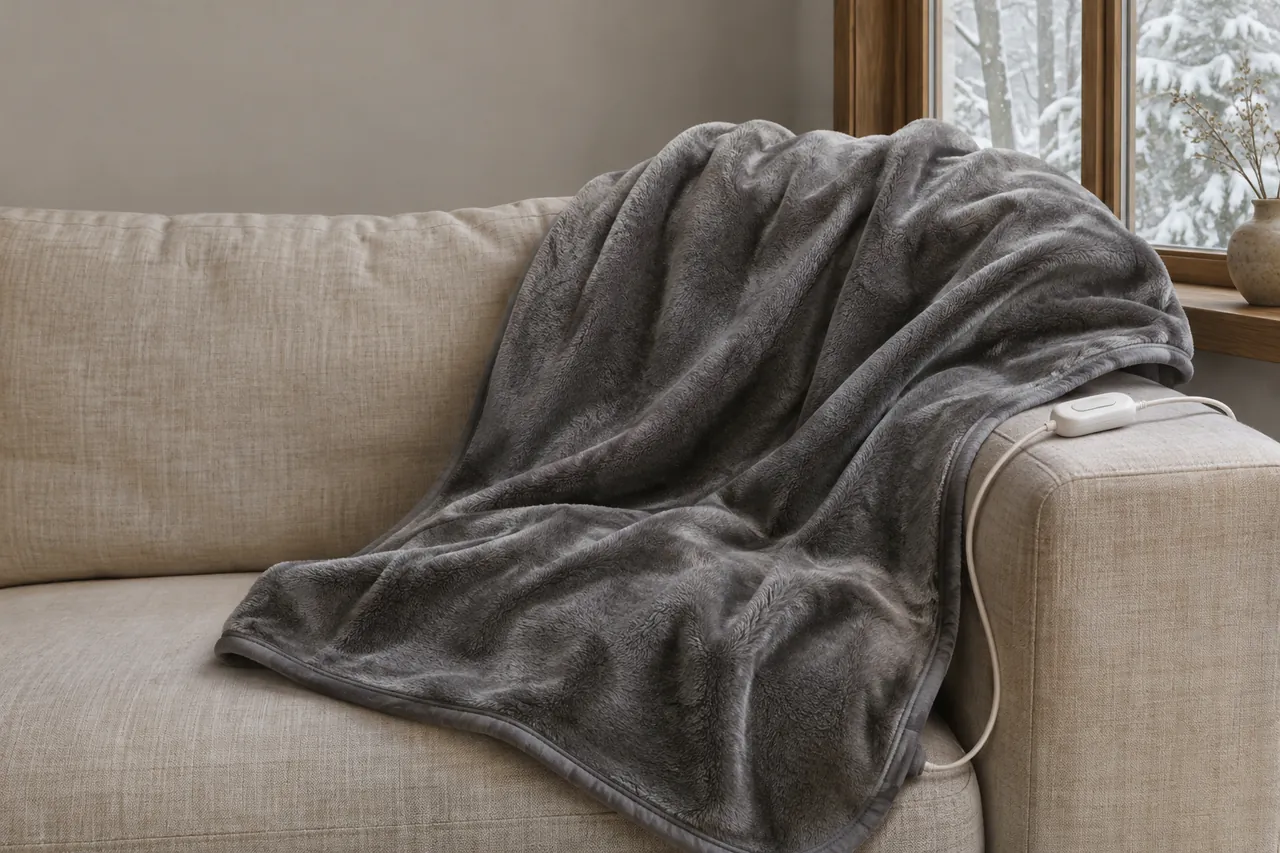
Start with the coverage you need: a heated throw covers a broader area, while a heating pad focuses warmth on a smaller one. Before buying, check that the product is suitable for your type of sofa and that its lead can reach a suitable outlet.
Introduction
Once you have chosen the type of cover, compare its dimensions with the space you want to use. Look at the controls, cleaning instructions and the route to the outlet as well: a throw that suits one room may be awkward in another, even when the fabric looks appealing in a photograph.
1. Do you need a throw, a pad or a mattress warmer?
Bedsure’s comparison separates heating pads, electric blankets and heated mattress pads by their intended use and coverage. A heating pad is meant for a more local area; a throw or blanket covers a broader area; a mattress pad is designed for placement on a bed. Choose the product made for the position and area you have in mind.
For a sofa, a loose top throw may be more relevant than a fitted mattress pad. If you are looking for warmth in one small area, a heating pad is another category to consider. Follow each product’s instructions for placement and duration, and do not use a heating pad while asleep. An item made to fit a mattress should not be repurposed as a seat covering.
The categories also differ in how much of the sofa they occupy. A small heating pad is intended for a local area, while a throw gives you a larger piece of fabric to arrange and put away. Compare their intended placement and controls first; a mattress pad has a different job altogether.
2. Will the throw work at your usual seat?
Sit where you expect to use the blanket and notice the space around you. Where is a suitable outlet? Can the cord reach without being stretched across a walkway? Is there a place for the controller where it will not be trapped behind a cushion? These questions help you judge whether a corded throw will work in that location.
Check the product instructions for the type of furniture you have. Some heated products include restrictions for particular chairs or moving mechanisms. A manual for one model does not establish permission for another, so match the instructions to the exact blanket and seat. Keep the cord clear of moving parts, foot traffic and places where it could be pinched.
A top throw is used as a cover rather than as a cushion to sit on. Spread it as directed and avoid bunching or trapping it beneath your body or between cushions. Leave the controller accessible and do not cover it unless the instructions specifically allow that arrangement. The goal is a setup you can use without pulling, folding or compressing the heated fabric.
3. How much coverage do you actually need?
A product photograph may show the throw on a different sofa or person. Use the listed dimensions to compare it with your own preferred coverage. Measure from the area you want to cover toward your feet, and consider how much width you need while seated. A throw that covers your lap comfortably may not provide the same coverage when you change position.
For one person, a smaller throw can be easier to arrange than a large bed blanket. A larger blanket may provide more fabric, but it also needs more room to remain in the position specified by its instructions. Choose the size for the seat and the person using it rather than assuming that the largest option is automatically the most convenient.
If two people share the sofa, decide whether they want shared coverage or separate controls. A wider blanket does not necessarily have two independent controls; the listing for the particular size should say what is included. Two individual throws are another possibility when each product can be used safely in the available space without crossing cables or stacking the active appliances.
Try comparing the stated width and length with a familiar unheated throw before ordering. Note whether you want coverage mainly across your lap or down toward your feet, then compare the actual measurements rather than the product photograph. For a shared sofa, also consider where each person can reach the control and whether the fabric has enough room to stay flat.
4. Can you operate, clean and store it as directed?
An automatic shutoff can be a helpful feature, but the timer is not a substitute for the product’s instructions. Check whether the exact model permits the way you intend to use it, including any use during sleep. Do not infer unattended or overnight permission from a timer alone. If you become sleepy on the sofa, switch the appliance off and follow its directions.
Bedsure’s safety guide recommends checking heated bedding for signs of wear and keeping it flat during use. If the blanket feels uncomfortably hot, switch it off and stop using it. Do not use a damaged cord or a blanket with scorch marks. Avoid placing a second active heating device underneath or over the throw.
A machine-washable claim belongs with the care label. Disconnect power before cleaning and follow the instructions for removing the controller if the model requires it. Keep plugs and controllers out of water, and let all relevant parts dry completely before reconnecting. Do not assume the same wash cycle or drying method applies to every electric blanket.
Before storing a throw, allow it to cool and follow its storage directions. Keep the cable and controller where they will not be pulled or crushed. These habits are especially helpful in a shared living room, where blankets may be moved between seats or put away after each use.
5. What can one real product listing tell you?
Sunbeam Australia lists the Feel Perfect Faux Fur Heated Throw TRF4300 at 1,200 by 1,600 millimetres. Its listing describes polyester faux fur, six heat settings, one digital controller and selectable automatic shutoff at one, three or nine hours. In the supplied Feel Perfect instructions, settings 1–3 are for continuous or overnight use; settings 4–6 are for preheating only and should not be used for more than 30 minutes. Sunbeam also describes the model as machine washable. These details apply to the TRF4300, not other throws.
Sunbeam lists the TRF4300 at 2 kg and includes a zippered storage bag in its specifications. Those details matter if the throw will be moved off the sofa after each use: consider where it will be kept and whether its weight is comfortable for the person handling it. Let the appliance cool and follow its storage instructions before putting it away.
The TRF4300 is an Australian model. The relevant instructions and power requirements apply to that particular product and market. Availability and product details can change, so read the current listing and the instructions accompanying the item you buy. A named example illustrates how to compare a listing; it is not a claim of personal testing or a ranking of every throw.
6. Which features fit your own routine?
The best electric blanket for a couch is the one whose coverage, power arrangement and care fit your intended use. Check the measurements against your seat, compare the controller and timer, read the furniture and placement instructions, and look at the care label. A clearly described model gives you more to work with than a vague promise of warmth.
For the TRF4300, Sunbeam lists a 150-watt rating and a 36-month replacement warranty in Australia. These provide two more points for comparing the complete offer: the rating identifies the appliance’s specified power, while the warranty terms describe coverage for that product. Neither figure predicts an individual electricity bill or how warm another model will feel.
References
Sunbeam Australia — Feel Perfect Faux Fur Heated Throw TRF4300
Bedsure — Heating Pad vs Electric Blanket vs Heated Mattress Pad.
Bedsure — Are Electric Blankets Safe? Risks, Myths and Safe Use.
Bedsure — Electric Blanket Heat-Up Time and What Affects It.
Manta Sleep — What is the Best Sleeping Position? It Depends.