
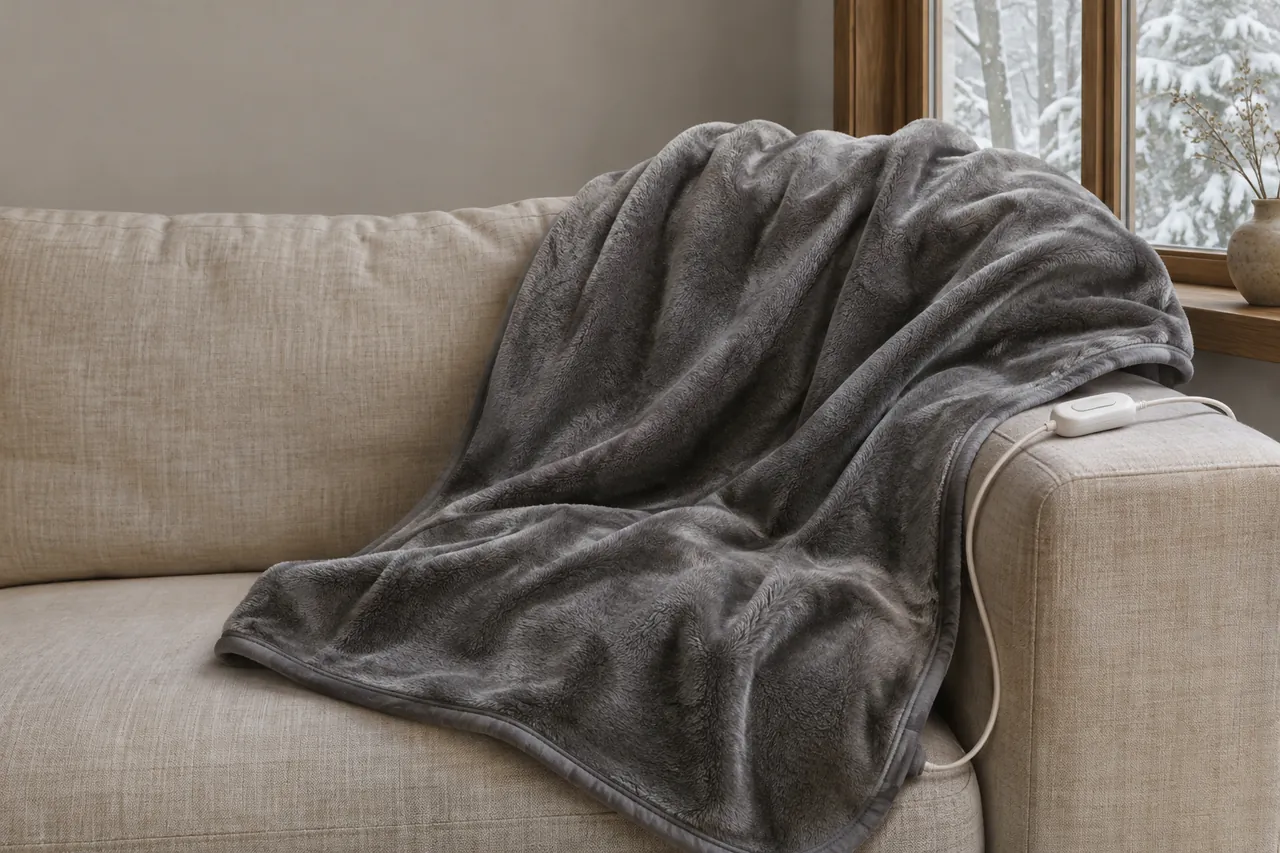
Before comparing fabrics or settings, look at your usual seat. A stationary sofa, a recliner and a chair with wheels create different routes for a power lead. The best heated blanket for couch use is one that suits that layout as well as the coverage you want.
Map the room before choosing the throw
Begin with the outlet and trace a possible route to your seat. A lead stretched across a walkway or trapped beneath a furniture leg makes that location a poor choice. The product’s connection and placement instructions help determine whether the arrangement works.
Motion furniture deserves special attention. Read the instructions for the exact product and seating you plan to use, including any restrictions on rocking chairs, recliners and chairs with casters. A throw advertised for a couch is not automatically suitable for every reclining sofa or moving chair.
For a stationary sofa, think through the full route from outlet to controller before buying. Is the controller reachable without pulling on the lead? Can people enter and leave the room without stepping over it? Will the blanket remain in the intended position when someone sits down or gets up? A suitable route keeps the lead clear of pinching points and does not require covering it with a rug or cushion.
A heated throw is a top layer, not a seat cover. Do not sit or lie on an active top throw or operate it folded, tightly bunched or trapped between cushions. Avoid stacking active electrical heating products. Turn the throw off when finished and follow its supplied instructions for safe placement and storage.
For a concrete measurement, Sunbeam lists an eight-foot cord for its Slate Gray Bubble Faux Fur throw. Compare that stated length with the route to your own outlet, allowing for the way the cord must be positioned and for comfortable access to the built-in control. Other models may have different layouts and lengths.
One person or two?
A personal throw is worth considering when one person wants a layer across the lap or shoulders while the rest of the sofa stays available. Take an ordinary blanket you already own and compare its dimensions with a product listing. Notice whether you prefer more length toward your feet or more width around your sides. A photo of a throw folded over a sofa arm gives a sense of style, but it rarely shows how the fabric will sit when someone is using it.
For example, a reader who usually sits upright may find that a compact throw is easier to arrange than a bed-sized cover. Another person on the same sofa may prefer more length. Neither preference requires a special formula: spread out a tape measure, compare it with a familiar blanket, and choose dimensions that leave the fabric arranged according to the product instructions. Do not assume that any single size will reach both shoulders and feet for every person.
If two people plan to share, measure the width they occupy together as well as the length each wants. A larger blanket can offer more coverage, but check its intended use and the space around the seating area. Too much loose fabric can be awkward on a small sofa, and heated material should not be tucked into cushions or left bunched while operating. Two separately controlled throws are another option to compare when each person wants independent control, provided each item is used according to its instructions.
Check the exact model if independent settings matter. A queen or king label alone does not establish how many controllers are included, and a larger single-controller blanket generally means the users share that setting. Look for the actual controller description in the selected size, not just an image or an assortment-wide feature list.
A concrete throw to measure against
The Sunbeam Slate Gray Bubble Faux Fur heated throw provides a concrete starting point: Sunbeam lists this model at 50 by 60 inches, with four heat settings, a four-hour automatic shutoff and a machine-washable design. Those are specifications for this specific throw, not a standard that applies to every product. Whether its dimensions suit you depends on how much coverage you want on your couch.
A living-room throw is visible as well as functional, so fabric is a reasonable part of the choice. The Sunbeam example is described as bubble faux fur. Other listings use terms such as flannel, microplush or sherpa. Compare the photographs and fabric descriptions with the surface you prefer, and remember that two products with the same fabric name can still differ in construction.
If a blanket will be kept on the sofa between uses, consider its colour and texture alongside the practical question of where to store its controller and cord. Do not wind the cable tightly around the controller or put heavy objects on a stored blanket. Follow the storage directions supplied with the product so that the fabric and lead are not strained.
The example also illustrates why a product photo is only a starting point: Sunbeam lists a velvet reverse as well as its bubble faux-fur surface. Those details help distinguish the two sides when comparing textures and deciding how the throw will look when folded over an armrest.
Read the controller and care label together
Heat settings let a user select among the levels offered by a particular controller. A greater number of settings offers more choices, but it does not establish the actual temperature at each level or prove that one blanket is warmer than another. Look for controls that are easy to understand and reach from your intended seat.
An automatic shutoff does not establish that a throw is intended for sleep or unattended use. Follow the model’s directions and switch it off when finished.
The Sunbeam example uses a built-in Quick-Control, so the control is part of the throw’s arrangement rather than an ordinary loose bedside controller. Look at its position in the product photos and instructions and picture whether you can reach it from your usual seat without pulling the fabric or cord. The four-setting control and four-hour shutoff describe this particular model.
Washability is useful in a room where blankets are handled often. Sunbeam describes the Slate Gray Bubble Faux Fur throw as machine washable, but the care label and instructions determine the appropriate preparation and cycle. Before cleaning a heated throw, switch it off and unplug it. Detach a removable controller as directed, keep electrical components out of water, and allow the fabric and connectors to dry completely before reconnecting.
Do not assume that two washable throws share the same drying method or cycle. If one product requires a gentler process than another, that may matter more to your routine than an extra setting. Keep the care instructions somewhere accessible and inspect the fabric, lead and controller for damage before use; discontinue use if you find damage.
Put reviews beside your own requirements
Good Housekeeping and Forbes Vetted publish heated-blanket guides with their own selections and testing perspectives. Bedsure also publishes a comparison of blankets and throws, including its own products. These articles can help you decide which attributes to compare: feel, controls, dimensions and care are all practical starting points. Read what each review says about the exact model and size being discussed.
A positive review of one product is not a measurement of another. If a roundup describes a bed blanket and you want a compact couch throw, find the dimensions and controller details for the size actually sold. Likewise, a category winner may suit its reviewer’s priorities while a different texture, size or care routine suits your home better.
Make a short comparison using the details that matter in your room: coverage for one or two, suitable furniture, cord route, controller position and washing method. A blanket with impressive features on paper is less useful if its lead cannot follow a clear path to the outlet.
Keep the chosen model’s instructions with the blanket so everyone using the sofa can follow the same setup, cleaning and storage guidance.
References
Sunbeam — Slate Gray Bubble Faux Fur Heated Throw
Good Housekeeping — Best electric blankets