
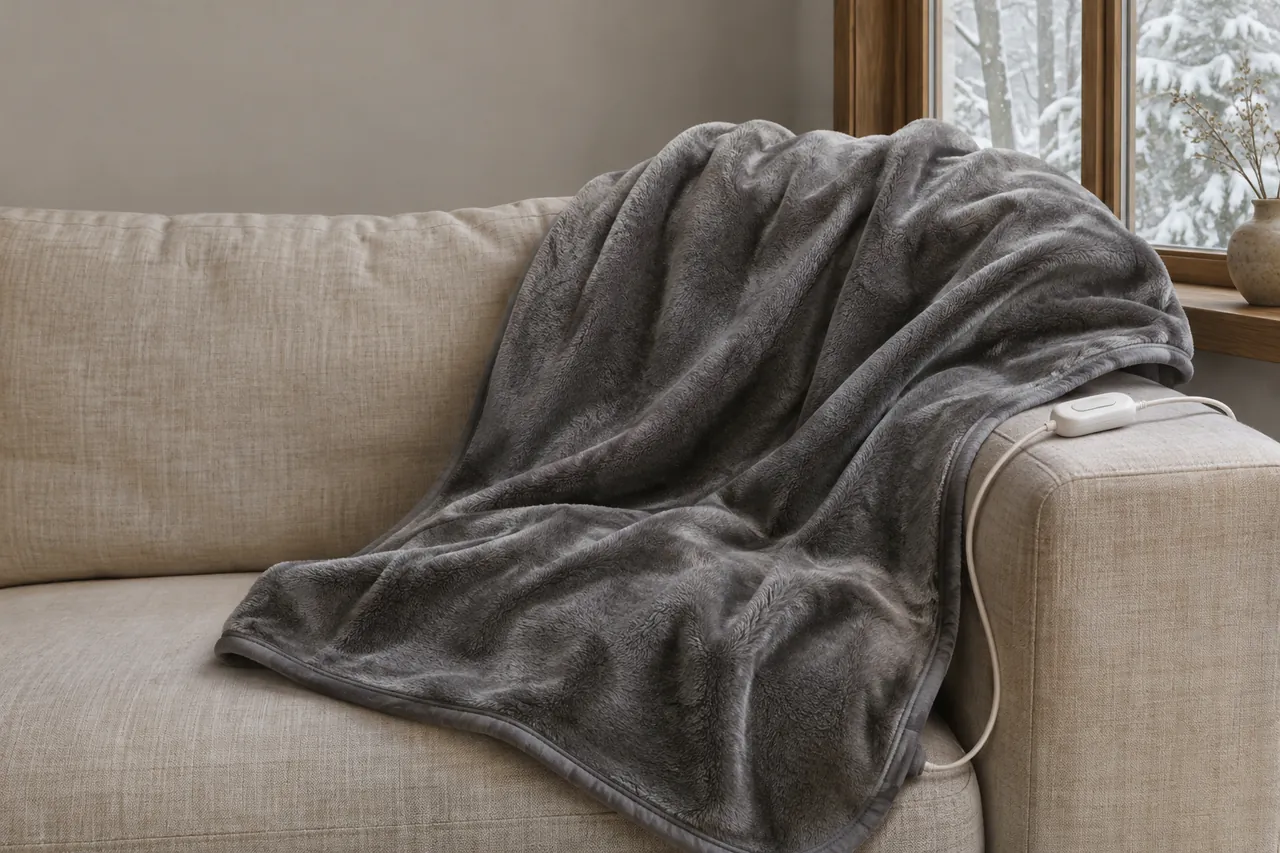
A queen-size electric blanket with dual controls can give two sleepers independent settings. Before comparing controls, check the mattress material and take three measurements: width, length and depth. Those details matter especially if you are choosing a fitted heated pad rather than a separate top cover.
Start with the mattress material
Start with your mattress maker’s care guidance. Tempur-Pedic says it does not recommend electric blankets or heating pads with its mattresses because high heat can interfere with the temperature-sensitive TEMPUR material’s response. For anyone who does use one, the company recommends limiting use to 30 minutes on a low or medium setting. That advice applies to its own material; other mattress products have their own care instructions.
An adjustable base adds another consideration: the mattress moves, and the frame can pinch a lead. Follow both products’ instructions for compatibility and routing. A matching surface measurement alone does not establish that a heated pad is suitable for a moving bed.
Tempur-Pedic also advises against a conventional mattress pad on its mattresses because the extra layer can reduce how the material responds to the sleeper. Its guidance illustrates why the mattress surface, the added layer and the heat source each deserve attention when comparing a fitted heated pad.
Measure the surface
Start with three measurements: the width of your mattress, its length, and its depth from the bottom edge to the highest part of its attached pillowtop. Write them down before shopping for a queen-size heated blanket or mattress pad. A label on its own cannot tell you whether a fitted skirt will reach beneath a deep mattress or how far a top blanket will hang over the sides.
Pull back the bedding and measure the mattress itself. Place a tape measure across the widest part of the sleeping surface for width, then from the head to the foot for length. Keep the tape straight rather than following the rounded sides. If an attached pillowtop changes where the surface begins and ends, make a note of that as well.
In the United States, 60 by 80 inches is the common reference size for a queen mattress, but product dimensions deserve a separate look. Regional sizing conventions and product cuts vary. When shopping online, compare the listed dimensions with the numbers you measured instead of relying only on “queen” in the title. This is especially useful when replacing older bedding or buying a product sold in several markets.
A heated mattress pad is intended to correspond to the mattress surface. An electric blanket used as an upper cover, by contrast, needs enough fabric to cover the people beneath it and may extend past the mattress edges. Compare each product’s measurements with the coverage you prefer, and follow its directions for placement. The dimensions of the mattress are the starting point; they are not automatically the ideal dimensions of the blanket.
A depth example: 16 inches versus 20 inches
For a fitted heated mattress pad, depth can be just as important as width and length. Measure vertically from the mattress bottom to the top of the attached pillowtop, if it has one. A straightedge laid across the top can make the measurement easier: measure down from its edge to the bottom of the mattress. Check more than one corner if the shape is uneven.
If you use a separate topper, record its thickness separately. Before including it under or over a heated product, read the placement and compatibility directions for both items. A skirt’s stated depth describes fit; it does not by itself establish that every combination of topper and heated bedding is suitable. Avoid forcing a skirt around a taller stack simply because the top surface dimensions match.
The Sunbeam Honeycomb Quilted Plush Heated Mattress Pad provides one concrete example. Sunbeam lists its queen pad at 60 by 80 inches, with a fitted skirt for mattresses up to 18 inches deep. The product listing also describes 12 heat settings and dual controls for queen and king sizes. These are details of that particular Sunbeam model, not specifications for all queen electric blankets or heated pads.
For example, imagine a mattress with a 60-by-80-inch sleeping surface and a 16-inch depth. A fitted pad listed at 60 by 80 inches with a skirt rated for mattresses up to 18 inches is within the stated dimensions for that bed. That is a useful first match, provided the mattress care instructions and the heated pad’s own directions allow the combination. The same reasoning does not turn a top blanket into a fitted pad: the two are measured for different jobs.
Now consider a mattress with the same 60-by-80-inch surface but a 20-inch depth. It exceeds this Sunbeam pad’s stated 18-inch limit, even though both carry a queen label. For a deeper mattress, compare the depth range of another pad before choosing it.
Compare a cover with a fitted pad
Before comparing controls, decide where you want the heated layer to go. An electric blanket serves as a top cover according to its instructions. A heated mattress pad is a fitted bedding layer designed for placement on the mattress as directed by its maker. Their shapes and sizing information differ, so a useful comparison starts with form, not just heat settings.
For a top blanket, spread out a tape measure across the bed and picture the amount of side coverage you want. A hypothetical 84-inch-wide cover centered on a 60-inch-wide mattress has 24 inches of extra width in total, or approximately 12 inches on each side when centered. That arithmetic describes the fabric beyond the mattress edges, not a promise that two people will have a particular amount of coverage once the blanket moves or is tucked.
Length matters too. Measure from the head of the mattress to the foot, then compare the blanket’s listed length with how you normally arrange your upper bedding. Some people prefer more fabric near their shoulders; others want extra coverage at the foot. Check the product’s directions before tucking or folding any heated blanket, and arrange it as specified rather than assuming it behaves like an ordinary throw.
For a fitted pad, concentrate on the pad’s surface dimensions and the skirt’s mattress-depth range. The extra width used to calculate a top blanket’s drape is not a substitute for a fitted pocket measurement. Similarly, the 18-inch skirt specification in the Sunbeam example does not describe a top blanket.
Plan for two controllers
Dual controls can make it easier for two sleepers to select their preferred settings independently, but the details vary by model. Check the listing for the size you are buying: some product families offer different controller arrangements across sizes. The queen and king versions of the Sunbeam model above are described as having dual controls; that observation does not establish the control configuration of another model.
Before making the bed, look at the product diagram and decide where each controller will be convenient to reach. Follow the actual connector and outlet instructions, give cords the room required by those directions, and keep them away from places where bed frames or furniture could pinch them. A tidy route should not pull on the connection when someone moves the bedding.
Finish with the care label
Once the measurements and compatibility line up, compare practical details that affect everyday use. Look for the controls’ placement, the available settings, the cleaning method, and the care instructions for the actual size and model. Product reviewers can help explain differences in feel and construction, but a review of one blanket should not be treated as a specification sheet for another.
Keep the instructions with the bedding so that setup and cleaning details remain easy to find. Before cleaning, switch off and unplug the product and follow its specific instructions for removable controllers and washing. Reconnect it only when the product and connectors are completely dry, as directed. Inspect the fabric, connections, and cords regularly, and stop using an item that shows damage.
Use an upper electric blanket in the position intended by its manufacturer rather than lying on it as though it were a mattress pad. Do not operate heated bedding bunched or folded unless the instructions specifically allow the arrangement, and do not stack active electrical heating products. These habits belong alongside the product’s own safety instructions, not in place of them.
Bring the mattress measurements with you when comparing listings. The surface dimensions narrow the size, while the depth helps determine whether a fitted skirt can reach around the mattress. Then compare the controls, texture and care directions for the remaining options.
References
Sunbeam — Honeycomb Quilted Plush Heated Mattress Pad
Sleep Foundation — Best electric blankets
Sleep Foundation — Best heated mattress pads
Good Housekeeping — Best electric blankets