
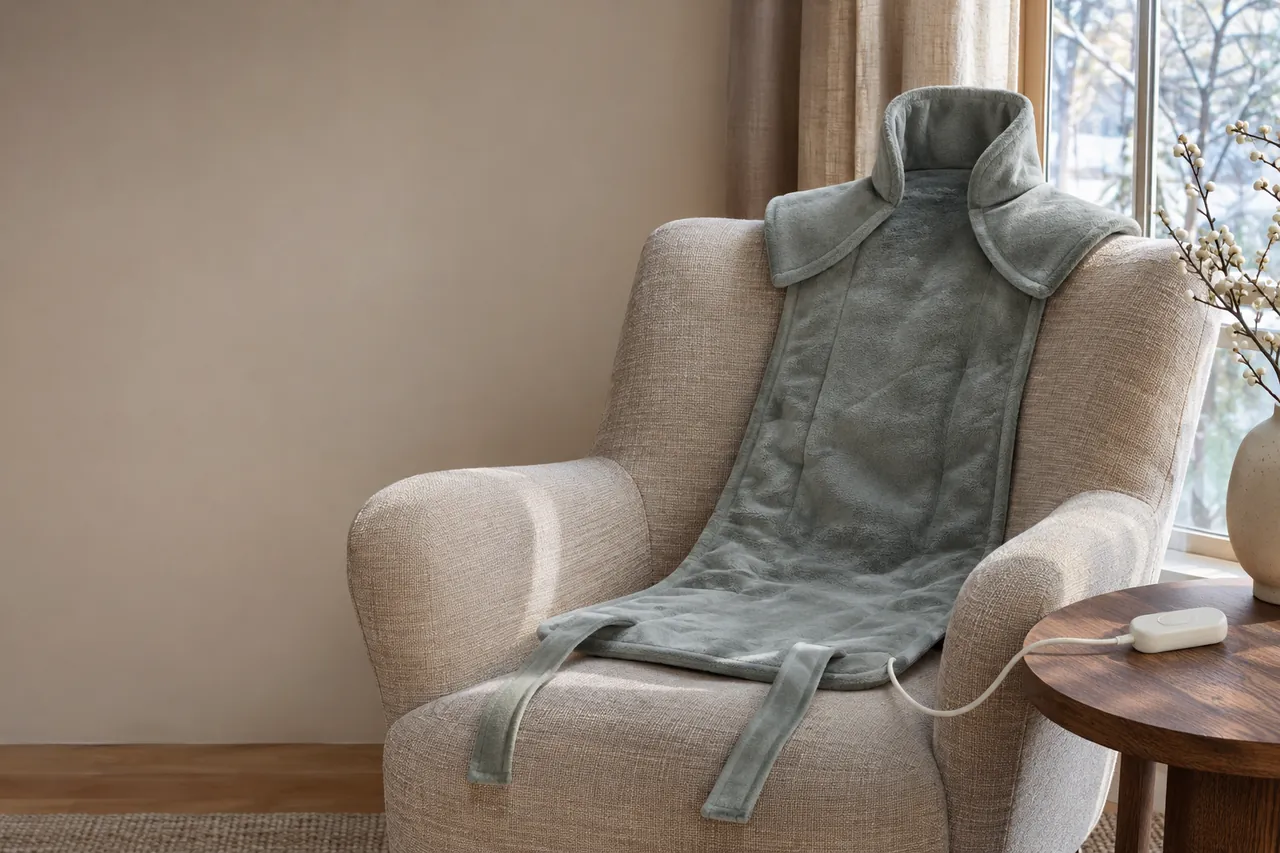
Before comparing a cordless heating pad and back massager, picture how you will adjust it after it is fastened. Can you reach the controls? Does the heated panel sit where you want it? Can you turn vibration off while keeping the warmth on? Those everyday questions can narrow the field faster than counting advertised modes.
Introduction
A heat-only wrap offers warmth; a combination belt adds a pulsing sensation. This guide walks through a comparison of two listing formats, then covers fit, independent controls, battery arrangements and care. The examples are for evaluating product descriptions, not claims of personal testing.
What a useful comparison looks like in practice
Compare two actual listings: the Sunbeam GoHeat 2000-825-000 is a cordless heating pad with a removable strap and three heat settings. The Comfytemp K9224 is a waist wrap with three heat settings and three vibration modes that can work separately or together. Sunbeam lists a two-hour automatic shutoff; Comfytemp lists 30 minutes. These are device timers, not recommended periods of continuous skin contact. Check each model’s fit and positioning instructions before choosing.
Controls deserve the same attention. Small buttons may be difficult to reach when the wrap is fastened behind you, while a control on the front can be easier to see. Consider whether changing the setting requires removing the belt, whether indicators are understandable, and whether the design lets you turn vibration off without losing heat. These details can make a familiar routine simpler than a long list of modes.
Finally, compare the complete package. Is the rechargeable power source included? Is a charging lead listed? Does an extension strap come with the version you are considering? Review the item description for the specific variant and check its care directions. If two products have similar features, those practical differences may matter more than promotional language about portability.
For someone who prefers warmth without movement, a heat-only option may be sufficient. For someone curious about a pulsing sensation, a combination wrap offers a choice of modes. When a listing does not explain how those modes work, compare another model with clearer details instead of assuming that every heating and massage belt has the same controls.
The Decision Process: Waist Fit, Control Flexibility, and Battery Power
Once you know which sensations you prefer, compare fit and controls before deciding how much battery capacity you need.
Measure around the area where the belt will fasten and compare it with the product’s stated range. Check the heated panel separately from the strap: a strap that closes is useful only if the panel reaches the area you want warmed. Follow the model’s placement and clothing instructions, and choose a fastening that releases easily without restricting breathing.
Look for a clear statement about whether heat and vibration operate separately. Independent controls let you choose one or both. The named Comfytemp listing describes heat-only, massage-only and combined modes for its model.
Battery arrangements differ. Some designs carry a power bank in a pocket; others use a different connection. Check what comes with the product and where the battery will sit when the belt is fastened.
Rechargeable batteries allow hands-free movement while doing light household tasks or working at a desk.
Charge the battery according to the device instructions, using the specified compatible accessories. Check the listing for what comes with the version you choose.
Compare the seller’s runtime estimates at their stated settings, since heat and vibration choices can affect time between charges. Runtime is not an instruction to keep the wrap on for that entire period.
Essential Operational Safety, Skin Protection, and Device Maintenance
Keep the controls easy to reach, use the product while awake, and follow its directions for positioning and care.
Switch off and remove a localized heating pad before sleeping. A shut-off feature is useful to understand, but it is not a substitute for following the device’s directions.
Avoid using or adjusting the device while driving. Choose a stationary setting where you can pay attention to how it feels.
Positioning matters: follow the specific device’s instructions and do not sit or lie on an ordinary flat heating pad. Massage cushions are designed differently, so use only the positions specified for that product.
An automatic shut-off describes the device’s control feature; it is not a suggested continuous contact time.
Check skin underneath the pad frequently during use. If it feels uncomfortably hot or the skin becomes unusually red or irritated, switch it off and stop using it. Do not use a heating pad on an area where you cannot feel heat normally. Product instructions may contain additional restrictions for people with diabetes, poor circulation or other conditions affecting sensation; follow the warnings for the particular model.
Do not put an electric heating pad, battery, controller or charger in a microwave.
The GoHeat 2000-825 manual gives a model-specific sequence: disconnect the pad, remove the battery/controller, tuck the pad cable into its pocket, and wash the pad on a gentle cold cycle or by hand. Do not wash the battery. Let the pad and connector dry fully before reconnecting. Other wraps have their own care instructions.
Evaluating Mechanical and Thermal Features: Heat-Only vs. Combination Wraps
A heat-only wrap provides warmth. A vibration wrap adds a pulsing sensation; it is different from a massage cushion with moving massage nodes. Neither style is automatically the better fit for every person.
A simple heated wrap can be appealing when warmth is all you want. Look at the fabric shape and fastening, not just the name: a belt designed for the waist will fit differently from a flat pad or a neck wrap.
A combination wrap adds vibration to the heat function. The sensation, sound, controls and placement vary by design. A massage cushion with moving nodes is another category, so compare the descriptions rather than assuming all products labeled “massager” work in the same way.
The Comfytemp K9224 gives you one way to compare a combination wrap with the GoHeat heat-only pad.
Its listing describes:
Cordless design: The listed Comfytemp model uses a rechargeable power bank, so the belt can be used away from a wall outlet.
Dual Thermal and Vibration Customization: The K9224 product page lists three heat levels and three vibration modes. It describes heat-only, vibration-only and combined operation, making the control choices more useful to compare than a single count of modes.
Upgraded Adjustable Straps: Incorporates wide, adjustable fabric straps designed to hold the warming and vibration surface securely against the lower back or abdomen across various body sizes.
Automatic shut-off: Comfytemp lists a 30-minute auto-off for this model. The timer describes the device setting, not a recommended duration of skin contact.
These features belong to the named Comfytemp model. Other cordless heating wraps can differ in their controls, fit and power arrangement.
Health Context and Scoped Medical Evidence
Heat can be a comfort measure, but a device listing is not a diagnosis or a promise of recovery. The background sources discuss different uses of warmth and should be read in their own contexts.
Cleveland Clinic describes muscle knots and discusses approaches including heat and massage. That general discussion should not be treated as a test of this particular belt or a guarantee that a heating wrap will resolve a back condition.
Verywell Health describes hot packs as a physical-therapy treatment. A clinician’s hot pack and a consumer battery-powered wrap are different products with different instructions.
For a consumer wrap, use the directions that accompany that specific device rather than applying a clinical hot-pack schedule to it.
Verywell Health also discusses warmth among options for period cramps. That context relates to menstrual discomfort; it does not establish product performance for a separate back condition.
The distinction matters when comparing claims: a source can offer useful background without being a product test. NHS back-pain guidance calls for emergency assessment if back pain occurs with pain, tingling, weakness or numbness in both legs; loss of feeling around the genitals or anus; bladder or bowel changes; changes in sexual sensation or function; chest pain; or after a serious accident. Seek urgent medical advice for sudden severe or rapidly worsening pain, or back pain with feeling hot, cold, shivery or generally unwell.
Summary of Key Buyer Decisions
A good comparison begins with the sensation you want and ends with a fit you can use comfortably. Check the shape, controls, power arrangement and care instructions together, rather than choosing a belt on its longest feature list.
References
Comfytemp — Cordless Heating Pad with Vibration Massage Relief
Cleveland Clinic — How To Get Rid of Muscle Knots https://health.clevelandclinic.org/what-are-muscle-knots-and-how-do-i-get-rid-of-them
Verywell Health — 15 Things to Help With Period Cramps on Pain Days
Verywell Health — Hot Packs Used in Physical Therapy https://www.verywellhealth.com/hot-packs-physical-therapy-modalities-2696130
Comfytemp — Cordless Heating Pad with Vibration Massage Relief: https://comfytemp.com/products/comfytemp-cordless-heating-pad-with-massager
Verywell Health — What Helps With Period Cramps: https://www.verywellhealth.com/what-helps-with-period-cramps-8413517