
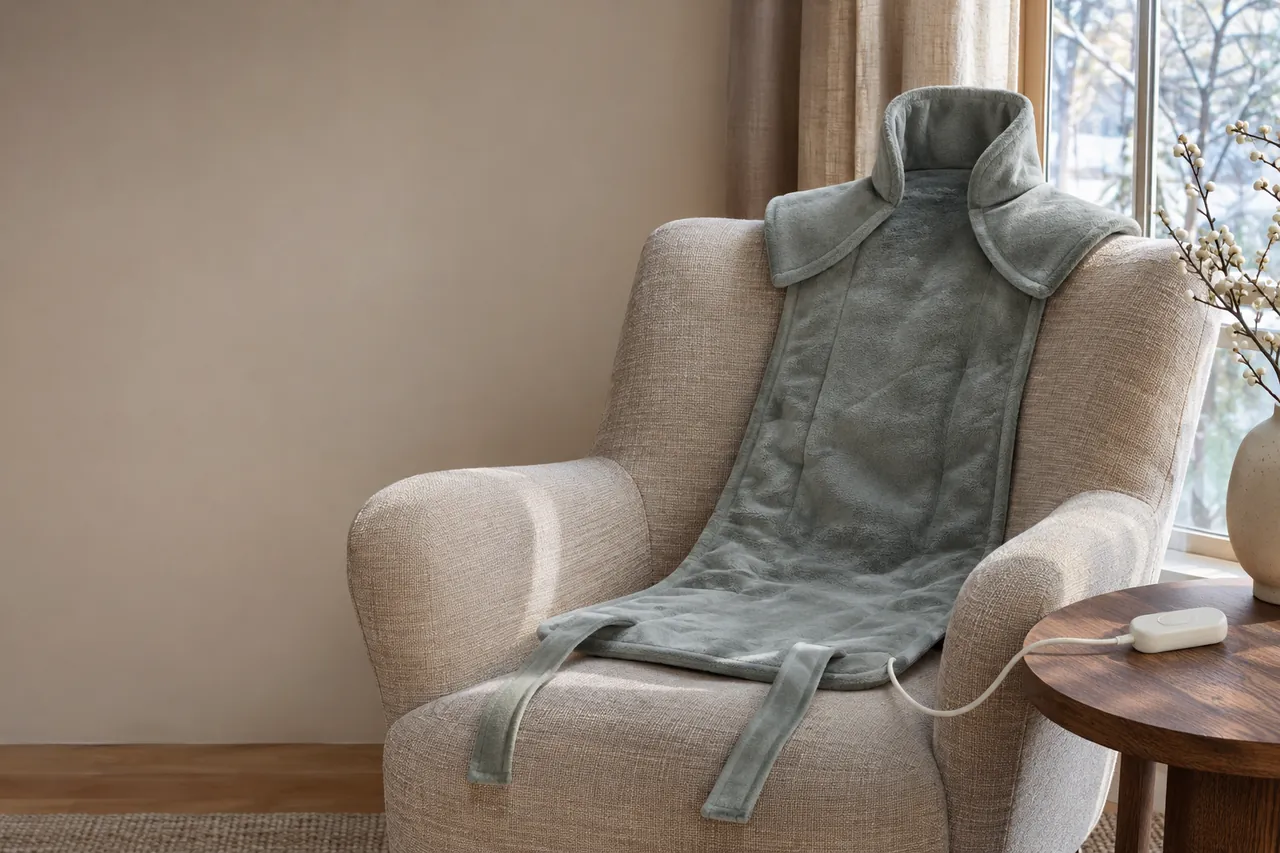
A cordless heating pad for your back needs to reach the place where you want warmth. A strap that closes around your waist does not reveal the height of the heated panel, and the size of the fabric is not always the size of the warming area. Start with those measurements before comparing battery life or the number of settings.
Introduction
Use a flexible tape to note the height and width of the area you want covered. Compare those reference points with the product description and rear-view photographs. Then work through the contents, fit and care directions for the exact version you are considering. This approach makes it easier to compare a small pad with a wider belt without assuming either design will cover your whole back.
Three questions to ask of any listing
First, what exactly is included? A product photograph may show a strap, a separate power bank and a charging cable, but a listing can offer several variants. Read the contents for the version you select. If a strap is optional, include that in your comparison: a pad that needs to be held by hand is a different experience from one secured around the waist. Equally, a belt with a built-in pocket may place its battery in a different position than a pad with an external lead.
Second, how will you put it on? Look at the orientation of the fastening and whether the strap can be adjusted without twisting the pad. Consider the clothes you expect to wear and whether the controls remain visible after fastening. A shorter pad may be easier to reposition, while a longer wrap may cover more of the chosen area; the measurements and product design, not the category name, tell you which is which.
Third, what happens after use? A rechargeable design needs a place to store the battery and cable as well as the fabric pad. Look for the maker’s cleaning and storage directions, including whether any controller or battery can be detached. A detachable component alone does not prove that the remaining fabric is machine washable. Some products have a removable cover, while others need a different cleaning method.
Consider how frequently you expect to move between rooms. Cordless power can make it easier to step away from an outlet, but you still need to keep track of the charge and the location of the controls. If the pad will usually stay beside one chair, a corded product with suitable positioning may also be worth comparing. Portability is useful when it matches your actual routine; it is not the only measure of a good fit.
A listing that provides clear dimensions, the included accessories, settings and care directions is easier to compare than one relying on broad phrases such as “full coverage” or “all-day comfort.” Keep a short note of the specifications that matter to you and compare like with like: panel with panel, waist range with waist range, and runtime claims at their stated settings. This also helps prevent confusing a product’s total fabric width with the area that actually warms.
Operational Safety, Skin Protection, and Device Maintenance
Keep the controls accessible, follow your product’s instructions, and stop use if the heat feels uncomfortable or your skin becomes irritated.
Turn off and remove a localized heating pad before sleeping. A timer describes a device feature, not a recommended amount of skin contact.
Follow the device’s positioning instructions. Do not sit or lie on an ordinary flat heating pad; products designed as supportive cushions have their own instructions.
Driving Safety: Users should never operate temperature controls on a heating pad while driving a motor vehicle. Adjusting heat settings while driving creates dangerous distractions.
Inspect your skin frequently during use. If the heat feels uncomfortable or the skin becomes unusually red or irritated, switch the device off and stop using it. The GoHeat manual says the pad must not be used by people with diabetes, poor circulation or heat insensitivity, or by children; it should not be used on someone who is sleeping or unable to respond. Inspect the pad, cord and battery controller before use and do not use a damaged unit.
Never put an electric heating pad, battery, charging cable or controller in a microwave.
Check the care label for the particular product before cleaning. Disconnect power and keep the battery, controller and charger away from water. Allow cleaned parts to dry fully before reconnecting them, following the model’s instructions.
A useful final check is simple: the panel reaches your chosen area, the fastening fits comfortably, the controls are accessible, and the power and care instructions suit the way you plan to use it.
Compact Battery Pads vs. Wearable Waist Wraps
Battery-operated personal heating devices generally fall into two structural designs: compact rectangular pads with removable straps and dedicated wearable waist wraps.
The Sunbeam GoHeat cordless pad is one compact example. Sunbeam lists a flexible pad with three heat settings, a rechargeable battery and an adjustable strap that fits up to 55 inches. The strap secures the pad; its reach does not describe the area that warms.
A longer example is Pure Enrichment’s PureRelief Cordless Lumbar and Abdominal Heating Wrap (PECLPBK-MG), whose listing gives a pad size of 19.69 by 9.45 inches. It has separate pockets for its rechargeable battery and included hot/cold gel pack. Compare the listed pad dimensions and intended placement with your own measurements; pad size and strap reach are separate from the actual heated area.
Check the rear view of each product. A photograph from the front can show how a belt closes without showing how far the heated panel reaches up the back. If your priority is an area above the waist, panel height and placement matter more than a broad claim of “back coverage.”
Evaluating Battery Performance, Straps, and Digital Controls
Choosing a cordless heating pad requires looking past high-level marketing phrases and evaluating how electrical power, strap security, and controller features function in practice.
Sunbeam advertises up to four hours of battery life on low for the GoHeat. That is the seller’s estimate for that setting and model. Compare runtime claims alongside the stated heat setting and included power equipment rather than assuming the same figure applies to every cordless pad.
Battery runtime describes operation between charges; it is not a recommendation to keep a pad against the skin for that long. Follow the directions for the particular product and stop if the heat feels uncomfortable.
A strap should hold the pad in the intended position without feeling restrictive. Measure around the area where it will fasten, check the stated adjustment range, and look at how easily the fastening releases. A belt can fit around the waist yet position its pad too high or too low for your purpose. Follow the product instructions for placement and clothing: the GoHeat manual says not to cover the pad with clothing or other insulating material while it is in use.
Consider whether you can reach and read the controls once the pad is positioned. Multiple settings give choices, but the controls and care instructions are specific to the model. Consult the individual listing for the actual features of that model.
Health Context, Physical Therapy Principles, and Medical Scope
Health articles provide background on the use of warmth, but they are not product tests. Read each source in its own context.
Thermotherapy principles explained across health educational resources provide context for managing daily discomfort:
Verywell Health discusses hot packs used in physical therapy. Those clinical packs are different from consumer cordless devices, so their application schedule should not be treated as the instructions for a wearable pad.
Another Verywell Health article discusses warmth for menstrual cramps. That is a separate context from evaluating coverage or battery life in a back wrap.
Choose a pad for comfortable localized warmth rather than as a promised fix for a medical condition. NHS back-pain guidance calls for emergency assessment if back pain occurs with pain, tingling, weakness or numbness in both legs; loss of feeling around the genitals or anus; bladder or bowel changes; changes in sexual sensation or function; chest pain; or after a serious accident. Seek urgent medical advice for sudden severe or rapidly worsening pain, or back pain with feeling hot, cold, shivery or generally unwell.
References
Sunbeam — GoHeat™ Cordless Heating Pad https://www.sunbeam.com/pain-relief/general-muscle-pain/sunbeam-goheat-cordless-heating-pad/SP_438956.html
Verywell Health — Hot Packs Used in Physical Therapy https://www.verywellhealth.com/hot-packs-physical-therapy-modalities-2696130
Verywell Health — 15 Things to Help With Period Cramps on Pain Days
Verywell Health — What Helps With Period Cramps: https://www.verywellhealth.com/what-helps-with-period-cramps-8413517
Pure Enrichment — PureRelief Cordless Lumbar and Abdominal Heating Wrap (PECLPBK-MG)