
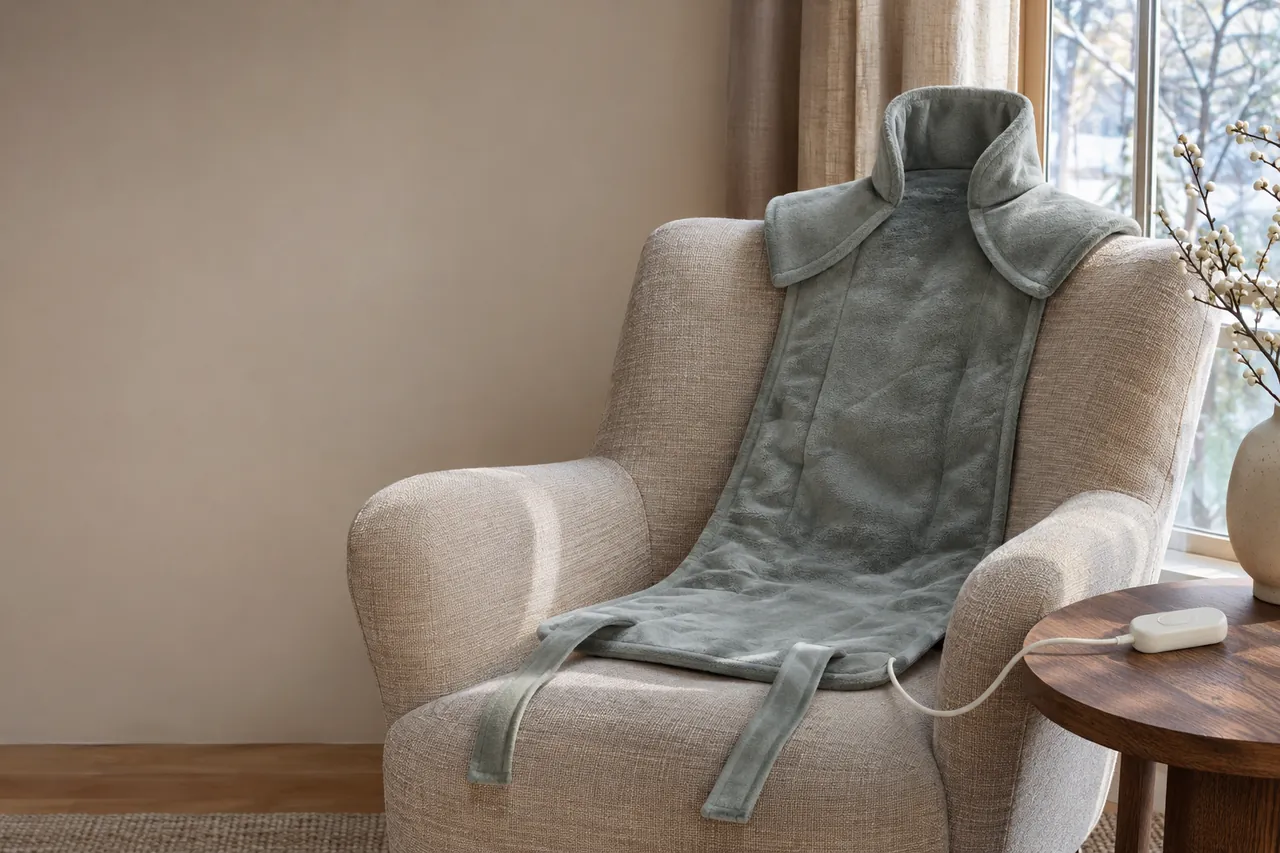
Where does the warmth need to reach: the back of the neck, the tops of the shoulders, or the area between the shoulder blades? That question is a useful starting point when choosing a cordless upper back heating pad. A shoulder wrap may sit comfortably around the neck yet end higher than the area you want to cover. A rectangular pad may reach farther down but need a different way to stay in place.
Introduction
Start by marking the area you want to warm, then compare its position with the product photographs and dimensions. Cordless designs make it easier to move away from an outlet, but the battery and any weighted filling also affect how the wrap feels on your shoulders. The following comparison looks at fit, weight, controls, battery descriptions, and the differences between a shoulder wrap and a lower-back pad.
Map the area you want to warm
A useful comparison begins with the shape of the fabric, rather than the broad phrase “upper back.” Look at the outline from the rear as well as the front: a high collar, shoulder panels, and a longer center section solve different coverage problems.
The Anatomy of Upper Back Coverage
Check the areas individually when comparing designs:
Neck: A raised collar is intended to sit around the neck. Consider whether you want warmth there or prefer an open neckline.
Shoulders: Wider side panels can drape over the shoulder tops. Check whether the shape appears suitable for your shoulder width.
Between the shoulder blades: Look for the length and shape of the rear panel. A shoulder wrap does not necessarily extend far down the back.
Try a coverage check before choosing
Use a flexible measuring tape to estimate the width across your shoulders and the distance from the base of your neck to the lowest point you want covered. Compare those measurements with the product diagram, keeping in mind that an overall rectangular measurement does not show the exact heated area. Look for a rear-view image that shows where the fabric falls and a clear description of the heated zones.
Think about the setting in which you will wear the wrap. If you plan to sit at a desk, check whether the closure and battery placement leave room for your normal posture. If you expect to move between rooms, consider how easy the controls are to reach and how the battery is carried. A more substantial wrap can feel reassuring to one person and cumbersome to another, so comfort is as important as the list of settings.
Physical Design Features for Staying in Place
Closures and fabric weight can help position a wrap, but the feel and fit depend on the individual design:
Weighted edges: Some wraps use glass beads to add weight to the drape. Consider that weight alongside the battery when deciding what will feel comfortable.
Chest closure: A magnetic fastening can keep the front panels together when the wrap is worn upright. For the PureRelief PECLPNE-MG, the manual says to remove necklaces and other metal accessories so they do not attach to its built-in magnets.
Collar shape: A shaped collar can bring fabric around the neck; the height and opening affect how it feels.
Before choosing, picture how you will put the wrap on and take it off. Can you fasten the front without pulling it tightly around your neck? Can you reach the controls and remove the battery without twisting? Compare the collar opening and shoulder span with your own measurements, then look at where the back panel ends. A design that stays in place should still leave you free to remove it easily.
Compare the shape before the feature list
Shoppers searching for warming appliances often evaluate different product categories across online listings. Understanding how contoured neck-and-shoulder drapes differ from corded lumbar pads prevents buying an appliance unsuited to your target area.
Contoured Neck-and-Shoulder Wraps vs. Lumbar Belts
Neck-and-shoulder wraps: The collar and shaped shoulder panels are designed for the neck and shoulders. Check the rear-panel dimensions if the area between your shoulder blades is your priority.
Lumbar and waist wraps: These are shaped for the lower back or abdomen, so their straps and horizontal layout serve a different area.
Distinguishing Personal Heating Pads from Full-Bed Appliances
Bedsure’s comparison distinguishes a localized heating pad from larger electric blankets and heated mattress pads. A pad focuses warmth on a smaller area; bedding covers a larger part of the bed. Compare each product’s own instructions and intended use instead of assuming the categories are interchangeable.
Two examples with different coverage
To understand how product features are specified in merchant listings, examine two distinct commercial models from Pure Enrichment:
PureRelief® Cordless Neck and Shoulder Heating Pad: The seller lists a 22 by 14.8 inch wrap weighing 3.5 pounds, with a rechargeable battery, four heat settings, magnetic closures, and glass-bead weighting. Its stated runtime varies by setting. The listed dimensions describe the item, so use the shape and measurements to judge whether it reaches your chosen area.
PureRelief® Lumbar & Abdominal Heating Pad: This is a corded product shaped for the lumbar area and abdomen, with an adjustable strap. It is a useful comparison for waist coverage, but it is not the cordless neck-and-shoulder model.
These two listings illustrate why both power source and body area belong in a comparison. A wrap labeled for the lumbar area should not be assumed to cover the shoulders; similarly, a shoulder design should not be assumed to extend to the lower back.
What battery life and weight mean in practice
The primary appeal of a cordless upper back heating wrap is untethered mobility. Moving around your home or workspace without trailing an electrical wall cord provides practical convenience. However, cordless operation introduces specific battery architecture trade-offs that buyers must evaluate.
Power Supply Components and Battery Weight
Cordless models use a rechargeable battery, though the location of the battery and the charging arrangement vary by model. Check the listing for what is included, where the pack sits, and how the controls are accessed while wearing the wrap.
A key engineering trade-off in cordless upper back design involves physical weight:
Incorporating high-density weighted fill (such as glass beads) alongside a rechargeable battery unit increases the overall weight of the garment.
The combined weight and its distribution matter: a comfortable drape for one person may feel heavy to another.
Dissecting Seller Descriptions: Runtime vs. Continuous Wear Limits
When reading a listing, separate the advertised battery runtime from guidance about wearing the pad:
Seller runtime descriptions: For the PureRelief cordless neck-and-shoulder model, the product description states 120 minutes of battery use, while the page’s specifications list 80–140 minutes depending on heat level. The manufacturer’s manual gives approximately 60–140 minutes across its four settings and describes a two-hour automatic shutoff. These figures describe the same model but differ by source and setting; battery life and shutoff do not establish a recommended heat session length.
Battery runtime and use guidance answer different questions. Runtime describes battery operation; use the product’s own directions for how to operate the pad and when to stop.
Use the pad while awake, start at a comfortable setting, and stop if the heat feels unpleasant or the skin becomes irritated. Turn it off and remove it before sleep.
Using and caring for the wrap
A few straightforward habits help you use a heating wrap more comfortably and care for it properly.
Use your wrap while awake
Use the pad while awake and turn it off before sleeping. Follow the directions supplied with the particular model.
Driving Safety Restrictions
Users should never wear or operate temperature controls on a heating wrap while driving a motor vehicle. Adjusting heat settings or responding to thermal discomfort while operating an automobile creates dangerous driving distractions.
Skin Monitoring and Dermatological Protection
Check the skin under the wrap frequently and stop if it feels too hot or the skin becomes irritated. The PureRelief PECLPNE-MG manual says not to use it on areas insensitive to touch or heat, and warns against use by a person with diabetes or poor circulation unless carefully attended. It also says not to sit on, lean against or crush the wrap, and not to use it with liniments, salves or ointments. Follow the warnings for your exact model.
Keep the electric wrap out of the microwave
Do not put an electric heating pad, battery, controller, or charging cable in a microwave. Microwave use applies only to products specifically designed and labeled for it.
Fabric Care Maintenance
Care varies between models. Read the care label and the product instructions before cleaning.
Disconnect power before cleaning, and keep the battery, controller, and charging equipment away from water. Follow the specific model’s instructions for removable components.
For the PECLPNE-MG, the manual says to disconnect the battery pack, then hand wash or machine wash the wrap in cold water on a gentle cycle. It permits line drying or low-heat tumble drying, and says the connector must be completely dry before reconnecting. Do not dry-clean, bleach or use a wringer.
Allow any cleaned fabric and connectors to dry completely before reconnecting power.
By mapping your coverage needs, evaluating battery trade-offs objectively, adhering to model-specific safety manuals, and respecting skin limits, you can select and operate a cordless upper back heating pad safely.
References
Pure Enrichment — PureRelief Cordless Neck and Shoulder Heating Pad: https://pureenrichment.com/products/purerelief-cordless-neck-and-shoulder-heating-pad
Pure Enrichment — PureRelief Lumbar and Abdominal Heating Pad: https://pureenrichment.com/products/purerelief-lumbar-abdominal-heating-pad-gray
Bedsure — Heating Pad vs Electric Blanket vs Heated Mattress Pad: https://bedsurehome.com/blogs/bedsure/heated-pad-vs-electric-blanket-comparison
Good Housekeeping — Heating pad review: https://www.goodhousekeeping.com/health-products/g30647898/best-heating-pads/