
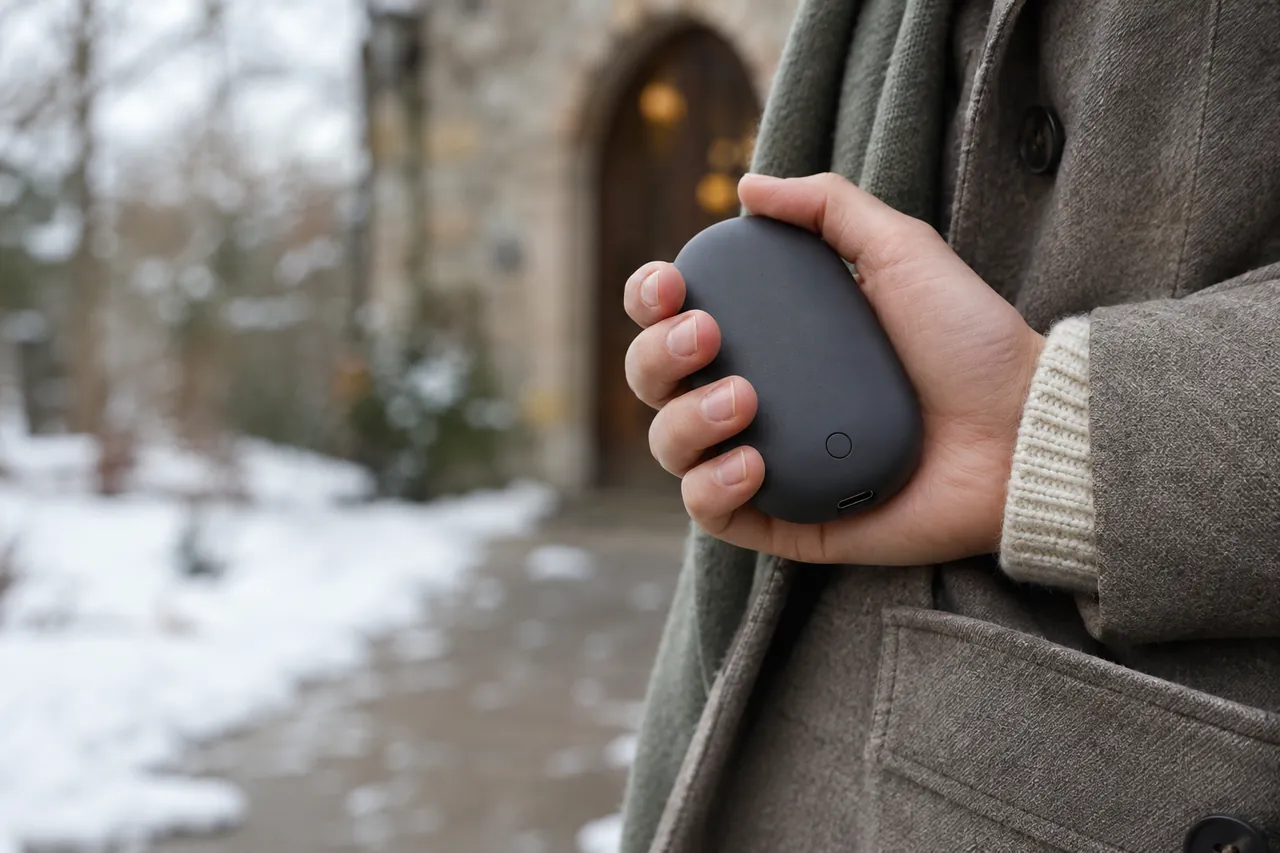
A magnetic pair can be useful in two quite different situations: a short commute with a pocket for each hand, or a long outdoor event where the time away from a charger matters. Start with the activity, then compare the size, controls and stated battery conditions of the exact pair. The magnetic connection tells you how pieces attach; it does not establish how every model heats or charges.
Two outings, different priorities
A commuter with two coat pockets
A split pair can be convenient when each hand has its own pocket. The useful comparison is whether the pieces fit those pockets, whether each can be controlled separately, and whether the pair is easy to collect at the end of the journey. A clear charging routine matters more than a feature the commuter will never use.
Before buying, measure the pockets while they contain the items you normally carry. Consider whether you can find each control with gloves on and where you will put both pieces when you arrive. A compact joined pair can be useful for storage, while separate pieces leave one available for each hand.
A spectator planning a longer event
For a longer event, read the listed runtime alongside the setting and charge time, and carry suitable clothing for the weather. The review’s figures describe a particular model and do not guarantee warmth for the entire event. Check the product’s limits around moisture and impact, and keep a practical non-electric option in mind for the rest of the day.
For a concrete example, GearJunkie found the OCOOPA UT3 PRO pair useful separately in jacket pockets. Its reviewers report that each unit heats on all sides when separated, while the outside panels heat when the pieces are joined. For a pair that is not subject to a safety notice, consider whether separate pieces or a joined shape is easier to hold between activities. The observation describes that reviewed model; another pair may distribute heat differently. A later Polish consumer-authority notice describes a Kolba safety campaign covering model UT4102, identified in reporting as UT3 PRO, because its battery may overheat or ignite. Do not use or charge a unit covered by that campaign; follow its return guidance.
One pocket or two?
Imagine waiting for a train with both hands in a coat. A two-piece warmer can give each pocket its own device. On the way home, joining the pieces may make them easier to find in a bag. Someone who usually carries a single warmer in a large pocket may prefer a one-piece device and have fewer individual items to manage.
GearJunkie reviewed the OCOOPA UT3 PRO as a pair of rechargeable units that can attach magnetically. The review says the pieces heat and recharge independently and describes four heat levels for that particular model. It also notes that the testers found the magnetic connection most useful for storing the pieces, while preferring to use them separately.
That is a model-specific observation, not a rule for every magnetic pair. Compare how each candidate attaches, whether the pieces operate independently and whether a control is easy to reach. If two people plan to share a pair, check the instructions for the exact product so both know how to operate and recharge their own unit.
Check the shape and controls
Check the dimensions of each piece as well as the joined pair. A shape that feels manageable in a coat pocket can be awkward in a narrow trouser pocket, and the combined thickness matters if the two parts are carried together. Think about where keys, a phone and gloves usually go; a warmer needs its own space without pressing on other items.
Do not assume a rechargeable unit will fit inside a glove. GearJunkie specifically lists glove and boot fit as a limitation of the UT3 PRO compared with smaller disposable warmers. For a device intended for pockets or hands, follow its instructions rather than forcing it into a tight glove or placing it where the surface is difficult to monitor.
The controls deserve the same attention as the outline. Are the buttons distinct enough to operate comfortably? Can you see a setting or battery indicator without removing a glove? Are there wrist straps or a pouch, and are they actually included with the version on the listing? GearJunkie reports straps and a carrying case with the UT3 PRO it reviewed; other packages may differ.
Read the battery claim in context
Runtime is useful only when you know what the number describes. Look for the setting, whether the advertised duration concerns one piece or the pair, and whether the units are used together or separately. “Up to” is a maximum described by a listing or test, not a promise that every setting will last the same amount of time.
For its UT3 PRO review, GearJunkie lists up to 15 hours total, a 3.5-hour charge time and a pair weight of 8.3 ounces. Those are the figures in that review for that model. The review also notes that severe cold or damp conditions can affect rechargeable battery life. They are not specifications for other warmers or a prediction for your trip.
If a listing does not explain its runtime clearly, compare it with your actual routine. A short commute and an all-day outdoor event have different requirements. A pair also has two units to keep charged and stored; think about when you will recharge them and whether the controls and indicators make that routine easy to follow.
Make the charging routine workable
A USB connector is a shape, not a complete charging specification. Use the cable and power supply specified for your device, and follow its instructions about whether it should be switched off and how it should be positioned during charging. The presence of two charging ports does not by itself establish whether both pieces may be charged while joined.
Inspect the cable, port and casing before use. Keep the device away from water unless its own instructions explicitly allow the exposure in question. A dropped, damaged, swollen or unusually hot unit should be taken out of use; avoid opening or attempting to repair its battery. Follow the instructions for cleaning, storage and charging rather than applying a schedule copied from a different product.
The GearJunkie review describes a protective port cover on each reviewed UT3 PRO unit and mentions a charging cable. Those details help identify what to look for on a model, but they do not establish water resistance or the accessories included with another seller’s package. Save the manual and model number with your purchase record.
Check the exact model against the recall
On July 30, 2026, the U.S. Consumer Product Safety Commission announced a recall of certain OCOOPA rechargeable hand warmers because their lithium-ion batteries can overheat and ignite. The notice lists models UT3053, UT3056, ZLS-118, ZLS-118S, ZLS-118D, H01 and H01(PD). It identifies the model and three-digit batch number on the underside of the affected warmers.
If your device is one of those recalled models, stop using it and follow the CPSC recall instructions. The notice describes a refund process and asks owners to mark the warmer and submit a photograph showing the marking, model and batch number. Follow the notice’s directions for disposal of the defective lithium-ion device; it specifically says not to put it in ordinary trash, curbside recycling or retail battery boxes.
The OCOOPA notice applies to the identified models, not every item sold under that brand. Separate CPSC recalls announced in October 2026 cover HotHands rechargeable model H163650 and Gobi Heat model UT3053. Check the brand and model on the actual device, stop using an affected unit, and follow the matching notice for the refund process and hazardous-waste disposal. An older review or product photograph does not establish whether a specific unit is recalled.
When cold fingers need attention
The NHS describes Raynaud’s as a condition that can cause colour changes, numbness, pain or tingling in fingers and toes, often in response to cold or stress. Its practical guidance includes keeping warm and wearing gloves in cold weather. A pocket warmer can be a comfort accessory, but it does not cure Raynaud’s or replace appropriate medical care.
Avoid placing heat directly on numb skin: reduced sensation makes it harder to notice excessive heat. Use the warmer according to its instructions, check the skin and stop if the device feels uncomfortable. A magnetic attachment holds pieces together; it should not be treated as a medical feature or evidence of improved circulation.
Quick answers
Can every magnetic pair be charged while attached?
The magnetic connection alone does not answer that question. Use the charging arrangement described for the particular model and its supplied accessories.
Does a magnetic connection make the warmer a medical device?
No. A magnetic connection is a way to join compatible pieces. Medical questions and the management of Raynaud’s belong to clinical guidance, not a claim about the fastener.
Are all OCOOPA hand warmers in the 2026 recall?
The cited CPSC notice names seven specific model numbers. Check the full notice and the marking on the device rather than extending the notice to an entire brand.
Sources
GearJunkie, hand warmer review
U.S. CPSC, OCOOPA recall notice
Mayo Clinic, Raynaud’s symptoms and causes