
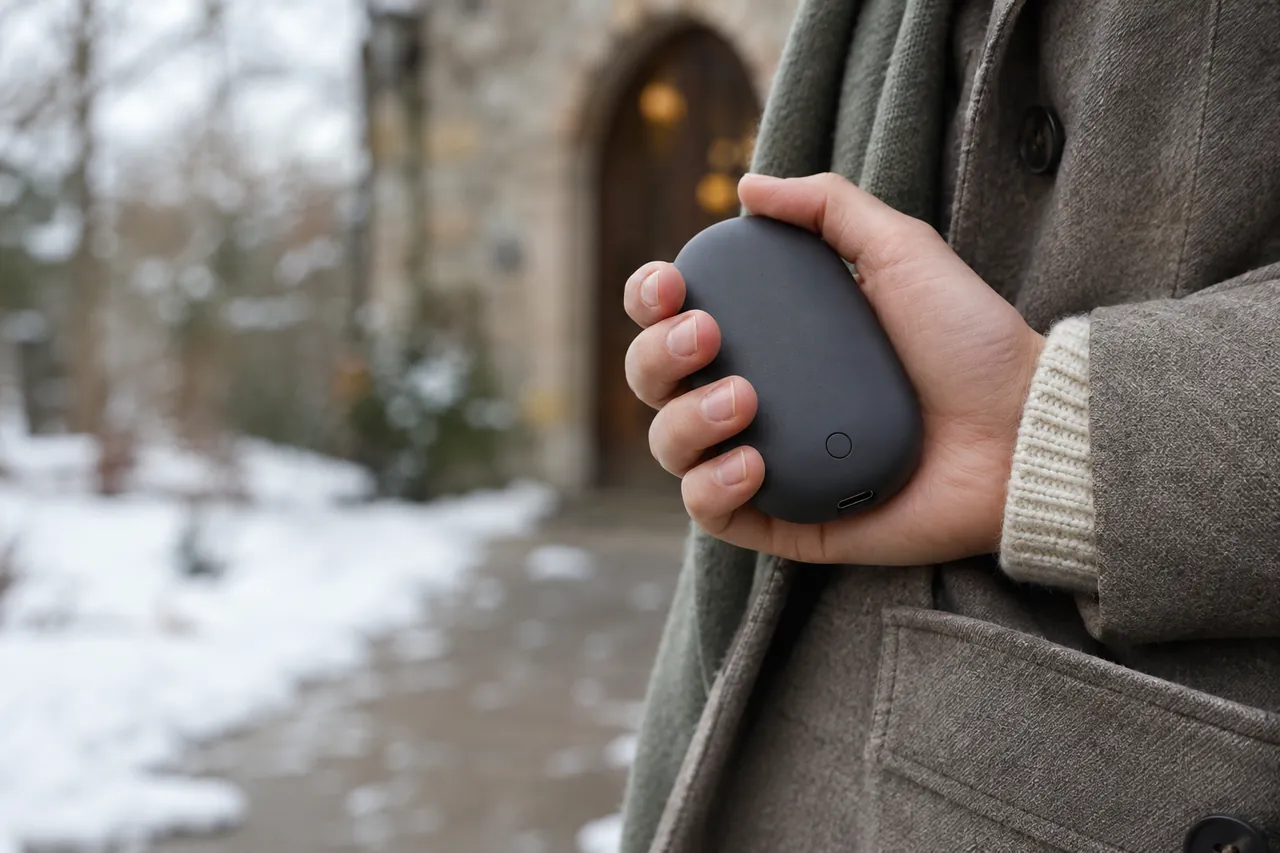
A square electric hand warmer may look small on a screen, but its thickness, edges and controls determine how it feels in your hand and how much space it takes in a coat pocket. Before comparing battery figures, picture the item where you will actually carry it. A flat face may be easy to hold; a thick body may still crowd a pocket shared with keys or a phone.
Introduction
The shape is a starting point rather than a complete specification. Square warmers can differ in their heating surfaces, settings, included accessories and charging directions. This guide uses one named listing to show how to read those details, then walks through the practical checks that apply when comparing another model.
Begin with all three dimensions
A product page normally gives height, width and depth. The first two describe the face you see; depth tells you how far the warmer projects from a flat surface. Cut a piece of paper to the listed face dimensions and hold it against your palm, then use the thickness measurement to judge whether it will leave enough room in your pocket. This simple comparison does not substitute for holding the product, but it makes the listing easier to visualize.
YOHO lists the ELAiCE e-Kairo Carré 24 at approximately 60 by 22 by 60 millimetres and about 64 grams. Its page describes a compact rechargeable warmer with a lanyard and LED light. Those figures and accessories belong to that listing; they do not describe every square warmer. The product’s face is roughly square, while its depth makes it a small object rather than a thin card.
When comparing another listing, use the same units and check whether its dimensions refer to the device or its packaging. Package size can help you plan a gift, but it does not tell you how the warmer will sit in a pocket. If a pair is sold together, check whether the stated measurements are for one piece or the joined set.
How does it sit in the hand?
Look closely at the corners and edges in product photos. A square outline can still have rounded corners or curved sides. Consider whether the edges rest comfortably against the palm and whether you can reach the switch without gripping the warmer tightly. A wide, flat surface and a narrow edge create different contact points, so the most comfortable orientation depends on the device and your hand.
Check which parts of the casing are intended to warm and follow the manufacturer’s contact directions. A visually symmetrical device does not necessarily heat both faces in the same way. Do not infer heating coverage from a picture, a material description or a different model’s review. Use a pouch or other protective layer when the instructions call for one, and move the unit if any area becomes uncomfortable.
Controls matter when your hands are cold or you are wearing gloves. Look for a button that is identifiable by touch and an indicator you can see. Read how to switch the unit off before placing it in a bag. A simple control is most useful when it remains accessible in the position where you intend to carry the device.
Test the pocket plan
Measure the opening and usable depth of your usual coat pocket, not just the garment’s overall size. A warmer that passes through the opening still needs room to sit without pressing against a seam or forcing the pocket open. Consider what else normally goes there. If keys or a phone share the space, a separate pouch or a different pocket may make the setup easier to manage.
A lanyard can make a small item easier to retrieve or keep track of. YOHO’s e-Kairo Carré 24 listing includes a wrist strap; check whether a strap is supplied with a different product instead of assuming that a visible attachment point comes with one. Arrange a strap so it does not catch on a door, bag or moving equipment.
Decide whether one warmer is enough or whether you want a separate device for each hand. A single square can move between pockets and requires only one item to keep track of. Two pieces provide another arrangement but also mean checking, charging and storing two devices. A magnetic pair is a separate design choice; a square outline alone does not imply magnetic attachment.
Use the product listing to compare the whole package
The e-Kairo Carré 24 package includes a charging cable, strap and instructions. Its built-in LED is a separate function worth considering if you want a little light as well as warmth. ELAiCE lists roughly 14 hours with the light alone and about three to four hours with heat and light together. The company lists a recharge time of about three hours, with duration affected by the power source and conditions. These figures describe the 2024 Carré, so keep the model name beside them when comparing another device.
YOHO describes approximately three to four hours of use for that model when placed in clothing. Treat this as the retailer’s stated figure under the conditions it describes, not a promise of the same duration in every environment. A second product may present a maximum, a range or figures for individual settings. Record the conditions beside each number rather than comparing the largest numbers alone.
Check return and warranty terms for the retailer and region where you buy. Keep the receipt, model name and instructions together. Availability and price can change, and a listing in one market does not establish local stock somewhere else. If a gift is intended, include the original operating directions so the recipient can identify the controls and charging method.
Charging and storage are model-specific
Use the cable and power arrangement specified in the instructions supplied with the warmer. A familiar connector shape does not establish compatibility with every power source, nor does an input port necessarily mean that the warmer can charge a phone. Check the product’s documented functions and use directions rather than borrowing a charging routine from another device.
Inspect the casing, cable and connector before use. Stop using or charging a device that is damaged, swollen, unusually hot or producing an unusual smell. Keep the components protected from moisture and physical damage according to the model’s instructions. After use, switch the warmer off and let it cool as directed before storing it with the appropriate cable.
A claimed storage charge percentage or replacement schedule for one battery should not automatically be applied to another model. Follow the instructions for the exact device. If the product develops a fault, retain its model information and check the relevant safety notices and disposal guidance rather than opening or attempting to repair the battery yourself.
Shape, packaging and product type
An electric hand warmer uses a rechargeable power source and has controls described by its manufacturer. A reusable gel pack can be a similar size or shape but has a different activation and reset process. A single-use air-activated packet has another set of placement and disposal instructions. Confirm the product type before deciding how it will fit into your routine.
The packaging dimensions can tell a different story from the device itself. For the e-Kairo Carré 24, ELAiCE lists the warmer at approximately 60 × 22 × 60 mm and its package at approximately 100 × 50 × 100 mm. Use the device measurements when checking a coat pocket; use the package measurements when planning a gift bag or storage space for an unopened item. The manufacturer identifies this 2024 version as EK-CR24, a useful detail to keep beside the dimensions when comparing listings or looking up its instructions.
ELAiCE’s own 2024 comparison shows why the shape and model name matter. The Carré measures approximately 60 × 60 × 22 mm and includes an LED light; the longer Oval measures approximately 67 × 110 × 16 mm and has a battery-charger function for compatible devices. ELAiCE does not list that phone-charging function for the Carré. The Oval is thinner but occupies more length in a pocket, while the square Carré has the shorter face. These are the manufacturer’s measurements and features for those named 2024 models.
Use warmth with attention to your skin
Follow the specific product’s directions for placement, settings and protective layers. Check the skin and stop if the warmer feels too hot or causes irritation. Avoid placing a hot surface directly against numb skin, where it can be harder to judge temperature. The OCOOPA article on Raynaud’s discusses keeping warm; a hand warmer provides external warmth and should not be treated as proof of a medical outcome.
If cold-related numbness, colour changes or pain are severe, worsening or interfering with daily life, seek appropriate medical care. A device that fits comfortably in a pocket is a convenience, not a substitute for an assessment of changing symptoms. Keep the model’s safety directions available to anyone using it.
The final decision comes back to your hand and your pocket. Compare the face dimensions and thickness, inspect the edges and switch, understand what comes in the package, and plan how you will charge and store the device. A square shape is useful when those details fit the way you intend to carry it.
Sources
OCOOPA, hand-warmer collection
OCOOPA, rechargeable hand warmer article