
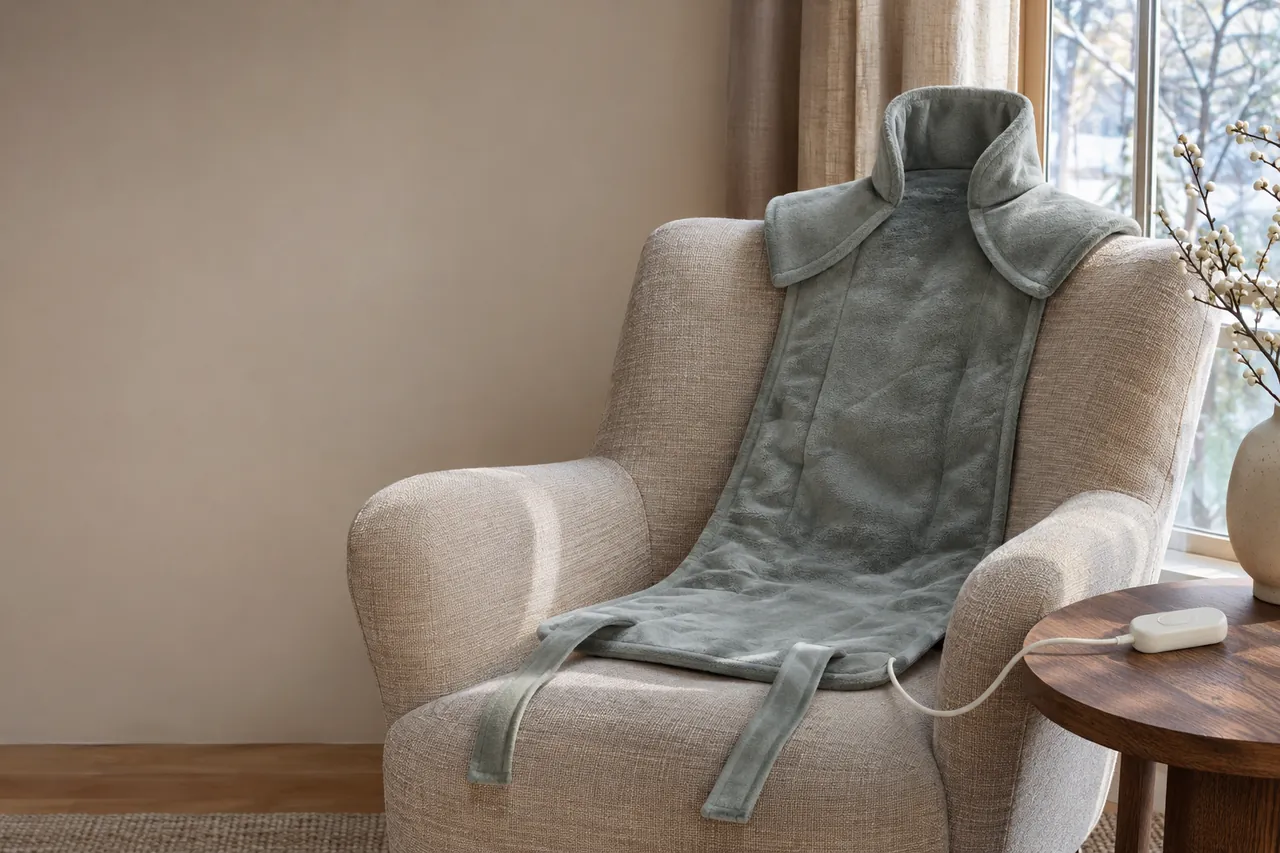
Heat can be one part of an everyday approach to a stiff lower back. The NHS lists a wrapped heat pack among options for stiffness or muscle spasms and encourages people with back pain to remain active where possible. A warming break can fit around that movement; it does not need to become the center of your day.
Introduction
A pad cannot identify the cause of back pain. What it can do is provide a place for a brief, awake warming break while you keep room for the activities that matter to you. Fit, placement and skin comfort deserve attention, as do any changes in symptoms.
What Surface Warmth Can and Cannot Do
Warmth can feel soothing when your lower back is stiff. The NHS lists a wrapped heat pack or hot-water bottle among options for easing joint stiffness or muscle spasms. Use the directions for the particular device you choose.
A heating pad does not diagnose the cause of back pain. If the warmth feels unpleasant, or your skin becomes irritated, stop using it.
Verywell Health describes hot packs used in physical therapy as one type of treatment in a clinical setting. Those packs are not the same as every electric pad sold for home use; do not transfer a clinic’s application schedule to your device.
Keep the next step simple: use a comfortable setting, end the session as directed, and return to an ordinary activity you can manage.
Make Room for Gentle Movement
A warming break need not mean staying still for the rest of the day.
NHS guidance encourages people with back pain to stay active and continue daily activities where possible, and advises against long periods in bed. Stop an exercise if it makes the pain worse.
Choose manageable activities that fit how you feel:
Awake warming: Use comfortable warmth according to the pad’s directions; stop if it feels uncomfortable.
Everyday activity: Consider a comfortable walk or ordinary household movement, without forcing an exercise that makes symptoms worse.
The order and length of these activities are personal choices, not a treatment schedule.
Gentle movement does not have to mean a demanding workout. Walking around the room, changing position or returning to a normal task at a comfortable pace can be a practical starting point. The NHS suggests activities such as walking and notes that stretches should be stopped if they worsen the pain. If discomfort is stopping your day-to-day activities or is not improving, seek appropriate medical advice.
Find a Comfortable Position While Awake
Use a localized heating pad while awake, follow its placement and timing directions, and turn it off before sleep.
A shut-off timer is a device feature, not a recommended amount of skin contact. Switch off and remove the pad before sleeping even when it has a timer.
Placement: Follow the model’s directions. Some flat pads must not be sat or lain on. A cushion designed to support the back is a different product and has its own instructions.
Skin checks: Follow the product’s directions for skin contact and any required cover. Check the skin during use and stop if the pad feels too hot or causes irritation.
Heat sensitivity: Reduced skin sensation or poor circulation can make heat injuries harder to notice. Do not use heat on numb skin. Product instructions may also prohibit or restrict use by people with diabetes, circulation problems or other conditions affecting sensation; follow the warnings for the specific device.
Do not put an electric pad, cable or controller in a microwave. Only heat a pack in a microwave when the product is explicitly designed and labelled for that method.
Choose Coverage for Your Lower Back
Start by measuring the area you would like to cover. Compare its height and width with the product dimensions and photographs. A pad’s overall size and its heated area are not necessarily the same measurement.
Flat pad or wearable wrap?
Lower-back products come in more than one shape. A flat pad and a wearable wrap may cover different areas and stay in place differently:
Flat pads: Compare the pad’s size with your target area and read its placement directions. Check its directions before deciding how to keep it in position.
Strapped wraps: An adjustable waist fastening may help position the pad. Check the stated waist range and where the heated panel sits when the strap is closed.
When heated bedding serves a different purpose
Bedsure’s comparison distinguishes a localized heating pad from heated bedding. A blanket lies over the body, while a heated mattress pad is designed for placement under a fitted sheet; a localized pad is used on a smaller area according to its own instructions. Do not treat those placements as interchangeable. Bedsure also advises against layering an operating heating pad over an operating electric blanket. Check the exact product’s instructions for placement, use and cleaning.
Controls and care
Look at the exact model’s description for settings, whether any cover or controller can be removed, and its cleaning instructions. A detachable controller does not by itself mean the entire pad is machine washable.
Compare the details that affect fit
For a wrap, measure around the area where the strap will fasten and compare that measurement with the stated range. Then check the panel’s position in product photographs. A belt that fastens around the waist may still place its warming area above or below the spot you have in mind. If the product gives both overall measurements and a heated-area diagram, use both. Follow its directions for placement, skin contact and clothing; instructions vary between models.
Instead of assuming that a larger pad will sit comfortably on a curved lower back, consider where its edges and controller will fall in your intended position. Some pads must not be sat on or crushed: Sunbeam includes that warning for its heating pads. Follow the directions for the model you choose, and keep the controller within easy reach without pulling the cord.
The number of settings is only one part of the decision. Look for controls you can read and operate comfortably, and make sure the cord can reach the intended outlet without stretching across a walkway. For a rechargeable model, check what is included, where the battery sits and what the listing says about charging. A seller’s battery runtime is not a direction to keep a pad on for that whole period.
Cleaning and storage matter too
Before buying, look at the care instructions for the actual pad and its components. Some covers can be removed; others have a different cleaning method. Disconnect power before cleaning, keep the controller and other electrical parts away from water, and allow cleaned parts to dry fully before reconnecting them. Use only the cleaning method specified for the model.
After use, switch the pad off and let it cool before storing it as directed. Keep the instructions where you can find them again. If the fabric, cord or controls show damage, stop using the pad rather than trying to operate a damaged appliance. These details make it easier to compare two otherwise similar products without relying on broad promises about comfort.
When to Get Urgent Help
Back pain has many possible causes. The symptoms accompanying it help determine when urgent assessment is needed.
NHS guidance says to call emergency services or go to an emergency department if back pain occurs alongside any of the following:
Bladder or Bowel Changes: Sudden loss of bowel or bladder control, difficulty urinating, or sudden inability to pass urine.
Loss of feeling around the genitals or anus. The NHS also lists changes in genital sensation during sex, inability to get or keep an erection, or inability to orgasm.
Pain, tingling, weakness or numbness in both legs.
The NHS also lists chest pain or back pain beginning after a serious accident as reasons for emergency care. Do not drive yourself to emergency care; ask someone to take you or call emergency services. It recommends urgent medical advice for severe pain that starts suddenly or worsens quickly, or back pain with feeling hot, cold, shivery or generally unwell. Back pain that interrupts daily activities, gets worse at night, does not improve with rest or has not improved after a few weeks should also be assessed.
Choose a pad that fits the area, follow its directions, and use warmth as a comfort option while paying attention to changes in symptoms.
References
Verywell Health — Hot Packs Used in Physical Therapy https://www.verywellhealth.com/hot-packs-physical-therapy-modalities-2696130
Bedsure — Heating Pad vs Electric Blanket vs Heated Mattress Pad – Bedsure https://bedsurehome.com/blogs/bedsure/heated-pad-vs-electric-blanket-comparison
National Health Service (NHS) — Back pain - NHS https://www.nhs.uk/conditions/back-pain/