
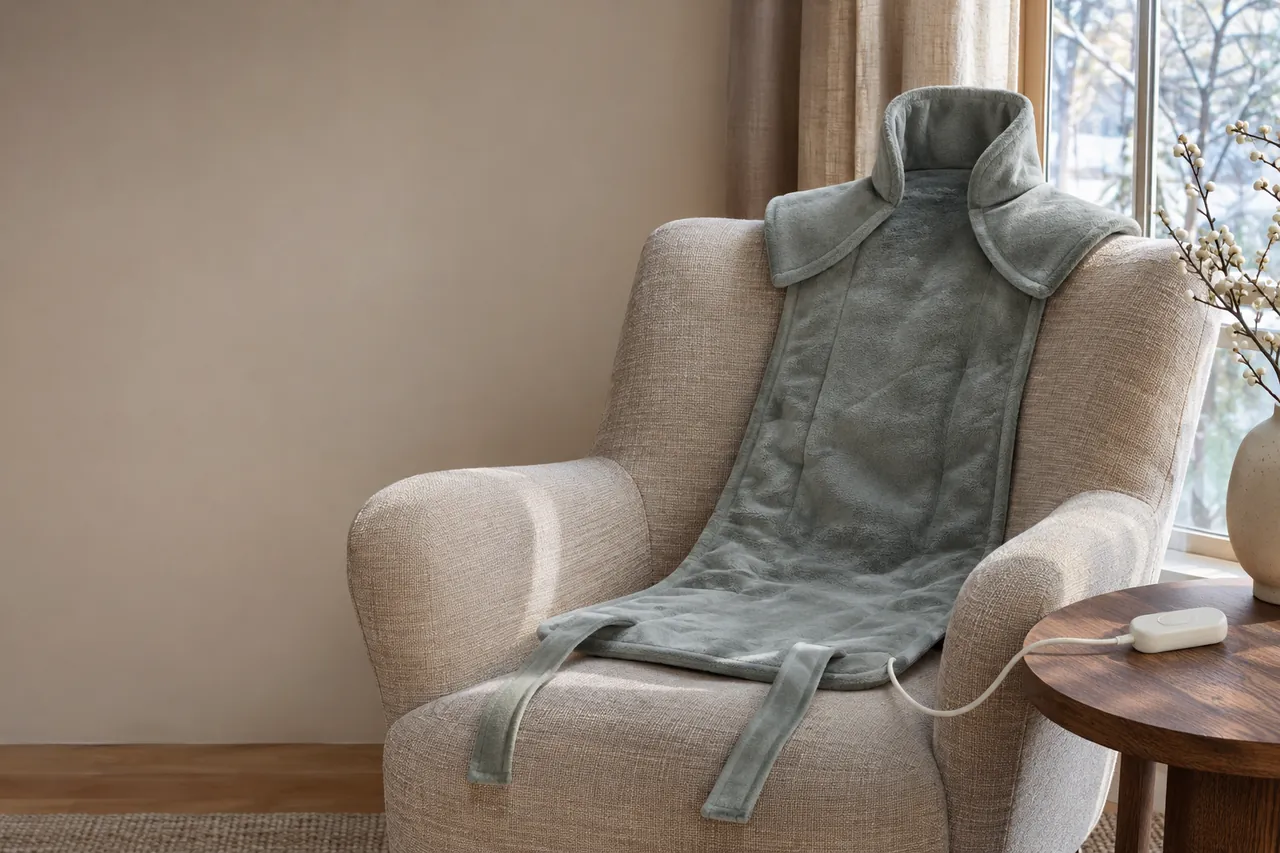
What does a study of infrared heat tell you when shopping for a lower-back pad? The answer starts with the people studied, the device they used, and whether the study included a comparison group. Those details are more useful than treating every product description as a clinical result.
Introduction
After examining one published study, this guide explains the terminology, looks at a named product and considers fit, skin monitoring and instructions for use.
What One Published Study Actually Examined
Analyzing the 2015 PubMed Far-Infrared Study
A 2015 study in the journal Work, indexed by PubMed, examined a far-infrared device in office workers with persistent lower-back pain. Its design and findings provide a useful starting point for reading product research:
Small Cohort Study Design: The 2015 study followed 50 office workers whose lower-back pain had lasted at least six months. They were instructed to use a Thermotex TTS Platinum pad at work for at least 45 minutes per workday over four weeks. That schedule describes the study, not a universal instruction for other devices.
Study design: The abstract describes a cohort study and does not report a randomized control group.
Device-Specific Findings: The researchers reported changes in nine of ten SF-36 health-status subscales, including physical and mental measures, with pain scores improving over the four weeks. The abstract reports no adverse events. The abstract does not describe a comparison group, so these observations alone cannot establish how much of the change was caused by the pad.
Avoiding Unfounded Generalizations
Crucially, consumers must avoid treating the findings of a small 50-person cohort study as universal proof for every commercial infrared heating pad, carbon fiber wrap, or graphene pad on the market. While the 2015 PubMed study observed positive comfort trends among its specific participant group, a small cohort study does not establish universal clinical efficacy, guaranteed medical outcomes, or proof that one specific heating material outperforms all competing appliances.
Buyers should view far-infrared technology as a comforting, passive thermal option that supports muscle relaxation, rather than a proven medical cure for structural spinal disorders.
Far Infrared, Near Infrared and Red Light
When evaluating an infrared heating pad lower back wrap, the first technical step is understanding what "infrared" means in consumer warming products. Personal heating appliances utilize specific regions of the electromagnetic spectrum, and distinguishing far infrared from near infrared or visible light helps clarify how these devices operate.
Far Infrared (FIR) Radiant Thermal Warmth
Far infrared radiant heat occupies longer thermal wavelengths in the electromagnetic spectrum. Far-infrared heating pads are marketed as devices that produce warmth using infrared radiation. Their construction, controls and fit vary by model; the infrared label alone does not establish a specific tissue effect or level of comfort.
Near Infrared (NIR) and Visible Red Light
Near infrared has shorter wavelengths than far infrared, while red light is visible. Devices can use lamps, LEDs or other emitters for different purposes. Their output and heating effects depend on the device and how it is used.
When shopping for an infrared lower back heat wrap, consumers should recognize that heating pads belong to the thermal warming category. Compare the actual device description and instructions before treating a heating pad and a light-therapy device as interchangeable.
A Product Example: Thermotex Platinum
To understand how far-infrared technology is integrated into a commercial appliance, examine published product documentation for a representative model: the Thermotex Platinum Far Infrared Heating Pad.
Published product parameters for the Thermotex Platinum model detail several distinct physical and operational features:
Three Heating Inserts: The manufacturer lists three heating inserts and describes the pad as flexible for use on several areas, including the back.
Targeted Surface Coverage: The manufacturer describes a flexible multi-insert pad for targeted coverage. Fit depends on the person and placement.
Manufacturer Product Descriptions: The manufacturer describes the pad as delivering far-infrared radiant warmth that penetrates surface tissue to ease muscle tightness and promote relaxation.
Care and placement: The Thermotex operator manual says to use the outer cover, check the skin frequently, and avoid sitting on or crushing the pad. It also describes resting the Platinum against the back while seated upright. Remove electrical components before washing the cover and let it dry fully before use. These directions are specific to the Thermotex system.
Crucial Safety Rule: Follow Model-Specific Instructions
Placement instructions differ between models. The Thermotex manual permits positioning the Platinum against the back while seated upright, but warns against sitting on or crushing the device. Keep the cover in place and check the skin frequently. Thermotex says its products should not be used during pregnancy or by people with hemophilia or severe adrenal suppression. For another pad, follow that model's own directions for placement, pressure and duration.
How to Read Heating-Element Descriptions
When comparing an infrared lower back heat wrap against traditional electric heating pads, consumers encounter various terms describing internal heating element construction. Understanding how heating elements are built helps clarify product design choices.
Comparing Heating Element Materials
Product descriptions may refer to different materials, including:
Carbon Fiber Elements: Some pads describe carbon fibre elements as part of their heating construction.
Graphene Heating Films: Some product descriptions use the term graphene for a heating material or film.
Traditional Copper Wiring: Some conventional electric pads use wired heating elements.
Hardware Descriptions vs. Clinical Advantages
It is essential to understand that carbon fiber, graphene, and copper wiring are construction descriptions; the design and measured performance depend on the individual product. They do NOT represent proven comparative clinical advantages. A graphene or carbon fiber heating pad does not possess clinical proof of superior therapeutic outcomes compared to a well-designed copper-wire pad.
For a useful comparison, look at the pad’s size, power source, controls, care instructions and fit. Those details tell you more about how a particular pad may fit your routine than the name of its heating material alone.
Use and Skin Safety
Operating an electric or infrared warming pad safely in your home requires practicing active skin monitoring, respecting electrical boundaries, and adhering to essential safety rules.
Increased Burn Risk from Reduced Skin Sensation
As detailed in consumer safety guidance from Comfytemp regarding heating pad burn risks, individuals with reduced skin sensation—such as seniors, individuals with diabetes, peripheral neuropathy, or impaired blood circulation—face significantly higher risks of thermal skin burns. Because diminished nerve sensitivity prevents individuals from detecting rising skin temperatures or thermal discomfort, low-level heat can cause gradual tissue damage without warning.
Preventing Toasted Skin Syndrome (Erythema Ab Igne)
A primary dermatological risk associated with repeated, prolonged heat exposure is Toasted Skin Syndrome, medically known as Erythema Ab Igne. As documented by dermatological experts at the Cleveland Clinic, toasted skin syndrome is a skin condition caused by repeated, long-term exposure to low-level heat or infrared radiation that is warm enough to alter skin tissue over time but not hot enough to cause an immediate thermal burn.
Repeated exposure over weeks or months can damage small blood vessels and pigment in the skin, producing a patchy or net-like discolored rash. To protect your skin, avoid repeated prolonged exposure, use a barrier as directed, and inspect the area regularly. Stop using the heat source if skin changes appear.
Essential Operational Safety Rules
Use While Awake Only: Never use any electric heating pad or infrared wrap while sleeping or napping. Reduced sensory awareness during sleep prevents you from detecting thermal discomfort.
Active Skin Monitoring: Inspect your skin underneath the pad frequently during every session. If the pad feels uncomfortably hot, or if skin shows redness or irritation, stop using the device immediately and turn off the power supply.
Do Not Generalize Operating Instructions: Never generalize timer settings, wearable durations, or moist-heat instructions across different heating products. Always follow the specific operating instructions printed in your individual product's user manual.
STRICT SAFETY WARNING: NEVER MICROWAVE ELECTRIC APPLIANCES. Never place an electric heating pad, infrared pad, power cord, or battery pack inside a microwave oven. Electric warming products contain internal wiring and circuitry that can spark or cause a fire if microwaved. Microwaving is strictly restricted to non-electric gel or organic grain packs explicitly labeled as microwavable.
By understanding far-infrared technology, evaluating research objectively, choosing appropriate pad coverage, and practicing active skin monitoring, consumers can enjoy safe, comforting lower back warmth.
Warmth and Movement
Understanding how surface warmth interacts with lower back tissue provides helpful context for managing everyday muscle tightness during work and rest breaks.
Vasodilation and Muscle Relaxation
As detailed in clinical resources from Spine-health, applying gentle surface warmth to skin prompts localized blood vessels to expand (vasodilation). This expansion increases localized blood circulation across the warmed target area, delivering oxygen and nutrients to tight paraspinal muscle fibers while helping carry away metabolic waste products. Increased blood flow relaxes muscle tightness caused by physical exertion, poor sitting posture, or daily stress.
Soothing Involuntary Spasms and Trigger Points
Back pain can have many causes. Heat may feel soothing, but the feeling alone does not identify the cause of discomfort.
Physical Therapy Application Principles
Educational literature from Spine-health regarding heat therapy application outlines key principles for managing lower back comfort:
Discrete Application Sessions: Follow the specific product’s stated duration and skin-monitoring directions.
Passive Warmup for Active Movement: In physical therapy settings, thermal application is utilized as a passive preparatory modality to relax tight muscle tissue before gentle stretching and active exercises.
Clear Scope Boundaries: Thermal warmth provides temporary muscle relaxation, but it does not cure underlying lumbar disc herniations, relieve sciatic nerve compression, or repair structural spinal joints.
For individuals seeking an ergonomic targeted lumbar and back heating wrap to integrate into their daily rest routine, selecting a warming device equipped with adjustable heat controls and automated safety shut-off features helps match the device to the intended setting and use.
References
PubMed — Far infrared wavelength treatment for low back pain: Evaluation of a non-invasive device
https://pubmed.ncbi.nlm.nih.gov/26409395/
Thermotex — Thermotex Platinum Far Infrared Heating Pad
https://www.thermotex.com/products/thermotex-platinum-far-infrared-heating-pad-all-purpose
Spine-health — Benefits of Heat Therapy for Lower Back Pain
Spine-health — How to Apply Heat Therapy for Pain Relief
https://www.spine-health.com/treatment/heat-therapy-cold-therapy/how-apply-heat-therapy
Comfytemp — Heating Pad Safety Burn: Who's Most at Risk at Home
https://comfytemp.com/blogs/news/heating-pad-safety-burn-risk
Comfytemp — Comfytemp Targeted Heating Pads and Wraps Collection
https://comfytemp.com/collections/heating-pad
Cleveland Clinic — What Is Toasted Skin Syndrome?
https://my.clevelandclinic.org/health/diseases/toasted-skin-syndrome