
A rechargeable lower back heat pad can free you from a wall outlet, but the number on the battery label tells only part of the story. Fit, charging habits and the difference between runtime and skin exposure all matter when choosing a wrap.
Introduction
Begin with the published specifications for the exact model. Then consider whether a cordless belt or a plug-in pad matches where you plan to use it, and how the product will be cared for between uses.
What advertised battery times mean
To understand how battery specifications are documented, examine published product listing details for representative commercial models:
Pure Enrichment PureRelief Cordless Wrap: For model PECLPBK-MG, Pure Enrichment’s product page highlights two hours of cordless use and lists a 60–140 minute runtime range. Its user manual breaks the range down by heat setting: approximately 140 minutes on warm, 110 on low, 80 on medium and 60 on high. The manual also describes an automatic shutoff after two hours of continuous operation.
Comfytemp Cordless Heating Pad: Comfytemp lists its K9242080 belly-and-back pad with separate front and back heating areas, three heat levels and selectable 15-, 30- or 45-minute automatic shutoff. Its product page states battery durations of six hours on low and two hours on high. Those are battery figures for that model; the selected timer controls an individual session.
Prospective buyers should view these published duration figures as the manufacturer's own stated operating ranges under specific testing conditions, rather than guaranteed figures for every scenario. Compare the figures for the exact product and settings described rather than treating one model’s runtime as a guarantee for another.
Crucial Safety Rule: Battery Runtime vs. Wear Duration
Importantly, buyers must recognize that a manufacturer's battery runtime statement—whether 60 minutes, 2 hours, or longer—is strictly an indicator of electrical battery discharge capacity. A battery runtime figure is NOT a recommendation for continuous thermal exposure against human skin.
Applying continuous thermal heat to the same skin area for extended periods increases the risk of thermal skin burns and dermatological irritation. Users should use rechargeable heat wraps for short, discrete sessions, allowing skin to cool down between applications regardless of remaining battery charge.
Selecting an ergonomic heating pad for back tightness involves evaluating physical waist fit, securing mechanisms, and daily charging routines to ensure long-term comfort and convenience.
Waist Sizing and Hands-Free Fastening
A wrap should cover the area you want without feeling restrictive. Pure Enrichment lists the pad size of its cordless PECLPBK-MG model as 19.69 by 9.45 inches. Its manual says to secure the fasteners without tightening them too much and not to sit on or against the wrap, crush it or make sharp folds. Compare the pad dimensions and fastening method with your fit needs and follow the model’s placement instructions.
Planning Charging Routines and Care
Integrating a rechargeable wrap into your day requires establishing simple power management habits:
Charging Discipline: Recharge your battery pack fully after use so the wrap is ready for your next session. Always use charging cables supplied or approved by the product manufacturer.
Disconnecting Batteries Before Care: Always disconnect and remove the rechargeable battery pack from its storage pocket before cleaning the garment.
Fabric Maintenance: Review the product manual care instructions for your specific wrap. Follow the cleaning instructions for the exact model; washing methods differ between products. Never submerge active battery units or non-detachable wiring in water.
For individuals seeking a versatile targeted lumbar and back heating wrap to support their active daily lifestyle, choosing a rechargeable model with adjustable waist straps, clear heat indicators, and removable battery components ensures reliable, comfortable warmth.
When a cordless wrap fits your day
A rechargeable warming wrap—such as the PureRelief® Cordless Lumbar and Abdominal Heating Wrap from Pure Enrichment—utilizes a removable, rechargeable battery pack stored inside a built-in fabric storage pocket. This wireless setup delivers complete physical mobility around your home or workspace. You can wear the belt while standing at a kitchen counter, pacing during phone calls, or performing light chores without being restricted by proximity to an electrical wall socket. Hands-free fastening straps hold the heating surface securely against your lower back curve, helping keep the warming surface in place.
When a plug-in pad makes sense
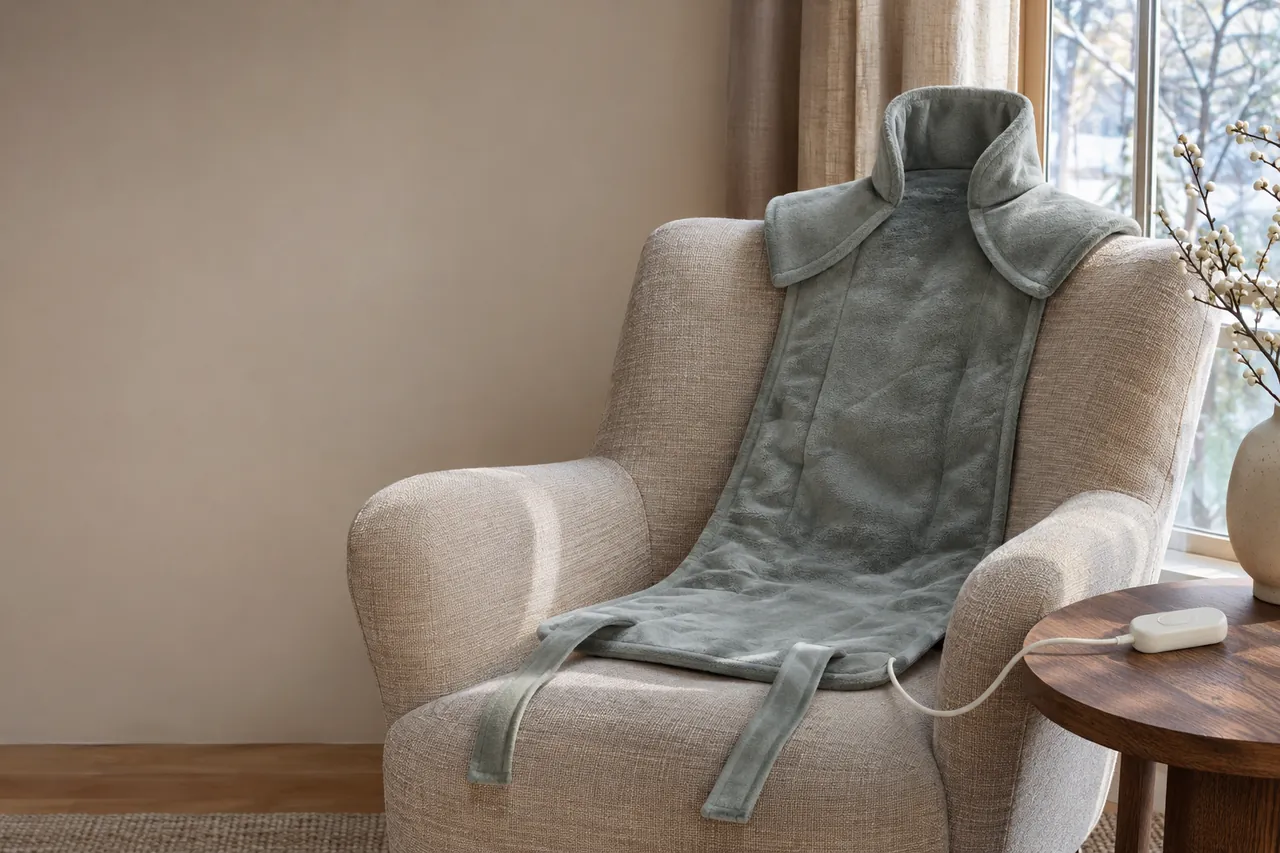
By contrast, corded electric heating pads—such as the PureRelief Lumbar & Abdominal Heating Pad (Gray, Model PELUMBAR-G)—depend on a continuous AC electrical connection through a power cord plugged into a wall outlet. It is essential to recognize that this gray PureRelief model is a corded appliance, not a rechargeable item. Mains-powered corded pads do not require battery recharging, making them suitable for stationary sessions while seated at a fixed desk or lounging on a couch. However, corded pads restrict physical movement to the radius of the electrical cord and require remaining near an outlet.
Choose for where you will use it
Matching power setups to your daily activities clarifies which design to choose:
Active Household & Office Mobility: If you need to move frequently between rooms, work at different locations, or travel, a rechargeable lower back heating pad supplies untethered warmth wherever you go.
Stationary Desk & Armchair Rest: If your warming sessions take place exclusively while seated at a fixed computer workstation or in a living room recliner, a corded pad provides continuous warmth without battery charging routines.
Soothing Involuntary Spasms and Trigger Points
Cleveland Clinic’s guides explain two terms that may appear in discussions of back discomfort:
Involuntary Paraspinal Spasms: Cleveland Clinic describes a back spasm as an involuntary muscle contraction and discusses heat as one way to ease discomfort. A warming wrap can provide surface warmth, but its battery specification says nothing about the cause of a particular person’s back pain.
Myofascial Trigger Points: The clinic also describes muscle knots as tight, sensitive areas and includes warmth among its suggestions for easing them. A wrap’s fit and controls are practical considerations, rather than evidence of a diagnosis.
Physical Therapy Hot Packs vs. Home Warming
Educational literature from Verywell Health regarding physical therapy hot packs describes how moist thermal packs are utilized in clinical rehabilitation settings. Physical therapists apply thermal compresses for short intervals to soothe tight muscle tissue, improve tissue extensibility, and prepare joints for active exercise. Note that clinical hot packs refer to moist thermal compresses administered in physical therapy clinics, not consumer electric heating pads.
Bedsure’s comparison also distinguishes a smaller pad for a particular area from an electric blanket that covers more of the bed. Each type has its own instructions; the choice of a blanket does not make overnight operation appropriate for every model.
Skin safety with a rechargeable wrap
A charged battery can last longer than a comfortable warming session. Use the wrap while awake, choose a comfortable setting and check your skin in line with the product’s directions.
Operating an electric or battery-powered warming appliance safely requires practicing active skin monitoring and adhering to essential dermatological safety protocols.
Understanding Toasted Skin Syndrome (Erythema Ab Igne)
A primary dermatological risk associated with repeated, prolonged heat exposure is Toasted Skin Syndrome, medically known as Erythema Ab Igne. As documented by dermatological experts at the Cleveland Clinic, toasted skin syndrome is a skin condition caused by repeated, long-term exposure to low-level heat or infrared radiation that is warm enough to alter skin tissue over time but not hot enough to cause an immediate thermal burn.
When a heating pad or thermal wrap is applied to the same skin area for extended periods day after day, low-level heat damages small blood vessels and elastic fibers in the skin. This results in a characteristic net-like, reticulated pattern of hyperpigmentation, skin redness, and brown discoloration across the warmed region. To protect your skin against toasted skin syndrome, avoid continuous heat exposure, limit warming sessions to short, discrete periods, inspect your skin regularly, and allow skin to cool naturally between sessions.
Keep Active Heat Off While Sleeping
Never wear or use any active electric heating pad, battery-powered wrap, or thermal appliance while sleeping or napping. Falling asleep with an active heat source significantly reduces your sensory awareness of rising skin temperatures, dramatically increasing the risk of thermal skin burns and skin damage. Always turn off, disconnect, and remove any heating device before lying down to sleep or nap.
Keep Electric Heating Products Out of the Microwave
Never place any electric heating pad, battery-powered wrap, USB charging cable, or electronic component inside a microwave oven. Electric warming products contain internal metallic wiring, battery cells, and electronic circuitry that can spark, cause a fire, and damage the appliance if microwaved. Microwaving is strictly restricted to non-electric organic grain or gel packs explicitly labeled as microwavable.
Active Skin Monitoring Protocols
Check your skin frequently and stop use if the wrap feels too hot or irritates your skin. For the PECLPBK-MG, the manual warns not to sit on or against the wrap, crush it, or make sharp folds. It also says not to use it on an infant or animal, on skin insensitive to touch or heat, or while sleeping. Burns can occur at any setting, so check the skin even on a lower setting and follow the complete instructions for your particular model.
References
Pure Enrichment — PureRelief® Cordless Lumbar and Abdominal Heating Wrap
https://pureenrichment.com/products/purerelief-cordless-lumbar-and-abdominal-heating-wrap
Pure Enrichment — PureRelief® Lumbar & Abdominal Heating Pad (Gray, Model PELUMBAR-G)
https://pureenrichment.com/products/purerelief-lumbar-abdominal-heating-pad-gray
Comfytemp — Portable Heating Pad for Period Cramps & Back Pain
https://comfytemp.com/collections/abdominal/products/comfytemp-portable-belly-and-back-heating-pad
Bedsure — Heating Pad vs Electric Blanket vs Heated Mattress Pad
https://bedsurehome.com/blogs/bedsure/heated-pad-vs-electric-blanket-comparison
Sunbeam — Pain Relief with Heat Therapy
https://www.sunbeam.com/pain-relief-education.html
Renpho — RENPHO Neck and Back Massagers with Soothing Heat
https://renpho.com/collections/neck-back-massagers
Cleveland Clinic — Back Spasms: Causes, Treatment & What Is It
https://my.clevelandclinic.org/health/diseases/22881-back-spasms
Cleveland Clinic — What Is Toasted Skin Syndrome (Erythema Ab Igne)?
https://my.clevelandclinic.org/health/diseases/toasted-skin-syndrome
Cleveland Clinic — How To Get Rid of Muscle Knots
https://health.clevelandclinic.org/what-are-muscle-knots-and-how-do-i-get-rid-of-them
Verywell Health — Hot Packs Used in Physical Therapy
https://www.verywellhealth.com/hot-packs-physical-therapy-modalities-2696130