
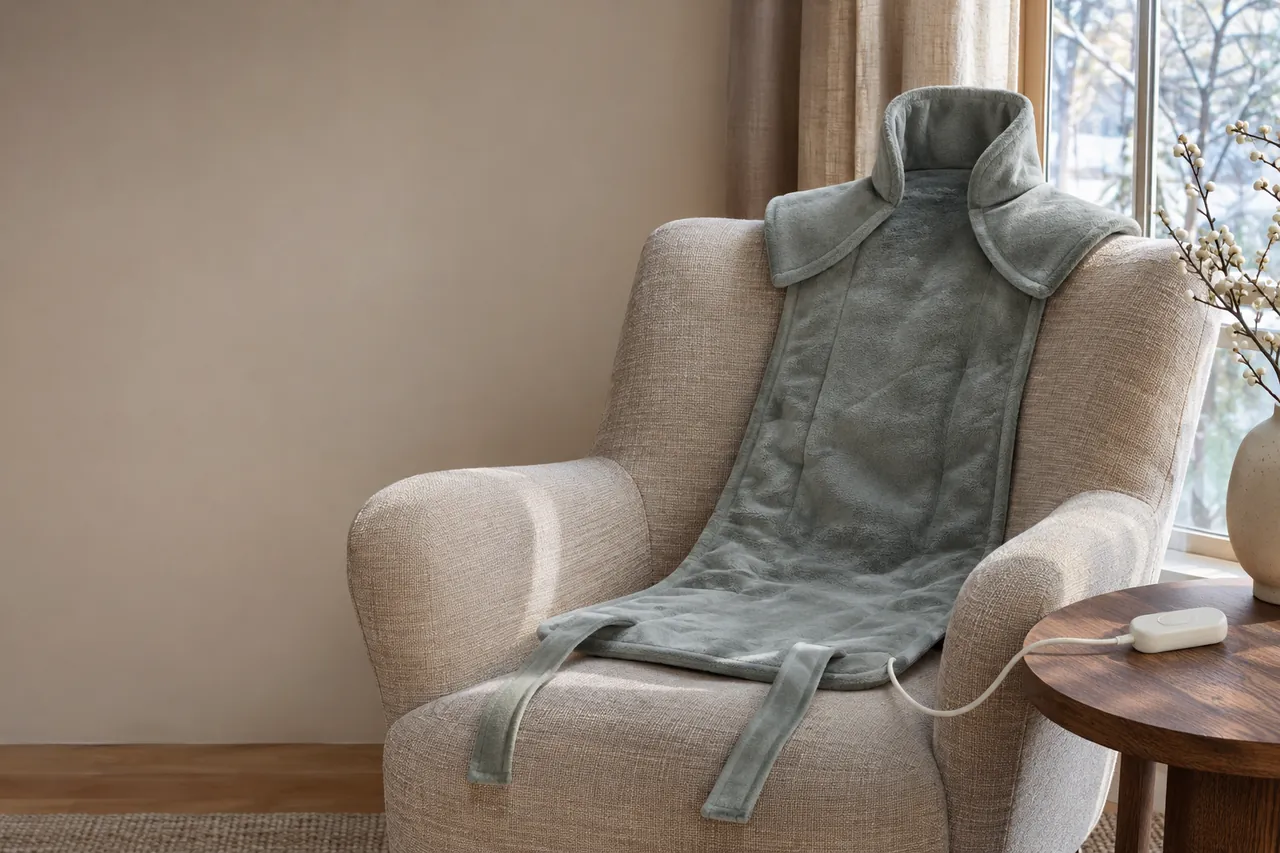
Warmth, vibration and kneading are three different sensations. A lower back heating pad and massager may combine some of them, but a device with more modes is not automatically the one you will enjoy using. Start by considering the type of discomfort, whether you want movement as well as heat, and how the device is meant to sit against your body.
Introduction
For a stiff back, warmth may offer temporary comfort. A spasm or a tender spot can have several causes, however, so the sensation alone does not establish a diagnosis. This guide begins with the health context and skin precautions, then compares the available formats and the details that affect fit and care.
When people use heat or massage
Understanding how surface warmth and mechanical vibration interact with human tissue provides helpful context for managing daily physical discomfort.
Physiological Effects of Surface Heat
The selected clinical sources describe different situations in which warmth or massage may be used:
Warmth and Comfort: Gentle warmth can be comforting for stiffness. Keep the temperature comfortable and follow the device instructions.
Back Spasms: Cleveland Clinic describes a spasm as an involuntary muscle contraction and discusses heat and massage among possible measures. Spasms can have different causes.
Muscle Knots: Cleveland Clinic describes myofascial trigger points as tight areas of muscle and discusses warmth, stretching and massage as possible approaches. A painful area does not establish its cause.
Understanding Thermal Care for Menstrual Cramps
Verywell Health discusses applying warmth to the abdomen or lower back for menstrual cramps. That article addresses period-related discomfort; its discussion should be understood in that context.
Different causes of back pain call for different approaches. Heat or massage does not repair a disc or decompress a nerve, and symptoms alone do not establish a diagnosis.
Dermatological Precautions and Emergency Red Flag Guidance
Check your skin during use and pay attention to symptoms that need medical assessment.
Dermatological Safety and Toasted Skin Syndrome
As documented by dermatological experts at the Cleveland Clinic, repeated, long-term exposure to low-level heat can cause Toasted Skin Syndrome, medically known as Erythema Ab Igne. This condition results in a characteristic net-like pattern of hyperpigmentation and brown skin discoloration across the warmed area.
To protect your skin during thermal sessions:
Protective Layer: Follow the device directions about whether a layer is needed or permitted.
Active Skin Monitoring: Inspect your skin underneath the pad frequently during every session. If the pad feels uncomfortably hot, or if skin shows unusual redness or irritation, stop using the device immediately and turn off the power supply.
Reduced Sensation: Reduced skin sensation can make it harder to notice excessive heat. Follow the device warnings for conditions that affect sensation.
Staying Active and Emergency Warning Signs (NHS Guidance)
The NHS recommends staying active and continuing ordinary activities as possible, while avoiding prolonged bed rest. Choose manageable movement and stop an exercise if it makes the pain worse.
However, certain symptoms accompanying back pain require immediate emergency evaluation. The NHS advises seeking immediate emergency medical assessment (going to an emergency room / A&E or calling emergency services) if your back pain occurs alongside any of the following urgent red flag symptoms:
Bladder or Bowel Changes: Sudden loss of bowel or bladder control, difficulty urinating, or sudden inability to pass urine.
Saddle Area Numbness: Sudden numbness, loss of feeling, or a pins-and-needles sensation around your genitals, buttocks, or back passage (anus).
Symptoms in Both Legs: Pain, tingling, weakness, or numbness in both legs.
These symptoms require emergency assessment rather than home care alone. NHS guidance also calls for emergency help when back pain occurs with chest pain, changes in sexual sensation or function, or follows a serious accident. Do not drive yourself to emergency care; ask someone to take you or call emergency services. Sudden severe pain, pain that is worsening quickly, or back pain with feeling hot, cold, shivery or generally unwell warrants urgent medical advice.
Choose a device that fits your routine, use it according to its instructions and pay attention to comfort and skin changes.
Appliance Form Factors: Comparing Heat-Only Pads, Vibration Wraps, and Shiatsu Cushions
Start with the sensation you want. A heat-only pad stays still, a vibrating wrap adds a pulsing movement, and a shiatsu cushion uses moving nodes. Their shapes and placement rules differ, too, so picture where you will use the device before comparing settings.
1. Passive Heat-Only Electric Pads
A heat-only pad provides warmth without a massage function. Designs include flexible flat pads and wearable wraps. Look for a shape that covers the area you want to warm and controls you can reach easily.
2. Vibration heating wraps
Vibrating heat wraps combine warmth with a pulsing sensation. Their flexible shape differs from the firmer moving nodes found in some massage cushions.
As a primary commercial example, the Comfytemp Cordless Heating Pad with Vibration Massage Relief illustrates vibration design parameters:
Cordless Portable Design: The Comfytemp model uses a rechargeable power source, so it can operate without a wall cord during use.
Vibration and Thermal Settings: The K9224 product page lists three heat levels and three vibration modes. It says heat and vibration can run separately or together, so a buyer can choose warmth without vibration as well as the combined setting.
Adjustable Waist Strap: The K9224130 uses adjustable dual elastic straps and an extension for a wider fit. The belt’s reach and the heated area are different measurements.
Integrated Safety Timer: Features an automated 30-minute automatic shut-off function for electrical safety.
3. Motorized Shiatsu Kneading Cushions
Some shiatsu-style cushions use rotating nodes to create a kneading sensation. Their shape and positioning instructions differ from those of a flat pad, and the intensity may feel different from vibration.
Independent Control Capabilities
For the Comfytemp K9224 wrap, heat-only, vibration-only and combined modes give you different choices. Its product page lists up to 5.5 hours on low settings and around 1.5 hours with high heat and massage, while the device shuts off automatically after 30 minutes. Battery life describes the charge across use; it does not set a recommended continuous session length. Follow the device instructions, stay awake and stop if your skin or muscles feel uncomfortable.
Practical Ergonomics: Fit, Power Options, Maintenance, and Positioning Rules
Selecting and operating a lower back heating pad and massager safely requires evaluating physical fit, power architectures, cleaning routines, and strict posture guidelines before use.
1. Waist Sizing and Strap Ergonomics
Measure around the area where the strap will fasten and compare it with the adjustment range for the chosen wrap. Check heated-panel dimensions separately from belt reach: the whole belt is not necessarily heated. The wrap should feel comfortable, and you should be able to reach the controls and remove it easily. Check the listing for an included extension strap, controller and power source, and follow the actual model’s placement and clothing instructions. Before settling at a desk, consider where the controller will sit and keep any cord clear of the chair and walking paths.
2. Power Architectures: Corded AC vs. Rechargeable Battery
Match the appliance's power setup to your daily mobility needs:
Mains-Powered Corded Electric Pads: Connect directly to an AC electrical wall outlet via a power cord. A corded model does not need battery recharging, but its settings and any automatic shutoff still determine operation. Position it as directed and keep its cable clear of moving furniture and walking paths.
Cordless Wraps: Rechargeable designs avoid a wall cord during use. Check which power source and charging accessories are included for the specific product.
3. Positioning Rules: Flat Pads vs. Structured Massage Cushions
A critical safety distinction involves physical positioning and pressure management:
Ordinary Flat Electric Pads: Do not sit or lie on, lean against, or compress an ordinary localized heating pad. Place it as directed in its own instructions.
Massage Cushions: Some cushions are designed for placement on a chair. Follow the positioning and pressure instructions for the particular model rather than assuming every cushion permits the same use.
4. Essential Operational Safety Rules
Use While Awake Only: Never wear or operate any electric heating pad, battery-powered wrap, or motorized massager while sleeping or napping. Reduced sensory awareness during sleep prevents you from detecting thermal discomfort or excessive mechanical pressure.
NEVER Use While Driving: Users should never wear or operate a heating pad or massager while driving an automobile. Adjusting control buttons or responding to vibration intensity creates dangerous driving distractions.
Automatic Shut-Off: An automatic timer is not a recommended length of skin contact. Follow the product instructions, use it while awake and check your skin.
Microwave Safety: Never place an electric pad, massager, cord, controller or battery in a microwave.
Fabric Care: Follow the specific device instructions before cleaning. Detachable electrical parts do not automatically mean the remaining fabric can be machine washed; keep electrical components dry.
Sources
Verywell Health — What Helps With Period Cramps in or Out of the House https://www.verywellhealth.com/what-helps-with-period-cramps-8413517
Cleveland Clinic — Back Spasms: Causes, Treatment & What Is It https://my.clevelandclinic.org/health/diseases/22881-back-spasms
Cleveland Clinic — How To Get Rid of Muscle Knots https://health.clevelandclinic.org/what-are-muscle-knots-and-how-do-i-get-rid-of-them
Cleveland Clinic — What Is Toasted Skin Syndrome (Erythema Ab Igne)? https://my.clevelandclinic.org/health/diseases/toasted-skin-syndrome
Comfytemp — Cordless Heating Pad with Vibration Massage Relief
National Health Service (NHS) — Back pain - NHS https://www.nhs.uk/conditions/back-pain/
Comfytemp — Cordless Heating Pad with Vibration Massage Relief: https://comfytemp.com/products/comfytemp-cordless-heating-pad-with-massager