
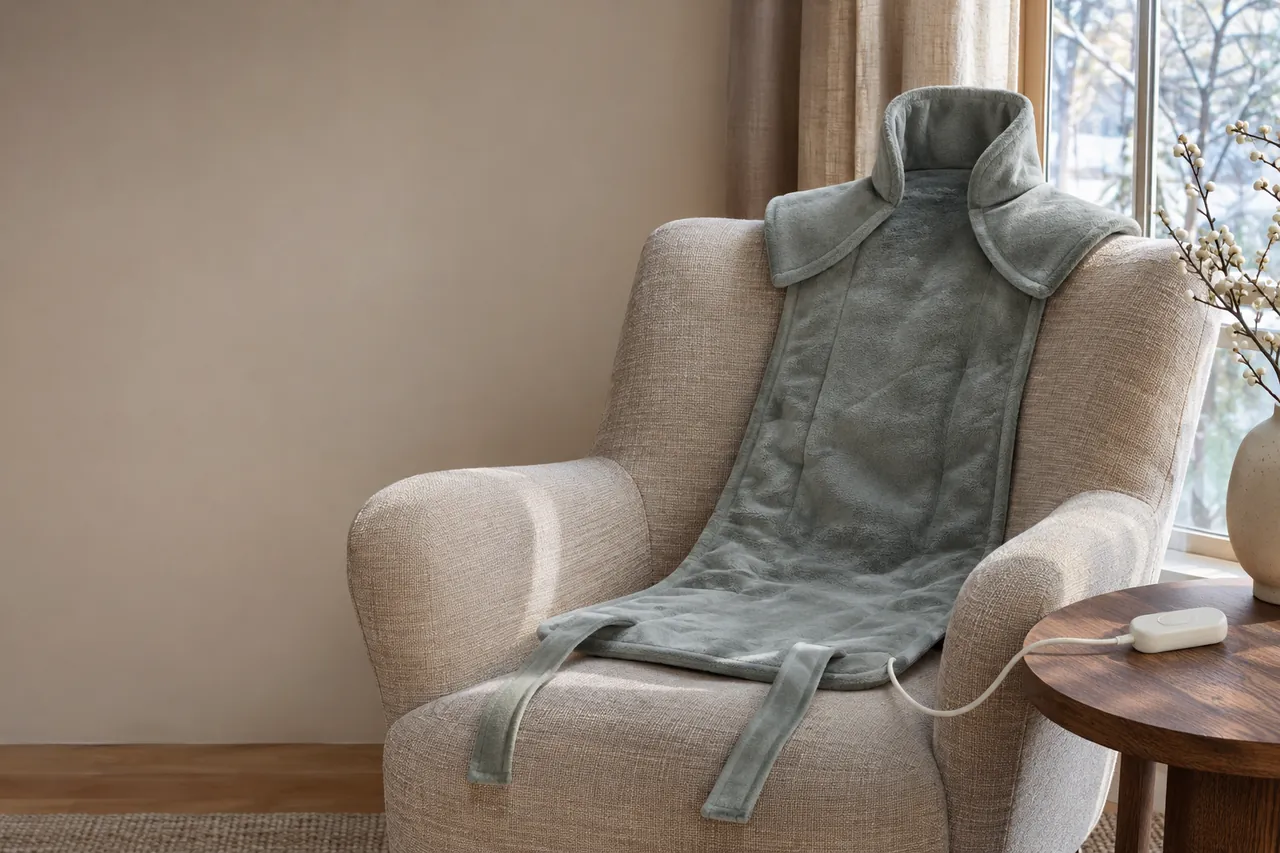
An electric lower back heating pad should fit both the area you want to warm and the way you plan to use it. Before comparing straps or heat settings, look at the placement instructions: a pad that is pressed under your weight is being used differently from one held in position by a strap.
Introduction
This guide starts with skin and electrical safety, then compares corded pads, rechargeable wraps and heated massagers. It also covers movement and symptoms that deserve medical attention.
Start With Skin and Electrical Safety
Read the placement and care instructions before plugging in the pad. Keep the controls within reach and check your skin while the heat is on.
What repeated heat can do to skin
A primary dermatological risk associated with repeated, prolonged heat exposure is Toasted Skin Syndrome, medically known as Erythema Ab Igne. As documented by dermatological experts at the Cleveland Clinic, toasted skin syndrome is a skin condition caused by repeated, long-term exposure to low-level heat or infrared radiation that is warm enough to alter skin tissue over time but not hot enough to cause an immediate thermal burn.
When a heating pad or thermal wrap is applied to the same skin area for extended periods day after day, low-level heat damages small blood vessels and elastic fibers in the skin. This results in a characteristic net-like, reticulated pattern of hyperpigmentation, skin redness, and brown discoloration across the warmed region. To protect your skin against toasted skin syndrome, avoid continuous heat exposure, limit warming sessions to short, discrete periods, inspect your skin regularly, and allow skin to cool naturally between applications.
Keep Active Heat Off While Sleeping
Never wear or use any active electric heating pad, battery-powered wrap, or thermal appliance while sleeping or napping. Falling asleep with an active heat source significantly reduces your sensory awareness of rising skin temperatures, dramatically increasing the risk of severe thermal skin burns and electrical hazards. Always power off, disconnect, and remove any heating device before lying down to sleep or nap. An automatic shutoff is an additional feature, not a reason to use a heating pad while asleep.
Keep Heating Pads Off While Driving
Safety and focus must take precedence during travel. Do not wear an electric heating pad or operate its controls while driving. Managing cords, adjusting digital controllers, or responding to thermal discomfort while operating a motor vehicle creates dangerous driving distractions.
Keep Electric Products Out of the Microwave
Never place any electric heating pad, battery-powered wrap, power cord, or electronic controller inside a microwave oven. Microwaving an electrical device can damage it or create a fire hazard. Microwaving is strictly restricted to non-electric organic grain or gel packs explicitly labeled as microwavable.
Check your skin during use
Inspect your skin underneath the heating pad frequently during every warming session. Check for unusual redness, swelling, or skin irritation. If a heating pad feels uncomfortably hot or causes skin irritation at any point, stop using the device immediately and turn off the power supply. Never ignore physical discomfort or attempt to cushion an uncomfortably hot pad with extra towels to force continued use. Always follow the specific operating instructions, care guidelines, and safety precautions printed in your individual product's user manual.
Choosing Between Three Electric Formats
When shopping for an electric heating pad for back tightness, the first practical decision is determining which product design best matches your daily environment and mobility needs. Personal warming products fall into three primary categories: corded electric pads, rechargeable cordless wraps, and motorized massagers.
1. Plug-in heating pads
Corded electric pads connect directly to a household wall socket through an electrical power cord. To understand how a dedicated corded lumbar pad is specified, examine published product details for a representative commercial model: the PureRelief® Lumbar & Abdominal Heating Pad (Gray, Model PELUMBAR-G) from Pure Enrichment.
Published manufacturer details for model PELUMBAR-G outline several distinct technical and physical parameters:
Pad Footprint and Form: Features physical dimensions of 19.69 inches by 9.5 inches, offering an elongated rectangular shape designed to drape smoothly across the lower back or abdomen.
Dual Adjustable Fastening Straps: Incorporates two adjustable straps that wrap around the torso, holding the heating surface flat against your waist for hands-free lower back or abdominal warmth.
Thermal Controls and Timer: Connects to an inline digital controller featuring 4 heat settings and incorporates an integrated 120-minute automatic shutoff feature for electrical safety.
Detachable Controller and Washable Shell: Constructed with a removable power cord and controller, allowing the plush fabric shell to be machine washed according to product manual care directions.
Included Accessories: Includes a hot/cold gel pack in the box, offering optional cold therapy or supplemental temperature layering.
The corded PureRelief pad needs a wall outlet. Its manual says not to sit on or against the pad, crush it or use it while sleeping. Arrange the cord and pad so the controller remains accessible, and follow the model’s instructions.
2. Rechargeable wraps
Cordless wraps can be used away from a wall outlet. Sunbeam’s GoHeat™ Cordless Heating Pad is one example: its removable rechargeable battery and controller fit into a side pocket, and its adjustable strap helps keep the pad in position. Its power arrangement and care instructions are specific to this model:
Cordless Battery Power: Sunbeam lists up to four hours of battery life on the low setting for model 2000-825-000. The same product has a two-hour automatic shutoff; battery life and the shutoff interval describe different things. The page also lists three heat settings.
Hands-Free Strap Fit: Incorporates an adjustable fabric strap that secures the pad around the waist, helping position the pad while standing or moving between rooms.
Machine-Washable Pad: Sunbeam says to remove the battery/controller, disconnect the pad cable and tuck that cable into its pocket before washing the pad and strap in cold water on a gentle cycle or by hand. Air-dry or tumble-dry low, and reconnect only when both pad and connector are completely dry. Do not wash the battery unit.
Wireless wraps suit active individuals who want surface warmth while performing light household tasks or moving around an office. However, users must distinguish battery runtime from safe wear time. A battery runtime figure represents electrical battery capacity under specific conditions, not a recommended continuous-use duration against human skin. Users should use cordless wraps for short, discrete sessions and allow skin to cool between uses regardless of remaining battery charge.
3. Heated massagers
Motorized massagers—such as products featured in the RENPHO neck and back massagers collection—represent a distinct category of structured massage appliances. Unlike flat electric heating pads, some RENPHO massagers combine powered massage mechanisms to apply mechanical compression alongside surface heat. These structured cushions or collar-style massagers serve individuals seeking active mechanical kneading rather than flat thermal wraps.
Warmth, Movement, and Back Comfort
Understanding how surface warmth interacts with lower back tissue provides helpful context for managing everyday muscle tightness, whether you use a corded electric pad or a wearable wrap.
Physiological Effects of Surface Heat
As detailed in educational resources from Sunbeam and clinical guidance from the Cleveland Clinic, applying gentle surface warmth to skin surfaces prompts localized blood vessels to expand (vasodilation). Heat can provide temporary comfort and help relax tense muscles; it does not establish the cause of back pain or correct an underlying condition.
Soothing Involuntary Spasms and Trigger Points
Back discomfort has many possible causes. Cleveland Clinic describes both back spasms and muscle knots and discusses warmth among ways to ease discomfort:
Involuntary Paraspinal Spasms: A back spasm is a sudden, involuntary contraction of lower back muscles often triggered by physical fatigue, heavy lifting, or poor posture. Applying gentle surface heat helps ease spasms by relaxing tense muscle fibers and stimulating sensory nerve receptors in the skin.
Myofascial Trigger Points: Muscle knots develop when small bands of muscle fibers remain tightly clenched under physical stress or prolonged sedentary posture. Targeted warmth combined with gentle stretching helps soothe clenched muscle fibers and ease physical tightness.
Physical Therapy Insights and Gentle Movement
Educational guidance from Verywell Health regarding physical therapy hot packs explains how thermal application is utilized in rehabilitation settings. Physical therapists apply thermal compresses for short intervals to soothe tight muscle tissue, improve tissue extensibility, and prepare joints for active exercise.
However, physical therapy guidance emphasizes a key distinction: thermal heat application is a passive modality that provides temporary relaxation. Heat is not a standalone cure, and comfortable movement can be part of a broader routine. Clinical literature from the Cleveland Clinic explicitly advises individuals experiencing back spasms to avoid prolonged bed rest. Gentle walking and light stretching can be practical ways to change position; stop a movement if it worsens your symptoms.
For individuals seeking an ergonomic targeted lumbar and back heating wrap to support their daily rest routine, selecting an electric model equipped with adjustable waist straps, multi-stage temperature controls, and automated safety shut-off features helps you compare options for your routine.
When Back Symptoms Require Medical Evaluation
Back discomfort has many causes. Heat may provide temporary comfort, but certain symptoms require prompt medical evaluation.
According to clinical guidance from the Cleveland Clinic, individuals experiencing lower back discomfort should seek immediate emergency medical evaluation if back pain or spasms occur alongside severe red flag symptoms:
Sudden loss of bowel or bladder control.
Sudden numbness, weakness, or a pins-and-needles sensation in your legs, feet, or genital area.
Severe pain that prevents movement.
By selecting an appropriate electric heating format, integrating gentle daily movement, respecting dermatological safety limits, and remaining attentive to red flag symptoms, you can manage lower back tightness safely and comfortably.
References
Pure Enrichment — PureRelief® Lumbar & Abdominal Heating Pad (Gray, Model PELUMBAR-G)
https://pureenrichment.com/products/purerelief-lumbar-abdominal-heating-pad-gray
Sunbeam — GoHeat™ Cordless Heating Pad
Sunbeam — Pain Relief with Heat Therapy
https://www.sunbeam.com/pain-relief-education.html
Renpho — RENPHO Neck and Back Massagers with Soothing Heat
https://renpho.com/collections/neck-back-massagers
Cleveland Clinic — Back Spasms: Causes, Treatment & What Is It
https://my.clevelandclinic.org/health/diseases/22881-back-spasms
Cleveland Clinic — What Is Toasted Skin Syndrome (Erythema Ab Igne)?
https://my.clevelandclinic.org/health/diseases/toasted-skin-syndrome
Cleveland Clinic — How To Get Rid of Muscle Knots
https://health.clevelandclinic.org/what-are-muscle-knots-and-how-do-i-get-rid-of-them
Verywell Health — Hot Packs Used in Physical Therapy
https://www.verywellhealth.com/hot-packs-physical-therapy-modalities-2696130