
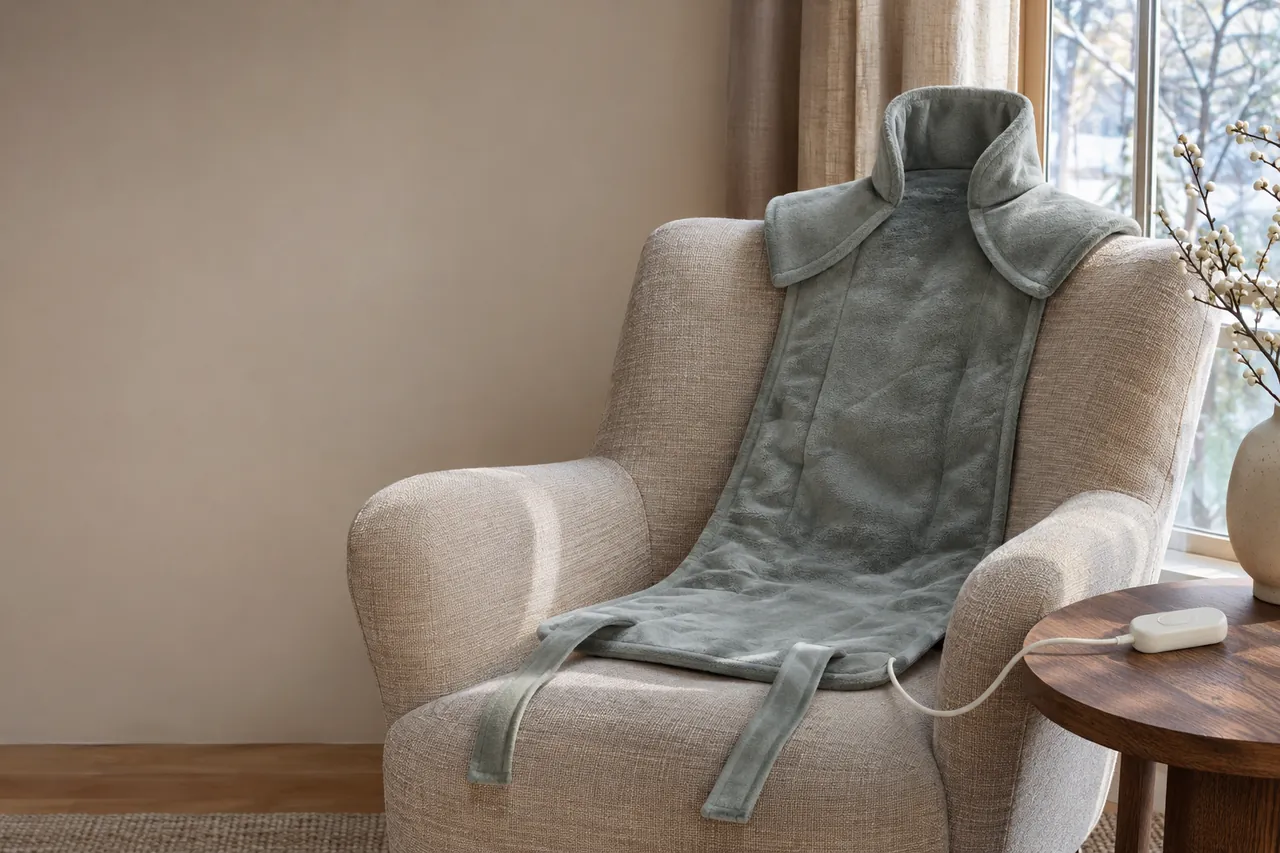
A lower back heating pad massager can mean a wearable vibrating wrap, a chair cushion with moving nodes, or an inflatable device designed for a reclining position. Start with the position in which you want to use it and the sensation you prefer. Those two answers narrow the field before you compare controls or materials.
Introduction
The questions below lead into a closer look at each mechanism, including the manufacturer’s description of the Homedics Lumbar Lift. The guide also covers fit, cleaning and the difference between general heat guidance and a claim about a specific device.
Five questions to narrow your choice
To narrow down your search for the ideal warming massager, evaluate these five practical decision questions:
Primary Posture: Will you use the device primarily while sitting upright at a desk, or while lying flat on a bed or floor mat?
Massage Mechanism: Do you prefer gentle high-frequency vibration micro-oscillations, firm rotating kneading nodes, or recumbent air-inflation stretching?
Power Needs: Do you require a cordless rechargeable battery for wireless movement, or will a corded AC adapter suffice for stationary armchair use?
Independent Controls: Can the heat and massage functions be operated independently so you can enjoy heat-only or massage-only sessions?
Fabric Care & Sizing: Does the product's waist sizing or physical footprint match your body frame, and are fabric care instructions manageable for your routine?
What kind of movement does the device make?
A central challenge when shopping for a lower back massager is navigating different massage technologies. The consumer market categorizes multi-functional warming massagers into three distinct structural form factors, each delivering a completely different physical experience.
High-Frequency Vibration Motors
Vibration produces a pulsing or shaking sensation. Different products offer different modes and intensity choices, so review the controls before choosing.
Motorized Rolling and Kneading Nodes
Kneading appliances use moving mechanisms that apply pressure. The feeling and placement differ by design; choose a position that remains comfortable and follow the device instructions.
Inflatable lumbar supports
Inflatable devices change the support under your lower back as an air chamber rises and falls. The Homedics Lumbar Lift SP-252HJ combines that movement with vibration and heat. Its controls let you raise or lower the airbag manually, or choose an automatic air-lift sequence with or without vibration. Heat has three levels.
Air Flex Design: Homedics describes an inflatable design with adjustable intensity for the lower back.
Vibration and Thermal Feature: Homedics lists vibration massage and optional heat.
Control Programs: The manufacturer lists 2 automatic programs and adjustable intensity.
The SP-252HJ manual limits each session to 15 minutes and says to use only gentle force. It also says not to use the device in bed or in an automobile. The product is designed for household use, with its power adapter and controller within reach.
Match the design to your position
The first practical decision when shopping for a lower back heating pad massager is identifying where and how you intend to use the device throughout your day. Personal warming massagers are built for distinct physical postures, making posture compatibility a key factor.
Upright Office Seating vs. Home Reclining
At a desk, a wearable belt or chair cushion can place warmth behind the lower back. The fit depends on both the product and the chair: check that you have enough seat depth, that the belt is not bunched or overly tight, and that the controls are within reach. Choose a comfortable position and follow the device’s placement instructions.
If you prefer relaxation breaks at home, your routine may center on lying flat on a floor mat, bed, or reclining armchair. For a floor or reclining setup, check the device instructions for approved placement and ensure that its shape suits the surface you plan to use.
Portability and Power Architecture
The power arrangement matters too. A cordless product can be convenient when moving between rooms; a corded appliance requires an accessible outlet. Check the connection and supplied accessories for the model you choose.
Check fit and controls
Choosing the right warming massager requires evaluating practical design features that influence daily comfort, control convenience, and physical fit.
Waist Straps, Cushion Drapes, and Body Fit
For wearable massagers, securing mechanisms dictate how effectively heat and vibration transfer to your body. Look for wraps featuring wide, adjustable hook-and-loop waist straps or elastic side panels. A secure waist wrap holds the heating elements and vibration motors smoothly against your lower back curve without slipping downward when you stand or walk. When evaluating options for a targeted lumbar and back heating wrap, confirming that waist sizing ranges accommodate your body frame ensures consistent surface contact.
For stationary chair cushions or recumbent mats, verify overall dimensions and fabric drapes. Chair cushions should fit neatly against your chair backrest without forcing your posture into awkward angles, while recumbent mats should provide a stable, cushioned surface for lying flat.
Navigating Control Switches and Digital Interfaces
Control layout is another vital buying consideration. Appliances equipped with independent switches for heat and massage allow you to run thermal heat alone, vibration alone, or both features simultaneously. Simple push-button controllers with clear LED indicators make adjusting settings straightforward during rest breaks.
Additionally, safety and focus must take precedence during travel. While some users wear cordless heating wraps while seated as passengers in vehicles, users should never operate mobile control switches or adjust heating settings while driving, as managing device controls while operating a vehicle creates dangerous driving distractions.
How to read reviews and clinical guidance
When researching warming appliances online, consumers frequently consult commercial buying guides and editorial review websites. Placing editorial reviews and physical therapy guidance in proper context helps clarify product capabilities.
What to compare in a product listing
A useful comparison starts with the way you plan to use the device. Check its controls, coverage and care instructions alongside the type of movement it offers:
Controls and shutoff: Look for controls that are easy to reach, an automatic shutoff and a cord long enough for the intended setup. For rechargeable designs, check what is included and how the battery is charged.
Coverage and care: Compare coverage, comfort and care instructions for the exact model, and check whether heat and massage can run separately.
Compare the right model: The Homedics Lumbar Lift has a distinct air-lift mechanism, so compare its instructions with those of the particular vibrating wrap or kneading cushion on your shortlist. A product review should make clear which model was used and what features were actually examined.
Physical Therapy Hot Packs vs. Consumer Massagers
Similarly, educational literature from Verywell Health regarding physical therapy hot packs describes how moist thermal packs are utilized in clinical rehabilitation settings. Physical therapists apply moist heat compresses for short intervals to soothe tight muscle tissue, improve tissue extensibility, and prepare joints for active exercise. Note that clinical hot packs refer to moist thermal compresses administered in physical therapy clinics, not consumer electric massagers.
For menstrual cramps, Verywell Health lists heat applied to the abdomen or lower back among options for relief. That guidance addresses heat, so choose a product whose instructions allow the intended placement and use it comfortably. Severe cramps accompanied by vomiting, dizziness or excessive bleeding need prompt medical attention.
What general back-care guidance covers
Understanding how surface warmth and mechanical massage interact with lower back tissue helps establish realistic expectations for everyday home comfort.
Soothing Involuntary Back Spasms and Trigger Points
Cleveland Clinic discusses back spasms and muscle knots, and includes heat among approaches for relief:
Involuntary Paraspinal Spasms: Cleveland Clinic describes a back spasm as an involuntary muscle contraction.
Myofascial Trigger Points: Cleveland Clinic describes muscle knots as tight, sensitive areas and discusses heat among relief options.
Try the setup before settling in
Try the device in its intended position and check whether you can reach the controls without straining. Choose a comfortable setting, follow the model’s positioning instructions and make adjustments while you are awake.
Skin safety and care
Operating an electric or battery-powered warming massager safely requires practicing active skin monitoring and adhering to essential dermatological safety protocols.
Understanding Toasted Skin Syndrome (Erythema Ab Igne)
A primary dermatological risk associated with repeated, prolonged heat exposure is Toasted Skin Syndrome, medically known as Erythema Ab Igne. As documented by dermatological experts at the Cleveland Clinic, toasted skin syndrome is a skin condition caused by repeated, long-term exposure to low-level heat or infrared radiation that is warm enough to alter skin tissue over time but not hot enough to cause an immediate thermal burn.
Repeated low-level heat exposure over several weeks can alter skin blood vessels, causing a reticulated pattern of hyperpigmentation and brown discoloration. To protect your skin against toasted skin syndrome, avoid continuous heat exposure, limit warming sessions to short discrete periods, inspect your skin regularly, and allow skin to cool naturally between applications.
Turn off the device before sleep
Never wear or use any active electric heating pad, battery-powered wrap, or vibrating massager while sleeping or napping. Falling asleep with an active heat source significantly reduces your sensory awareness of rising skin temperatures, dramatically increasing the risk of thermal skin burns and electrical hazards. Always power off, disconnect, and remove any heating device before lying down to sleep or nap.
Keep electric devices out of the microwave
Never place any electric heating pad, battery-powered wrap, vibrating massager, or power cord inside a microwave oven. Only microwave a pack that is specifically labeled for microwave use, following its instructions.
Active Skin Monitoring and Care Guidelines
Always consult the product manual for your massager before cleaning. Never submerge active electrical components, internal motors, power cords, or battery packs in water. Follow the specific product instructions for cleaning its cover. Inspect your skin underneath the device frequently during every session. If a massager feels uncomfortably hot or causes skin irritation at any point, stop using the device immediately and turn off the power supply.
Sources
Homedics Official — Lumbar Lift Lower Back Stretcher & Massager
https://www.homedics.com/collections/relieve-pain/products/lumbar-lift-lower-back-stretcher-massager
Good Housekeeping — 9 Best Heating Pads of 2024, Tested by Experts
https://www.goodhousekeeping.com/health-products/g30647898/best-heating-pads/
NYT Wirecutter — The Best Heating Pad
https://www.nytimes.com/wirecutter/reviews/best-heating-pad/
Verywell Health — Hot Packs Used in Physical Therapy
https://www.verywellhealth.com/hot-packs-physical-therapy-modalities-2696130
Verywell Health — 15 Things to Help With Period Cramps on Pain Days
https://www.verywellhealth.com/what-helps-with-period-cramps-8413517
Cleveland Clinic — Back Spasms: Causes, Treatment & What Is It
https://my.clevelandclinic.org/health/diseases/22881-back-spasms
Cleveland Clinic — What Is Toasted Skin Syndrome (Erythema Ab Igne)?
https://my.clevelandclinic.org/health/diseases/toasted-skin-syndrome
Cleveland Clinic — How To Get Rid of Muscle Knots
https://health.clevelandclinic.org/what-are-muscle-knots-and-how-do-i-get-rid-of-them