
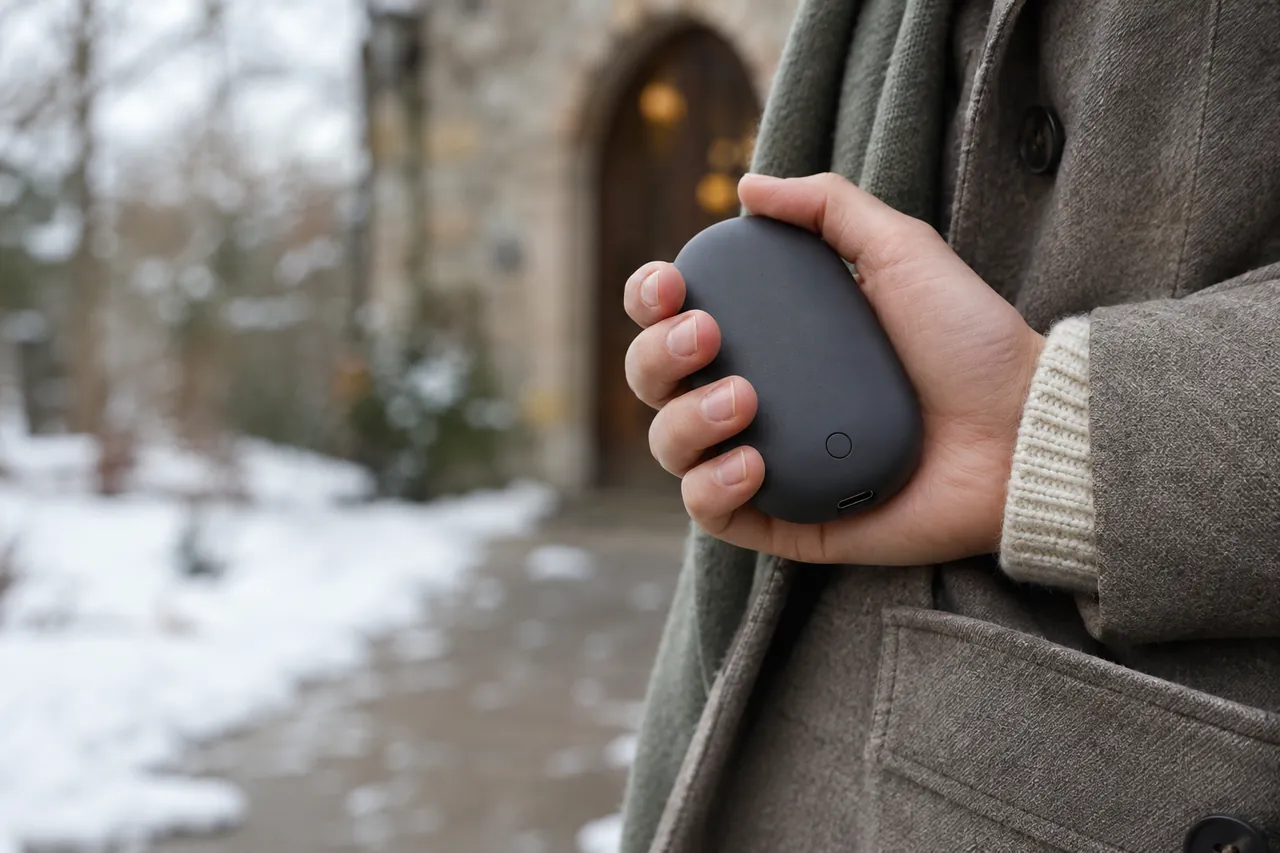
A magnetic split pair can be carried together, separated between two pockets or shared with someone else. Before choosing one, check whether the two pieces operate independently and whether their shape fits your pockets. The right pair should also suit the way you plan to carry, control and recharge both pieces.
Introduction
This guide follows three decisions: how you will carry the warmers, how to read the battery information, and how to check the exact model for safety notices. We also separate a hand warmer’s comfort role from the medical information readers may encounter when searching for cold hands.
Decision 1: two separate pieces or one joined pair?
A magnetic split design joins two pieces for carrying and allows them to be pulled apart. For a commute, one unit in each coat pocket can be more convenient than passing a single warmer from hand to hand. On a short stop, holding both pieces together may be easier to keep track of. If you expect to share the set, look at whether each half has its own controls and charging connection.
GearJunkie tested the OCOOPA UT3 PRO as an example of independently operating magnetic pieces and found the connection useful for storage. A later Polish safety notice concerning a Kolba campaign lists model UT4102 among affected OCOOPA hand warmers because their batteries may overheat or ignite; reports identify UT4102 as UT3 PRO. Do not use or charge a unit covered by that campaign. Read the notice and match the model and sales channel before treating an older product review as a purchase recommendation.
The magnets hold pieces together; the warming comes from the electrically heated unit. Do not treat the magnetic connection as a medical feature or assume that a joined pair has the same heat pattern as two separate pieces. The review describes the way the surfaces of its tested model behave when joined, but another design may be arranged differently.
Picture your pockets before studying the specifications
Size and shape are more useful when compared with a real item. Measure the space in the pocket where you intend to carry a warmer and consider whether your hand can comfortably fit beside it. A rounded device may be pleasant to hold but take up more room than a flat packet. If two halves are joined, compare the combined thickness as well as the size of each piece.
A rechargeable unit is usually a rigid object, not a thin flexible insert. GearJunkie notes that the magnetic pair it reviewed does not fit inside gloves or boots like a disposable warmer. If you need to use your fingers for a task, plan where to put the warmer while your hands are busy. A coat pocket offers a place to return your hands between tasks without requiring the device to fit inside a close glove.
Think about whether you are buying for one person or two. Sharing a split pair gives each person one piece, but it also means each will need access to the right charging arrangement later. For a gift, the number of included pieces and the ease of recognising their controls can be more useful than a long list of advertised materials.
Decision 2: what does the battery claim actually describe?
Lifesystems’ Dual-Magnetic set, product 42467, offers a concrete example: its listing specifies two 5,000 mAh batteries, four heat settings and 6–9 hours of heat. The two capacity figures refer to separate warmers, so one person can carry each piece without sharing a single battery. Each warmer is listed at 109 g and 32 × 100 × 28 mm, making it easy to compare one unit with the space in each coat pocket. These figures describe this Lifesystems model; consider the selected setting and conditions when planning an outing.
Heat level and operating conditions can affect how long a rechargeable warmer lasts. GearJunkie notes that severe cold can affect the battery life of its reviewed units. The number on a listing is therefore a useful comparison only when the test conditions and the way the pair is counted are clear. It is not a guarantee that every outing will match that number.
A USB connection does not automatically make a warmer a power bank. GearJunkie reports that its reviewed OCOOPA UT3 PRO has charging ports for the warmers but no phone output; the Polish campaign noted above lists UT4102, identified in reporting as UT3 PRO. Lifesystems describes its Dual-Magnetic model 42467 differently: each warmer has an integrated USB-C cable for charging a compatible phone or GPS device. For the Lifesystems pair, the 42467 manual instructs users to switch each warmer off before connecting it to a power source or plugging in another device. Compare the functions of the exact model, and check applicable safety notices before buying or using it.
The same caution applies to included cables. Check whether the package contains a charging lead and whether the two pieces charge separately or through a supplied arrangement. Keep the instructions with the product so the correct charging method and compatible power source remain easy to find. Avoid adopting a charging sequence from a different model merely because the products look similar.
A quick comparison at the checkout
A magnetic pair may make sense when you regularly want one warmer in each pocket, value the option to share, and are comfortable keeping track of two rechargeable pieces. A single rechargeable unit may be simpler if you mostly warm one hand at a time or want fewer items to charge. Disposable warmers are another format, especially when a slim, flexible packet is the priority; they have different handling and disposal considerations.
Compare the number of pieces, their dimensions, controls, included charging equipment and the stated conditions behind any runtime claim. Then look at the seller, return terms and the model identifier. A low price is less helpful if the listing does not tell you which version is being supplied or how to identify it when it arrives.
Decision 3: check the model, not just the brand
A specific U.S. recall illustrates why the model number matters. In July 2026, the Consumer Product Safety Commission announced a recall of OCOOPA rechargeable hand warmers with model numbers UT3053, UT3056, ZLS-118, ZLS-118S, ZLS-118D, H01 and H01(PD). The agency said the lithium-ion battery in the recalled units could overheat and ignite, presenting fire and burn hazards. The notice identifies the model and three-digit batch number on the underside.
The CPSC directs owners of the recalled units to stop using them immediately and follow the recall process for a full refund. Its notice also explains how to submit the requested identifying information and how to handle disposal of the defective battery. Do not place the recalled device in household trash, ordinary recycling or retail used-battery collection boxes; follow the local hazardous-waste directions described in the notice.
The U.S. notice applies to its listed models and should not be extended to every product from the brand. A separate October 2026 notice from Poland’s consumer authority describes a Kolba campaign involving UT3201, UT3053, UT4102, UT3056, UT3042, UT3043 and UT3057, with a risk that the battery could overheat or ignite. Its scope and return arrangements are those of that specific campaign. Check the model and seller against the relevant notice; stop using or charging an affected unit and follow the campaign instructions. Keep the packaging and order details.
Cold hands and when a warmer is only a comfort tool
Cold fingers are not always the same problem. Mayo Clinic describes Raynaud’s as a condition in which areas such as fingers or toes can feel numb and cold in response to cold or stress. A pocket warmer may be considered as a comfort accessory, but the selected sources do not establish that a magnetic warmer prevents an episode or treats the condition. Avoid placing heat against numb skin, where excessive temperature may be difficult to notice.
For cold weather more broadly, Mayo Clinic recommends protecting the whole body with suitable layers, including a hat, socks and mittens or gloves. A coat with cuffs that close around the gloves helps keep cold air away from the hands. Plan those layers independently of the warmer, and do not put heat directly on skin that cannot reliably sense it.
Make the choice around your routine
Start with the way you will carry the pieces: together, one in each pocket, or shared. Next compare the model-specific controls and charging arrangement, and read the conditions behind the battery claim. Finally, match the model identifier against current safety notices. The best-looking pair is only useful if its shape, care instructions and purchase details fit the job you need it to do.
Sources
GearJunkie — hand warmer reviews
Mayo Clinic — Raynaud’s symptoms and causes
Cleveland Clinic — heat or ice for arthritis
Pure Enrichment — WeightedWarmth body pad
Lifesystems, Dual-Magnetic Rechargeable Hand Warmers
Polish consumer authority: OCOOPA hand warmer safety campaign