
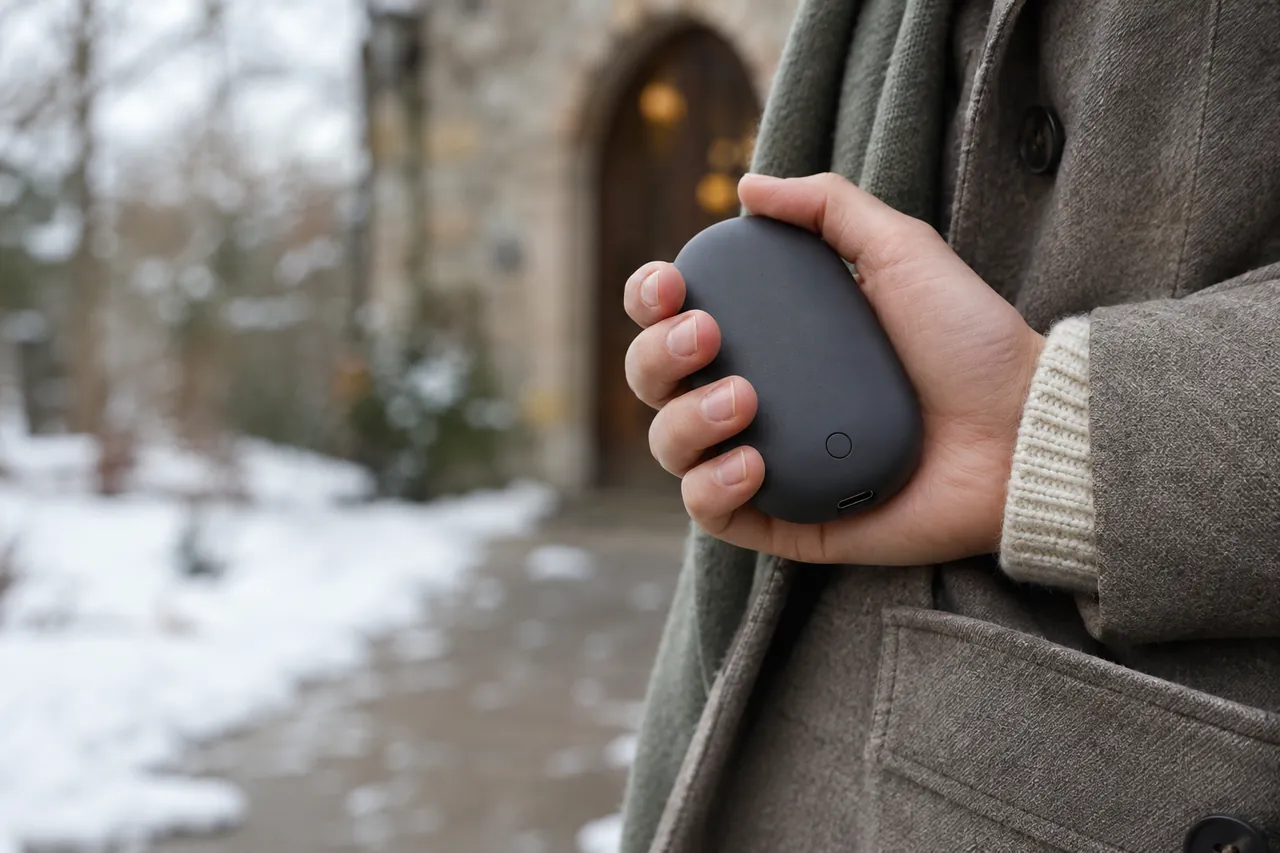
Magnetic hand warmers are designed to join together for carrying and separate into two pieces when you want one in each hand or pocket. That simple change in shape is the reason to consider them: instead of moving one warmer from side to side, you can use two compact units independently. The exact controls, heating surfaces and charging arrangement depend on the model.
Introduction
GearJunkie’s review of the OCOOPA UT3 PRO describes a pair that recharges independently and attaches magnetically. The review provides a useful example of how a split design works, as well as a reminder to check the details of the specific product rather than treating all two-piece warmers as identical. A later Polish consumer-authority notice describes a Kolba safety campaign covering model UT4102, identified in reporting as UT3 PRO, because its battery may overheat or ignite. Do not use or charge a unit covered by that campaign; follow its return guidance.
Safety recall: check the model number
In July 2026, the US Consumer Product Safety Commission announced a recall of OCOOPA rechargeable hand warmers with model numbers UT3053, UT3056, ZLS-118, ZLS-118S, ZLS-118D, H01 and H01(PD) because their batteries can overheat and ignite. In October 2026, the CPSC announced separate recalls of HotHands rechargeable model H163650 and Gobi Heat model UT3053. Each recall covers specified devices, so check the brand and model on the actual unit; the UT3 PRO name in a review alone does not establish whether a device is included. Stop using an affected unit and follow its recall notice for the refund procedure. Do not place recalled devices in household trash, ordinary recycling or retail battery collection boxes; follow the notice and local hazardous-waste guidance for defective lithium-ion batteries.
Joined and separated: a closer look at one design
When the UT3 PRO pieces are joined, they make a single unit that can be carried together. GearJunkie says the exposed outer panels provide heat in that configuration. When separated, each piece operates independently; the reviewers describe warmth around each unit and preferred placing one in each pocket. This is a description of the reviewed model, not a universal rule for every magnetic warmer.
The magnetic connection is a way of holding the pieces together. The warmth comes from the device’s heating system, and the connection should not be taken as evidence of a medical benefit from magnets. If you intend to use a pair joined in one pocket, check the product directions for the permitted configuration and controls.
The shape of the joined pair matters as much as the shape of each half. Compare both arrangements with the pockets you use most. A device that feels comfortable in a hand may be bulky in a close-fitting glove; GearJunkie notes that the UT3 PRO does not fit into gloves or boots like a small disposable packet.
Think about where each piece will go when you take your hands out of your pockets. A pair is convenient only if both parts remain easy to find and carry. Some sets include straps or a case; the UT3 PRO review lists both, but the contents of other packages can differ.
How two split designs compare
The detailed UT3 PRO review describes four heat settings, an indicator light and a button on each unit. It also describes the two pieces heating independently. Those features illustrate a design where each hand has its own control; other models arrange their controls or heating faces differently.
GearJunkie also reviews UNIHAND rechargeable warmers that lock together. Its testers report that these heat on one side of each piece, in contrast with their description of the UT3 PRO. The reviewers also noted that the UNIHAND units became very hot on their upper settings. These observations describe the units they tested and help frame a practical comparison: which surface touches your hand, how readily you can adjust the control, and whether the setting feels comfortable. Check the specific listing and instructions for the orientation and operation of the version you buy.
Do not compare only the number of settings. Look at the button position, indicator and any carrying case, and consider whether you can operate the controls with gloves on. A setting is helpful when it is easy to identify and adjust while the warmer remains in a comfortable position.
The GearJunkie UT3 PRO review lists a stated maximum runtime, but the guide also discusses how cold and damp conditions can affect battery performance. Read runtime figures alongside their test conditions and the selected heat level. A maximum is not a promise that both halves will last for an entire outing in every setting.
Charging and carrying two pieces
Each separate piece needs a charging plan. The UT3 PRO review describes two charging cables and an input port on each unit. Another pair may use a different cable arrangement. Keep the equipment supplied or specified for the model together, and follow its charging instructions rather than assuming that any matching-looking connector has the same function.
The way the halves are carried also matters. In GearJunkie’s UT3 PRO review, the two independently rechargeable pieces came with wrist straps and a soft carrying case. The reviewer preferred holding the pieces separately or keeping one in each jacket pocket, using the magnetic join mainly for storage. Those details make the split design easier to picture in use than a specification list alone.
Protect the units from damage in a bag or pocket and follow their instructions about moisture. A protective port cover on one model does not establish that every device is waterproof. Keep the connections clean and dry as directed, and avoid charging a damaged or wet unit.
Inspect the casing, lead and connectors before use. If a device is damaged, swollen, unusually hot during charging or gives off an unusual smell, stop using it and follow local battery-disposal guidance. The US Consumer Product Safety Commission notes that lithium-ion batteries require care during charging, use and storage.
A magnetic pair compared with other warming formats
A single rechargeable warmer has fewer pieces to manage, though it may need to move between hands. A split pair can be shared between pockets and then joined for storage. Compare the size and weight of the complete pair as well as each half; two smaller shapes can still take up space in a compact bag.
Disposable air-activated packets are another option in GearJunkie’s guide. They do not need recharging and can fit in places where a rigid device is too large, but they are used for one session. Follow the packet’s own directions for placement and duration. Reusable gel packs have a different reset process and are another format to consider when that process is convenient.
For a pair that is not recalled or damaged, check its indicators and keep the specified charging equipment together before a trip. Follow the instructions for that particular device. Do not charge or use a unit covered by a recall.
Warmth, sensitive skin and cold-triggered symptoms
Use the warmer according to its instructions and pay attention to how your skin feels. A high setting is not automatically the most comfortable choice. Move or switch off the device if it feels too hot or irritates the skin, and avoid prolonged contact in one position.
The NHS explains that Raynaud’s can cause fingers or toes to change colour and feel cold, numb or painful when triggered by cold or stress. Its advice includes keeping warm. A person with reduced sensation may find it harder to judge surface temperature, so follow the device warnings and your clinician’s advice about suitable warming methods.
The NHS recommends medical assessment when symptoms are severe or worsening, interfere with daily life, occur only on one side, or accompany joint pain, a rash or muscle weakness. Mayo Clinic advises prompt medical attention if someone with severe Raynaud’s develops a sore or infection on an affected finger or toe.
Cleveland Clinic discusses heat and cold as different approaches to arthritis discomfort. That general guidance does not establish a treatment effect for a particular magnetic warmer. Keep the product’s comfort function distinct from medical treatment and follow an appropriate care plan for persistent symptoms.
What to check before choosing
Start with the two configurations: do the separate pieces fit comfortably where you want to carry them, and is the joined pair convenient to store? Then check which surfaces heat, how the controls work and how both pieces recharge. A case, straps or an external charging function belongs on the checklist only if it is included with the exact model.
Finally, read the use and care directions. They explain the intended contact, moisture and storage limits for the device you will actually own. That combination of fit, controls and a workable charging routine makes a more useful comparison than a product name alone.
References
GearJunkie: The Best Hand Warmers of 2026 — https://gearjunkie.com/winter/best-hand-warmers
Mayo Clinic: Raynaud’s disease symptoms and causes — https://www.mayoclinic.org/diseases-conditions/raynauds-disease/symptoms-causes/syc-20363571
NHS: Raynaud’s — https://www.nhs.uk/conditions/raynauds/
Cleveland Clinic: Ice or heat for arthritis — https://health.clevelandclinic.org/heat-or-ice-for-arthritis
Pure Enrichment: WeightedWarmth weighted body pad — https://pureenrichment.com/products/weightedwarmth%E2%84%A2-weighted-body-pad-with-heat
US Consumer Product Safety Commission: Batteries — https://www.cpsc.gov/Regulations-Laws--Standards/Voluntary-Standards/Topics/Batteries
US CPSC: OCOOPA rechargeable hand warmer recall — https://www.cpsc.gov/Recalls/2026/OCOOPA-Direct-Recalls-1-5-Million-Rechargeable-Hand-Warmers-Due-to-Risk-of-Serious-Injury-or-Death-from-Fire-and-Burn-Hazards-One-Death-Reported-Imported-by-Shenzhen-Street-Cat-Technology