
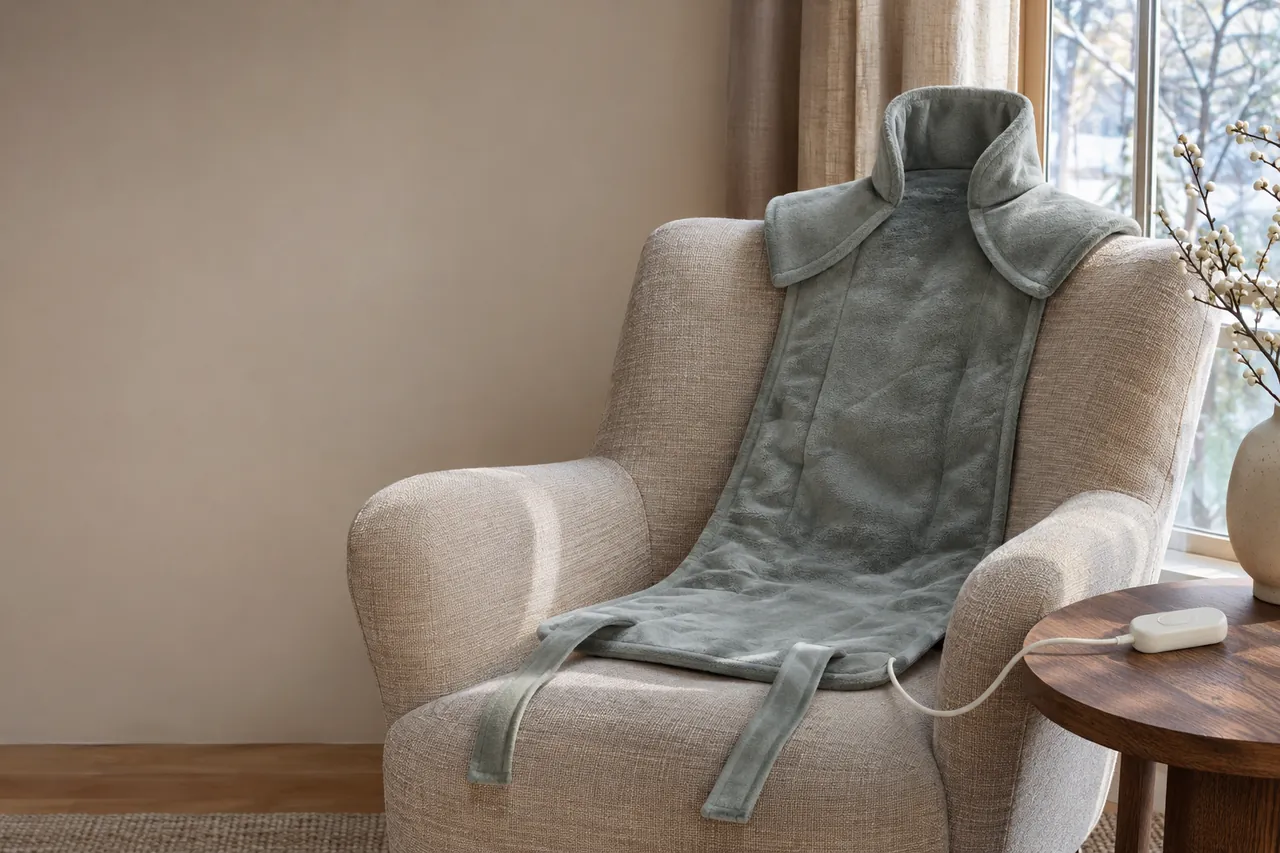
Where will you actually use a portable low back heating pad? If the answer is several rooms, pay attention to the weight of the battery and the position of the controller. If you prefer a regular chair near an outlet, a corded design may be sufficient. Fit and safe placement matter in either case.
Introduction
Before comparing specifications, measure your waist over your usual clothing and consider how you will store and clean the pad. Check that you can adjust or remove it easily without trapping it under your body.
Start with where you will use it
Start by picturing a normal day. A cordless pad may be convenient when you want to move from one room to another without a trailing cord, while a corded model can work well at a regular rest spot near an outlet. Look at where the controller sits and whether you can reach it without twisting or pressing against the pad.
For a trip, leave space for the charger and any strap as well as the pad itself. Check the care directions before packing and avoid crushing the device under heavy items. At your destination, choose a place where you can stay awake, check your skin and remove the pad easily.
Fit, controls, and cleaning
Selecting an effective wearable heating wrap requires evaluating waist sizing, fastening mechanisms, controller options, and cleaning routines before making a purchase.
1. Waist Measurement and Strap Ergonomics
Measure around your waist over the clothing you intend to wear, then compare the measurement with the product’s stated strap range. A comfortable fit should hold the pad in place without being uncomfortably tight.
2. Digital Controls and Multi-Stage Temperature Settings
Review controller layout options before buying. Multi-stage heat settings allow you to adjust surface temperature based on ambient room conditions and personal comfort. Simple inline controllers with intuitive button layouts make it easy to cycle through temperature levels during a rest break.
3. Fabric Care and Travel Hygiene
Check the care instructions for the particular pad before washing. Remove the battery or controller as directed and allow washable parts and connectors to dry completely before reconnecting.
4. Keep the electric pad out of the microwave
Never put an electric heating pad, its cord, controller, or battery in a microwave. Only heat a separate non-electric pack if its own instructions permit that method.
A closer look at Sunbeam GoHeat
To understand how a portable warming wrap is engineered for mobile use, examine published product page specifications for a primary commercial model: the Sunbeam GoHeat™ Cordless Heating Pad (Model 2000-825).
Published details on the official Sunbeam GoHeat product page outline several specific design parameters:
Compact Pad Footprint: The flexible pad is designed for targeted placement on the back, arms, legs or shoulders.
Cordless Battery Power: Powered by a removable, rechargeable lithium-ion battery pack stored inside a dedicated fabric pocket, supplying wireless thermal warmth without wall cords.
Up to 4 Hours of Battery Runtime: Sunbeam quotes up to four hours on Low with a full charge. For a day split between rooms, think about where you will recharge the removable unit and whether its controls remain accessible when the pad is positioned without leaning on it.
Three Selectable Heat Settings: Sunbeam lists three heat settings, controlled by the battery unit that fits in the pad’s pocket.
Adjustable Fastening Strap: Incorporates an adjustable fabric strap extending up to 55 inches to secure comfortably around the waist.
Machine-washable pad: Sunbeam says to remove the battery and disconnect the pad cable before washing; let both pad and connector dry completely before reconnecting.
Automated Safety Shut-Off: Features an integrated 2-hour automatic shut-off timer for electrical safety.
The strap length describes how far the fastening reaches around your body; it does not increase the area of the warming pad. Leave room for the battery/controller in its pocket, and position the pad so you can reach the controls without leaning on it.
Crucial Safety Distinction: Battery Runtime vs. Safe Wear Duration
Sunbeam lists a battery runtime and an automatic shutoff for this model. Neither figure is a recommendation for continuous skin contact.
Use the pad while awake and follow its instructions for the duration and skin contact. Stop if your skin becomes uncomfortable, red, or irritated; allow skin to cool between uses.
What other formats offer
When evaluating personal warming options for your lower back, prospective buyers encounter several distinct product form factors. Understanding how these designs differ in power delivery, shape, and physical support helps you choose an appliance tailored to your daily schedule.
As seen across specialized personal wellness catalog offerings—such as those featured in the Comfytemp heating pad collection—personal warming devices include flat rectangular electric pads, contoured weighted body wraps, and dedicated lumbar support belts. Matching these designs to your daily routine involves evaluating key functional trade-offs:
1. Mains-Powered Corded Electric Pads
A corded electric heating pad uses a power cord and is suited to a rest break near an outlet. The cord limits how far you can move while the pad is connected.
2. Battery-Operated Portable Heating Wraps
Some battery-operated wraps use a rechargeable battery and an adjustable fastening strap. The specific battery design, strap length and controls vary by model.
3. Motorized Heated Massagers vs. Flat Heating Wraps
If you want vibration as well as heat, Comfytemp’s Cordless XL Heating Pad with Massager (K9244030) is a different kind of wearable: its listing describes nine heat levels, five vibration modes, on-device buttons and app controls. Its double straps and extension are listed to fit up to 58 inches around the waist. GoHeat offers three heat settings and a removable strap but is presented as a heating pad rather than a massage device. Placement differs too: Comfytemp instructs users of K9244030 to wear clothing while using it. The GoHeat manual instead places its lighter fabric side against the body and says not to cover the pad with clothing or other insulating material. Use the directions for the model you choose.
Warmth, cold, and skin care
Understanding how surface warmth interacts with lower back tissue provides helpful context for managing everyday muscle tightness during rest breaks.
Deciding Between Heat and Cold Therapy
The NHS describes both wrapped cold packs and wrapped heat packs among self-care measures for back pain. It describes heat as an option for stiffness or muscle spasms, and a wrapped cold pack as an option for pain and swelling.
Cold packs: Wrap a cold pack before applying it, following the advice for the pack and your circumstances.
Warmth: Use a comfortable setting on a heating pad as directed and check your skin during the session.
Movement: The NHS recommends staying active and continuing daily activities where possible. Stop an exercise if it makes the pain worse.
Posture and Mobility Safety Boundaries
Operating a portable warming wrap safely requires respecting physical posture boundaries:
Keep body weight off the pad: Do not sit or lie on a localized heating pad. The GoHeat 2000-825 manual specifically says not to sit on, lean against, crush or fold it, and not to cover it with insulating material while in use. It also warns against use by people with diabetes, poor circulation or insensitivity to heat. Follow the instructions for your exact model.
NEVER Use While Driving: Users should never wear or operate an electric heating pad while driving an automobile. Adjusting digital controls or responding to thermal discomfort while operating a motor vehicle creates dangerous driving distractions.
Use While Awake Only: Never wear or operate any electric heating pad or battery-powered wrap while sleeping or napping. Reduced sensory awareness during sleep prevents you from detecting thermal discomfort or rising skin temperatures.
Dermatological Safety and Burn Prevention
Comfytemp notes that reduced skin sensation can make excess heat harder to notice. Do not use a heating pad on skin where you cannot feel heat normally.
Follow the pad’s directions for a fabric barrier, check your skin during use, and stop if it becomes uncomfortable or irritated.
Red Flag Symptoms: When Back Pain Requires Emergency Medical Care
Some symptoms accompanying back pain require immediate emergency assessment.
According to official back pain clinical guidance from the National Health Service (NHS), you should seek immediate emergency medical assessment (going to an emergency room / A&E or calling emergency services) if your back pain occurs alongside any of the following urgent red flag symptoms:
Symptoms in Both Legs: Pain, tingling, weakness or numbness in both legs.
Saddle Area Numbness: Sudden numbness, loss of feeling, or a pins-and-needles sensation around your genitals, buttocks, or back passage (anus).
Bladder or Bowel Changes: Sudden loss of bowel or bladder control, difficulty urinating, or sudden inability to pass urine.
The NHS also recommends emergency care for back pain with changes in sexual sensation or function, chest pain, or pain that began after a serious accident. Do not drive yourself to emergency care. Seek urgent medical advice if severe pain starts suddenly or worsens quickly, or if you feel feverish, shivery or generally unwell.
A good fit makes a portable pad easier to use: measure over your usual clothing, look for controls you can reach, and choose a place where the pad will not be pressed against a chair or mattress.
Sources
Sunbeam — Pain Relief with Heat Therapy https://www.sunbeam.com/pain-relief-education.html
Sunbeam — GoHeat™ Cordless Heating Pad https://www.sunbeam.com/pain-relief/general-muscle-pain/sunbeam-goheat-cordless-heating-pad/SP_438956.html
Comfytemp — Heating Pad Safety Burn: Who's Most at Risk at Home https://comfytemp.com/blogs/news/heating-pad-safety-burn-risk
Comfytemp — Electric Heating Pads for Pain Relief & Muscle Relaxation https://comfytemp.com/collections/heating-pad
National Health Service (NHS) — Back pain - NHS https://www.nhs.uk/conditions/back-pain/