
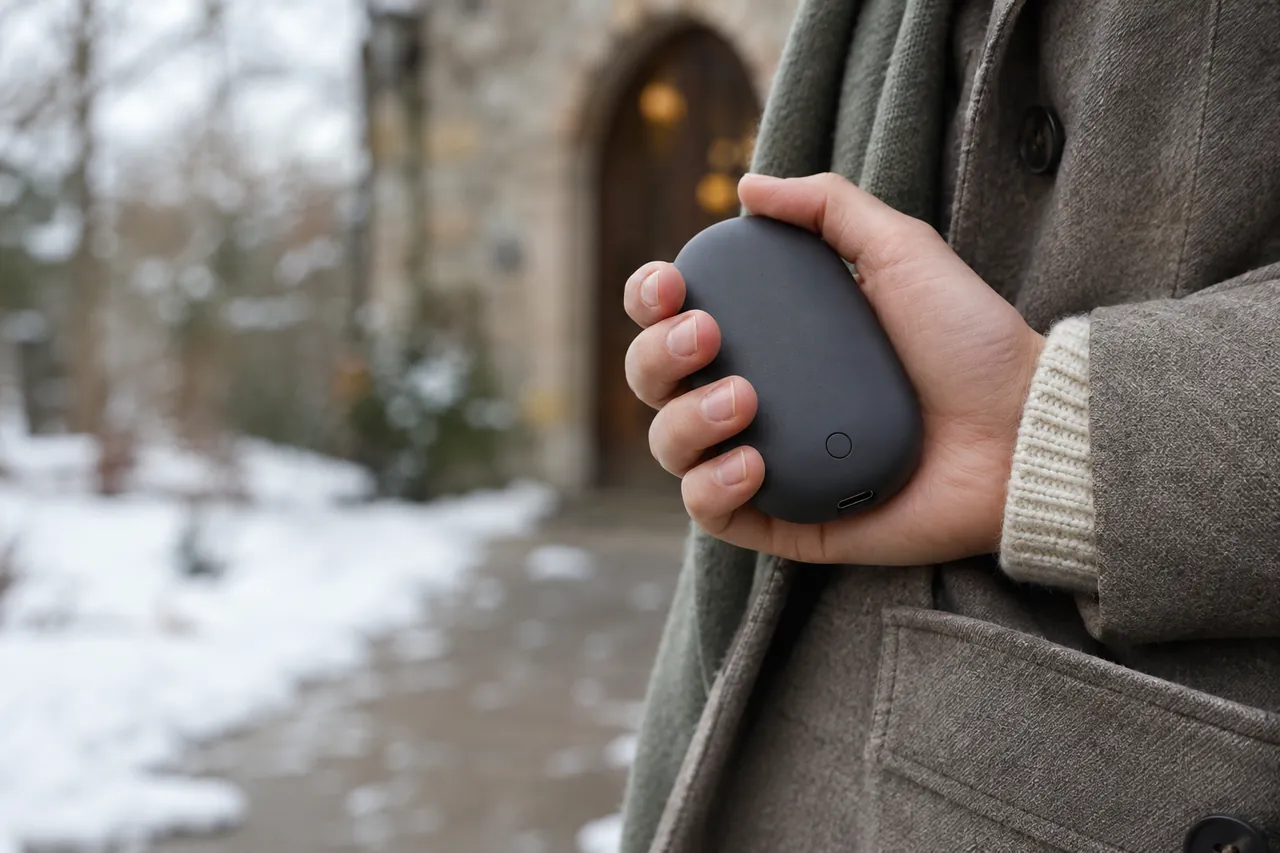
A review says a hand warmer lasts all day. A product page gives an “up to” number. Another reviewer likes a warmer that feels too bulky for your pocket. All three statements can describe different experiences. The useful task is to find the model, test conditions and trade-offs behind the headline before choosing a rechargeable hand warmer.
Introduction
This guide reads a published outdoor review alongside manufacturer information and a product recall. It explains what each source can tell you and how to turn a review into a shortlist for your own routine.
Who is speaking, and what did they do?
A manufacturer’s page is the natural place to find the features and instructions for its product. Ocoopa’s hand-warmer collection, for example, presents its own range. That is useful for identifying the models the brand describes, but a catalogue is not the same thing as an independent comparison of products used in the field.
GearJunkie describes taking a range of hand warmers on outdoor activities and reports both advantages and drawbacks. Its review also discloses that it may earn a commission from affiliate links. A disclosure does not by itself establish whether a conclusion is right or wrong; it tells you about a commercial relationship while you assess the stated methods, observations and limitations.
GearJunkie says its testers placed warmers in an insulated down-jacket pocket and measured the pocket’s ambient temperature after 30 minutes, using a stopwatch and thermometer. That measures warmth within that setup; it is not the same as measuring every device’s surface temperature or a guarantee of how warm it will feel in another pocket. The team also reports outdoor use, so read a field observation with the context it gives. When comparing reviews, look for the model, the setting and whether a claim comes from a specification or an observed test.
Read a recommendation through its trade-offs
GearJunkie’s guide discusses an OCOOPA UT3 Pro magnetic pair and reports that its two units operate separately and join for storage. A later Polish consumer-authority notice describes a Kolba safety campaign involving model UT4102, which reporting identifies as UT3 Pro, because the battery may overheat or ignite. Do not use or charge a unit covered by that campaign; check the model and sales channel against its notice. This is a practical example of why a review should be read alongside current, region-specific safety information.
The same guide discusses a Zippo Heat Bank 9 as a single rechargeable warmer that can also charge a small device. The reviewers describe it as bulky and rigid and note that a second unit would be needed for two pockets. If you want one hand warmer and value an additional charging function, those observations may be relevant; if you want one piece in each hand, the configuration changes the comparison.
These are GearJunkie’s reported observations, not tests performed for this article. They also concern the specific products described in that guide. Do not transfer a review of a Heat Bank 9 to every Zippo model or assume that another magnetic pair has the same shape, controls or accessories.
Check the date and the exact variant
A product name may cover a family of sizes, battery capacities or versions. Before using a review to make a purchase, match the model and variant to the current listing and packaging. Look at the review’s publication or update date and ask whether it identifies the version it assessed. A photograph can help, but the model identifier is a stronger way to connect a review to a safety notice.
A retailer listing can change after a review is published. Price, stock, included accessories and return terms may also vary by seller. Use the current product page for the offer you are considering, and treat an older review as evidence about the item and conditions it actually describes.
What does a battery-life number measure?
An “up to” figure is a maximum claim under some set of conditions, not a universal promise. Look for the heat setting, whether the number applies to one unit or a pair, and whether another function such as charging a phone was in use. A review that gives a number without its conditions leaves less room for a meaningful comparison.
GearJunkie notes that severe cold can affect the battery life of rechargeable warmers. That matters if your planned use is a long, cold outdoor event rather than a short walk between buildings. Compare the reviewer’s setting and environment with your own intended use, and avoid turning a single reported result into a guaranteed duration.
A power-bank claim is another detail to read carefully. The ability to recharge a compatible device does not establish how many times it will recharge your particular phone. Check the model’s instructions and the requirements of the device you plan to connect. Heating and charging are different uses of the warmer’s stored energy.
Compare the shape with the job
One warmer can be passed from hand to hand or kept in a single pocket. A split pair can provide one piece for each hand, or be shared. A thin disposable packet may fit in a space where a rigid rechargeable unit will not. The best format for a stadium seat may differ from the one you can comfortably use while handling equipment.
Measurements are more helpful when compared with your own clothing. Check the length, width and thickness of the exact item, then compare them with the pocket where you intend to carry it. Consider the position of the button and whether you can operate it with gloves on. A review that discusses grip and placement can be more useful than a list of impressive specifications.
Also consider the cost of the complete setup. A pair may include charging cables or a pouch, while another offer may list accessories separately. Compare the contents and return conditions of the selected offer before deciding that two prices represent the same purchase.
A review is not a recall check
The U.S. Consumer Product Safety Commission announced a recall of OCOOPA rechargeable hand warmers with model numbers UT3053, UT3056, ZLS-118, ZLS-118S, ZLS-118D, H01 and H01(PD). The agency says batteries in the recalled units can overheat and ignite. Owners of affected products should stop using them and follow the notice’s refund process.
The CPSC explains where to find the model and batch numbers and how to submit the requested information. It also provides disposal guidance for defective lithium-ion batteries: do not place the recalled device in household trash, ordinary recycling or retail used-battery collection boxes. Follow the local hazardous-waste directions in the notice. The recall concerns the identified models; do not infer that every product from the brand is included.
A separate Polish consumer-authority notice describes a Kolba campaign involving UT3201, UT3053, UT4102, UT3056, UT3042, UT3043 and UT3057. Its scope and return arrangements belong to that campaign; the U.S. CPSC notice above has its own model list. Check the notice relevant to the actual purchase and model. A review can remain online after a safety action, so match the identifier on the unit rather than relying on colour, shape or an abbreviated name.
A closer look at one cold-weather test
One example shows why the conditions behind a runtime matter. GearJunkie reports that the Dnaleao rechargeable warmers it tried produced roughly six hours of warmth during a very cold Yellowstone outing, compared with the twelve hours stated for that product in its guide. That is one reported experience in a particular setting, not a forecast for every unit or every heat level. The same review lists a three-to-four-hour charge time and a weight of six ounces for the pair. Its testers found the two units useful separately in pockets and used the joined shape mainly for storage. Those details help a reader weigh the trade-off: a compact pair can be convenient to carry, while the reported cold-day runtime is shorter than the guide’s twelve-hour maximum. Keep the test conditions and named model beside each figure when comparing another review.
For any hand warmer, follow its own operating and charging instructions, stop using it if it is damaged or uncomfortably hot, and avoid applying a hot device to numb skin. A product review can help with a purchase decision; it cannot diagnose the reason someone has cold hands.
Turn the review into a shortlist
Write down the exact model, number of pieces, dimensions and the conditions behind any runtime figure. Add the reviewer’s main trade-off, the features confirmed by the manufacturer, the seller’s current terms and the result of a model-specific safety check. Then choose the device that fits the activity you actually have in mind, with the review serving as evidence rather than a substitute for your own requirements.
Sources
GearJunkie — The Best Hand Warmers
Ocoopa — Hand warmer collection
Ocoopa — Rechargeable hand warmer article
Comfytemp — Heating pad collection