
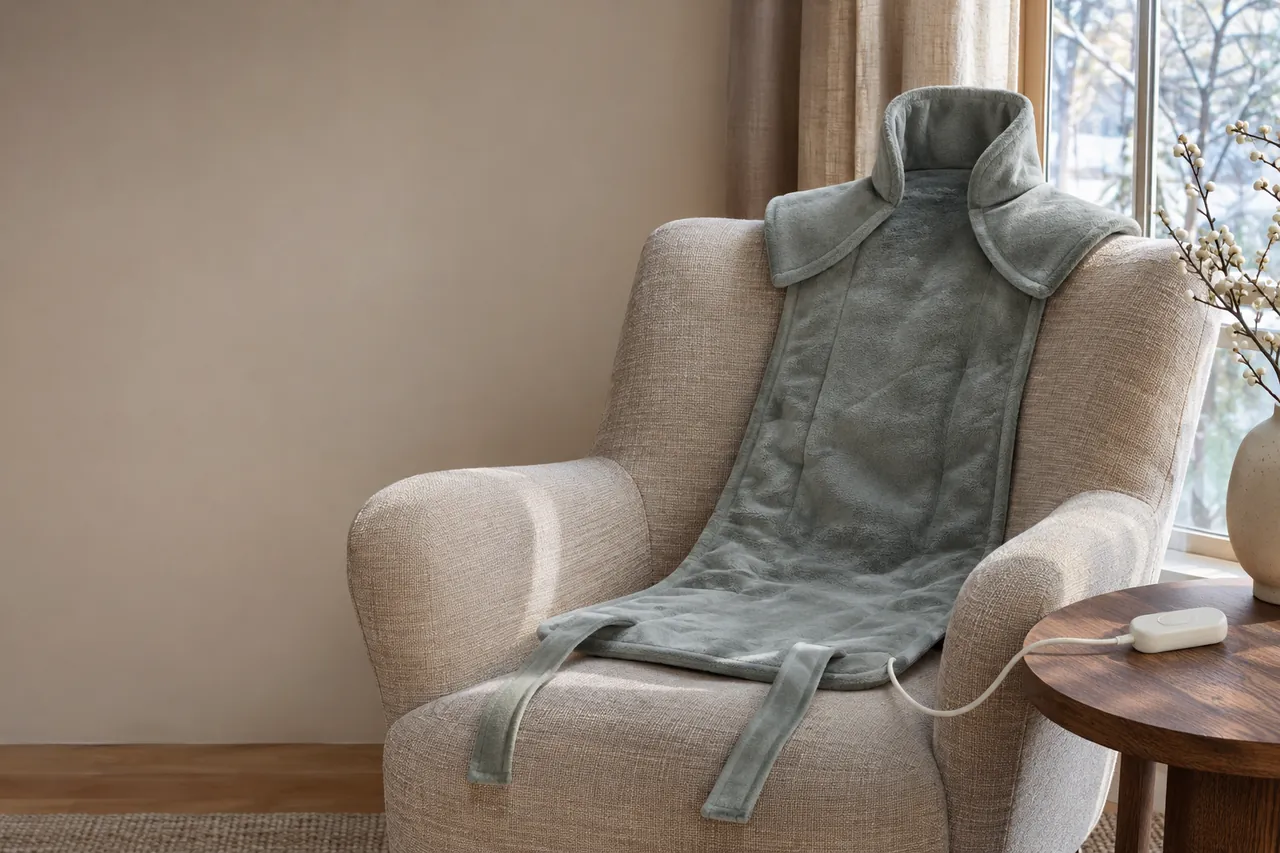
Battery runtime and safe time against the skin answer different questions. A rechargeable lumbar heating pad can provide warmth without a wall cord during use, but its fit, controls and user restrictions matter as much as the number on its battery listing.
Introduction
Use the Sunbeam GoHeat 2000-825 as one example of how a model’s specifications and instructions fit together, then compare those details with your own needs.
Read the Battery and Fit Details First
Evaluating physical design features, battery setups, and fastening systems helps you select a rechargeable lumbar heating pad that fits your body frame and daily schedule seamlessly.
Rechargeable wraps are designed to operate without a wall cord while their battery supplies power. Battery placement and charging arrangements vary by model.
Compare the dimensions and strap adjustment with the area you want to cover. The wrap should fit without folding, crushing or pressing against the pad.
To see how technical specifications and safety warnings are documented for a commercial cordless wrap, examine published details for the Sunbeam GoHeat Cordless Heating Pad (Model 2000-825):
Battery Power Specification: Sunbeam lists up to four hours of battery life on low for this model, while the pad has a two-hour automatic shutoff. Those numbers describe different features. The 2000-825 manual recommends 20 minutes on high or two hours on low and instructs users to check their skin frequently. These are directions for this model, not a schedule for other pads.
Thermal Control Settings: Features an inline digital controller offering 3 adjustable heat settings (Low, Medium, and High) to customize surface warmth.
Hands-Free Strap System: Incorporates an adjustable fabric strap designed to wrap securely around the waist.
Fabric Care: Follow the GoHeat model’s own cleaning instructions and remove its battery before cleaning.
Charging and storage also affect ownership. The manual says battery runtime can decrease over time and depends on use and storage conditions. Keep the battery unit and pad in a cool, dry location between uses, and use the power supply provided with the unit.
What the GoHeat Manual Requires
Operating any electric or battery-powered warming device safely requires reading and following the exact user manual provided with your specific product model.
Official user documentation for the Sunbeam GoHeat Cordless Heating Pad (Model 2000-825) explicitly mandates strict operational restrictions and safety warnings:
Do Not Sit On, Lean Against, or Crush the Pad: The GoHeat 2000-825 manual prohibits sitting on, leaning against, crushing or folding the pad.
Restricted Health Categories: The GoHeat manual says not to use this model on or by a person with diabetes, poor circulation or insensitivity to heat; someone sleeping, helpless, unconscious or incapacitated by medication; or a person described by the manual as an invalid. It also says not to use it on or by children, on an infant or an animal, or on areas of insensitive skin.
Do Not Cover with Insulating Material: The GoHeat manual warns against covering the pad with insulating material.
For individuals seeking an ergonomic targeted lumbar and back heating wrap to integrate into their daily rest routine, selecting a rechargeable wrap equipped with adjustable waist straps, clear heat settings, and automated safety controls can help match the device to your routine.
Is Cordless the Right Fit for Your Space?
A cordless heating wrap can make it easier to move between rooms without a trailing cable. A corded pad needs an outlet within reach, so consider where you expect to use it and how the cable will be positioned. Both styles vary in shape, controls and positioning restrictions. The Sunbeam GoHeat 2000-825 manual prohibits sitting or leaning on the pad, as well as crushing or folding it. Check the instructions for the particular product you choose.
Check the Strap and Controls
Sunbeam lists an adjustable strap that fits up to 55 inches around. For this model, the manual says to connect the pad to the battery unit, place the unit in its pocket with the controller facing up, and position the lighter fabric side against the body. Fasten the strap to the darker outer fabric and adjust it to a comfortable, snug fit without overlapping the heated area or restricting circulation. The power button cycles through low, medium and high; indicator lights show the selected setting. Keep the controls accessible and check your skin during use.
Charging and Care Between Uses
The GoHeat manual says its battery indicator flashes green while charging and turns solid green when fully charged. Charging can take up to three hours with the standard charger. Use the supplied power equipment and follow the manual’s instructions for your version. For cleaning, disconnect the pad cable and remove the battery/controller; do not wash that unit. Tuck the pad cable into its pocket, then hand wash or machine wash the pad in cold water on a gentle cycle. Air-dry or tumble-dry on low as directed, and reconnect only when both the pad and connector are completely dry. Do not dry-clean, bleach, iron or use a wringer.
Skin Monitoring and Safety
Operating a personal heating pad safely in your home requires practicing active skin monitoring, respecting electrical boundaries, and adhering to essential safety protocols.
As detailed in consumer safety literature from Comfytemp regarding home heating pad burn risks, individuals with reduced skin sensation—such as seniors, individuals with diabetes, peripheral neuropathy, or impaired blood circulation—face significantly higher risks of thermal skin burns. Because diminished nerve sensitivity prevents individuals from detecting rising skin temperatures or thermal discomfort, low-level heat can cause gradual tissue damage without warning. Some product labels, including the GoHeat 2000-825 manual, prohibit use by people unable to respond or remove the pad. Follow the restrictions for the specific model.
A primary dermatological risk associated with repeated, prolonged heat exposure is Toasted Skin Syndrome, medically known as Erythema Ab Igne. As documented by dermatological experts at the Cleveland Clinic, toasted skin syndrome is a skin condition caused by repeated, long-term exposure to low-level heat that alters skin tissue over time without causing an immediate thermal burn. Repeated exposure causes a characteristic net-like, reticulated pattern of hyperpigmentation and brown skin discoloration across the warmed area. To protect your skin, limit warming sessions to short, discrete periods and allow skin to cool naturally between applications.
Essential Daily Safety Rules
Use While Awake Only: Never wear or use any electric heating pad or battery-powered wrap while sleeping or napping. Reduced sensory awareness during sleep prevents you from detecting thermal discomfort or rising skin temperatures.
Active Skin Monitoring: Inspect your skin underneath the pad frequently during every session. If the pad feels uncomfortably hot, or if skin shows redness or irritation, stop using the device immediately and turn off the power supply.
STRICT SAFETY WARNING: Keep electric pads, controllers, cords and batteries out of the microwave. Only microwave a separate pack when its label expressly permits it, and follow its directions.
Proper Fabric Care: Always disconnect and remove the battery pack before laundering machine-washable fabric covers. Ensure all fabric components are completely dry before reconnecting battery units.
Choosing Heat or Cold
Understanding when to use heat versus cold therapy helps you choose the right comfort approach for your body's specific physical needs. According to medical resources from Healthline and Medical News Today regarding heat and cold application, choosing between temperature modalities depends on the timing and underlying nature of your physical discomfort:
Cold Therapy Applications: Cold packs are commonly used for a recent injury or swelling. Protect skin from direct ice contact and follow the pack’s directions.
Heat Therapy Applications: Gentle warmth can provide temporary comfort for muscle stiffness. It is not suitable for every condition, so follow the product’s instructions.
Dry Heat vs. Moist Heat Options: Spine-health describes dry and moist heat as different ways to apply warmth. Use moisture with an electrical pad only when its instructions specifically permit it.
What Warmth Can Do
Before selecting a personal warming appliance, it is essential to establish a clear understanding of the distinction between temporary muscle comfort and medical treatment. Thermal heat applied to your lower back is a supportive home comfort measure designed to provide temporary surface muscle relaxation. Applying a heating pad does NOT cure underlying spinal disorders, repair herniated lumbar discs, rehydrate worn spinal cartilage, or restore damaged spinal nerve function.
The manual explains how to operate this model; it does not identify the cause of an individual’s back pain.
References
Sunbeam — GoHeat™ Cordless Heating Pad
Sunbeam — GoHeat Cordless Heating Pad User Manual
Sunbeam GoHeat 2000-825 and 2003-825 manual (PDF)
Spine-health — How to Apply Heat Therapy for Pain Relief
https://www.spine-health.com/treatment/heat-therapy-cold-therapy/how-apply-heat-therapy
Spine-health — Benefits of Heat Therapy for Lower Back Pain
Healthline — Treating Pain with Heat and Cold
https://www.healthline.com/health/chronic-pain/treating-pain-with-heat-and-cold
Medical News Today — Heat and cold treatment
https://www.medicalnewstoday.com/articles/29108
Comfytemp — Heating Pad Safety Burn: Who's Most at Risk at Home
https://comfytemp.com/blogs/news/heating-pad-safety-burn-risk
Cleveland Clinic — What Is Toasted Skin Syndrome (Erythema Ab Igne)?
https://my.clevelandclinic.org/health/diseases/toasted-skin-syndrome