
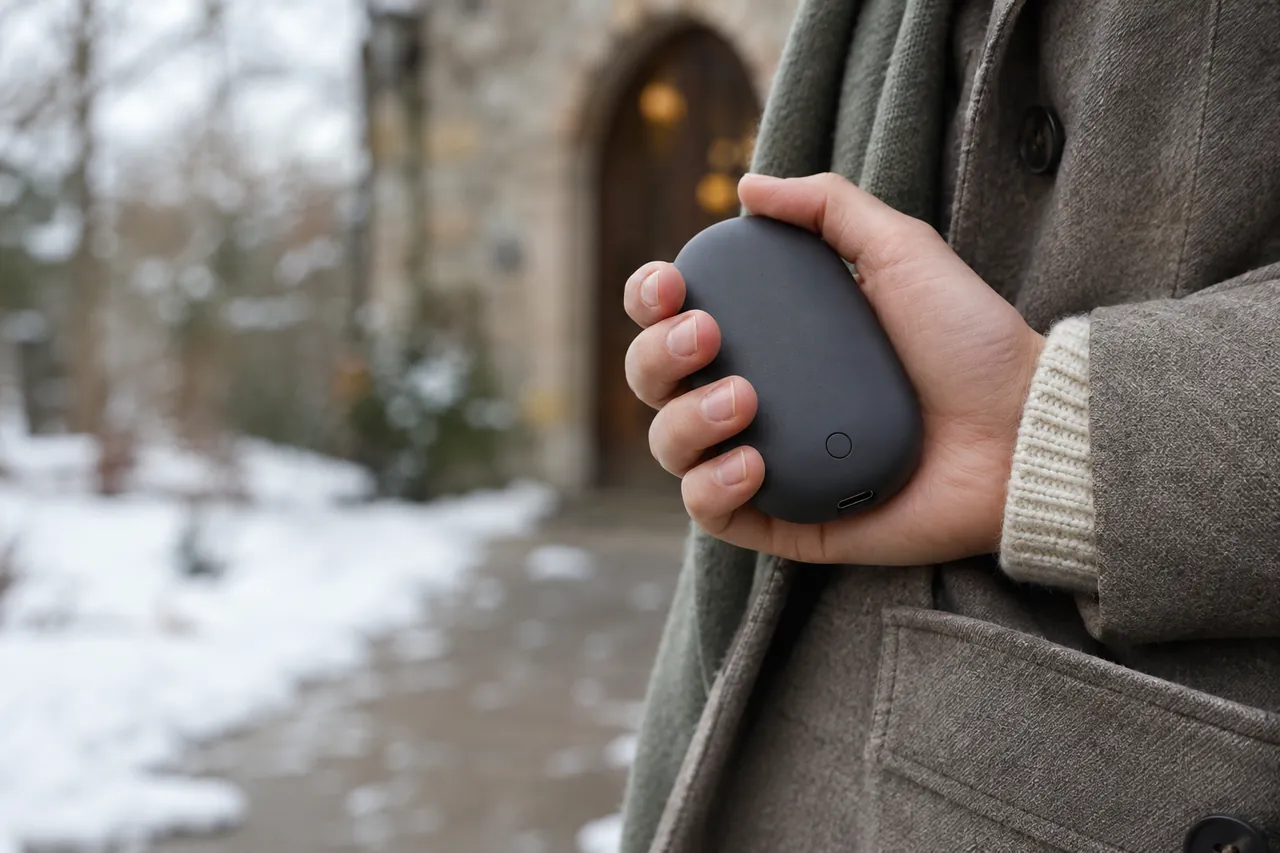
A runtime printed on a hand warmer package answers only part of the question most buyers have: will these keep my hands comfortable for the time I need them? With split magnetic hand warmers, the answer also depends on what the number describes. Is it the performance of one piece, a combined figure for the pair, or a result at a particular setting? Start by finding the conditions behind the figure, then compare the size, controls and charging routine that come with it.
Introduction
A pair can be stored together and separated for two hands or two coat pockets. That arrangement is useful only if both pieces suit the way you expect to carry and operate them. The longest headline figure is less useful than a clear picture of what the particular model does between charges.
The first question: what does the runtime number count?
Look for the exact wording beside a stated duration. “Up to” identifies an upper figure, not a promise that every setting will last that long. A range can reflect different operating conditions, but the range alone does not tell you the duration at every level. A figure presented for a pair also needs context: the listing should make clear whether it describes simultaneous operation or a different arrangement.
Keep the model name with the number in your notes. Similar-looking warmers can have different batteries, controls or charging arrangements. A specification from one generation should not be transferred to another merely because both pieces snap together. If a seller lists several variants on the same page, check which one is selected before comparing the advertised duration.
GearJunkie’s review lists the OCOOPA UT3 PRO at up to 15 hours total and describes two independently rechargeable pieces with four heat levels. A later Polish consumer-authority notice describes a Kolba safety campaign involving model UT4102, identified in reporting as UT3 PRO, because the battery may overheat or ignite. Do not use or charge a unit covered by that campaign. Match the model and sales channel to the notice before relying on an older review.
A reviewer’s day is not the same as a lab-style runtime test
Reviews can reveal details a specification table leaves out: whether controls are easy to reach, how the pieces feel in pockets, and whether the reviewer preferred them joined or separated. GearJunkie reports using the UT3 PRO pieces independently in hands or separate jacket pockets and finding the magnetic connection especially useful for storage. That observation belongs to its reviewers’ experience; it does not establish how every wearer will use the pair.
Read the testing description alongside the result. Did the reviewer state a setting, how long the device was switched on, whether both pieces were running, and where the warmers were carried? A series of short sessions and a continuous session answer different questions. A comparison is strongest when the same conditions are explained for each product, rather than inferred from a score or a star rating.
Outdoor Life gives a useful example of how a setting changes a reported result. For the magnetic OCOOPA pair it tested, one unit ran for 8.7 hours on low and the other for 5.4 hours on high. The test took place indoors at 70°F after charging, with each half set to a different level. The review does not give a full model number, so it cannot establish whether that sample matches the UT3 PRO or a safety notice. The figures describe that test, not a prediction for every pair outdoors.
Think in sessions rather than a single maximum
Map the times you expect to use warmth: perhaps a walk to a station, time waiting outdoors and a return trip. Add the periods when the warmer will actually be switched on, rather than counting an entire day as continuous operation. Then consider whether you can recharge between those sessions. A model that fits the schedule and is easy to operate may be more useful than a larger pair with an impressive maximum you rarely need.
Settings matter because different levels offer different amounts of warmth and may use the battery differently. Begin with the setting that feels comfortable and follow the device’s directions. Do not interpret a high setting as a target or a long runtime as a recommended length of uninterrupted contact. Take breaks, monitor your skin and remove the device when it feels too hot.
A pair adds another practical choice: you may want warmth in both pockets at once, or you may use one piece while keeping the other available. Whether that is convenient depends on the controls and charging design of the model. Read the instructions for the pair you own instead of assuming all magnetic halves operate or recharge in the same way.
What else a split design changes
Two pieces can make it easier to distribute warmth between hands, but they also give you two items to keep track of. Check their dimensions, weight and shape against the pockets where they will travel. A rigid rechargeable warmer does not fit the same spaces as a soft disposable packet. GearJunkie notes that the reviewed UT3 PRO does not fit inside gloves or boots in the same way as disposable warmers.
Controls should be easy to locate without repeatedly removing gloves or opening a bag. Look at how each piece is switched on, how settings are indicated and whether a protective pouch or wrist strap is included. A photo can show the general layout, but the exact package contents and instructions belong to the selected listing. Consider whether the parts can be stored together securely when not in use.
The accessories can make a split pair easier to organize between uses. GearJunkie lists two USB-C charging cords, two wrist straps and a soft carrying case with the UT3 PRO it reviewed. The straps help keep each piece close at hand, while the case gives both halves and their cables a place in a bag. Package contents vary between listings, so compare the accessories alongside the warmer rather than assuming a photo shows everything included.
Charging and care are part of the comparison
Check what cable and power arrangement the product specifies, how each half is connected, and how the charging indicator is read. Keep the directions with the device and use the equipment and method described for that model. A connector that looks familiar does not by itself establish that every charger, cable or charging arrangement is appropriate.
Plan where the warmers will be kept between uses. Protect them from damage, follow the product’s instructions on moisture and storage, and inspect the casing and connections before use. Stop using or charging a damaged device. A case can make a pair easier to find in a bag, while a model-specific charging routine helps prevent a missed charge before the next trip.
Read the current return and warranty terms for the exact variant as well. If you buy a pair as a gift, keep the model identification and instructions with the package so the recipient can use the correct settings and care guidance. Runtime is only one part of owning a rechargeable product; convenient controls and clear directions matter every time it is used.
Check the model against safety notices
The U.S. Consumer Product Safety Commission has recalled specified OCOOPA rechargeable hand warmer models UT3053, UT3056, ZLS-118, ZLS-118S, ZLS-118D, H01 and H01(PD). If a device matches the notice, stop using and charging it and follow the CPSC’s current instructions for the remedy and disposal. The recall identifies particular models; do not apply it to every warmer with a similar appearance.
A separate Polish consumer-authority notice describes a Kolba safety campaign involving UT3201, UT3053, UT4102, UT3056, UT3042, UT3043 and UT3057. Its scope and return arrangements are specific to that campaign; the U.S. CPSC notice has a different list. Check the exact model and sales channel against the applicable notice, and do not use or charge a covered unit. Retain the packaging and purchase records for identification.
Warm hands, with attention to skin
Mayo Clinic describes Raynaud’s as a condition in which cold or stress can trigger changes in blood flow, with symptoms that can include coldness, numbness and color changes. Warmth is relevant to avoiding cold exposure, but a device’s advertised runtime does not establish a treatment result. OCOOPA’s article also discusses keeping hands warm in the context of Raynaud’s.
Follow the warmer’s instructions for contact and use a suitable fabric barrier when directed. Do not place heat directly against numb skin or an area where temperature cannot be sensed normally. Remove the device if warmth becomes uncomfortable or skin becomes irritated. A long battery duration is not a reason to keep a hot surface against the same area without checking it.
Before settling on a pair, put the runtime beside the rest of your plan: how long each session lasts, whether you need both pieces at once, and where you will recharge them. Compare the stated duration at the setting you expect to use with the size and control layout of the exact model. Keep the instructions and model number with the pair, especially if you share it or store it between seasons. The best fit is the one that works with those habits as well as the pocket in your coat.
Sources
GearJunkie, The Best Hand Warmers of 2026
Mayo Clinic, Raynaud’s disease
OCOOPA, rechargeable hand warmers and Raynaud’s
Pure Enrichment, WeightedWarmth body pad
Outdoor Life - Rechargeable hand warmer testing