
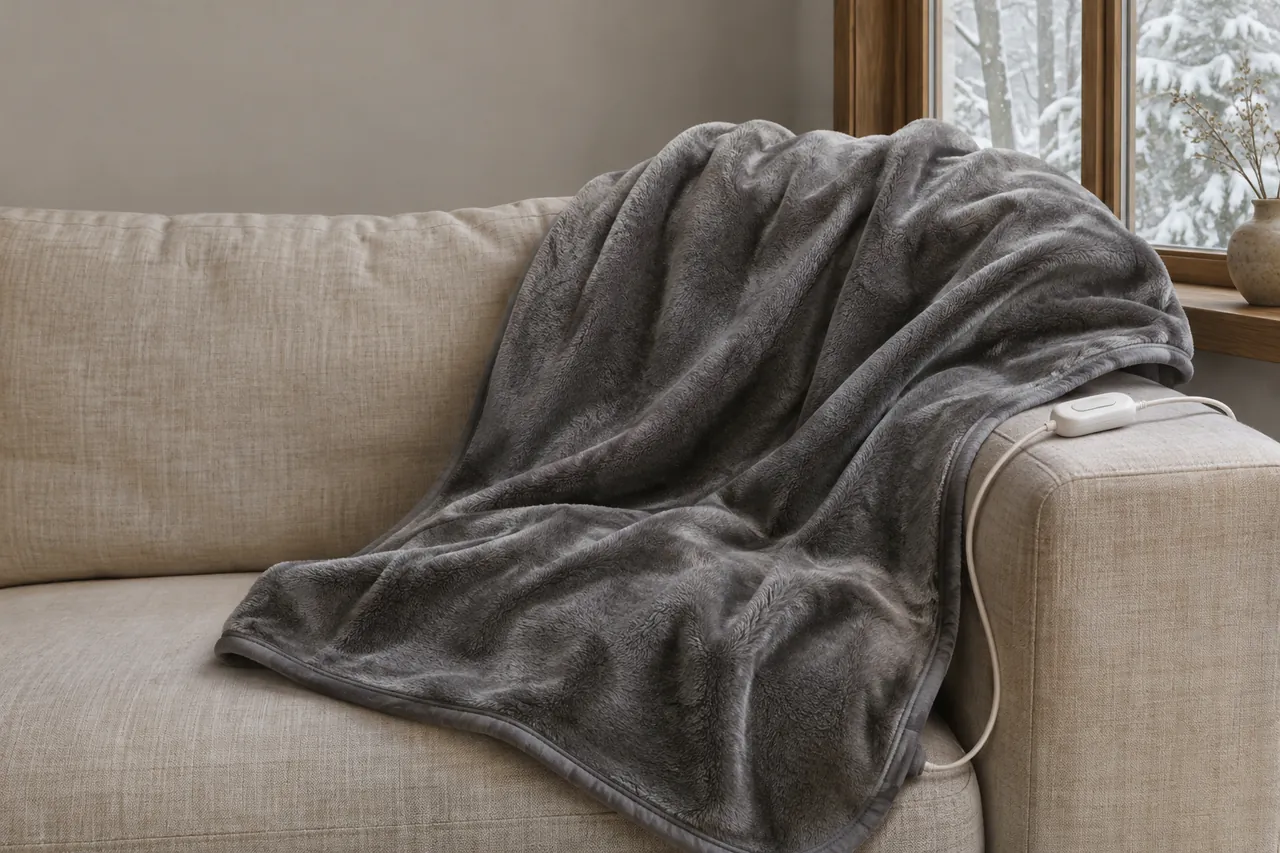
One person likes a warmer side of the bed; the other sleeps comfortably under a lighter cover. That familiar mismatch makes choosing an electric blanket for a double bed more than a question of size. Coverage, the position of the heating layer and the way the controls work all affect how well it fits your routine.
Introduction
The label on the package is only the starting point. Two products marked “double” can differ in their dimensions, the part of the bed they cover, and the way their controllers work. A useful choice starts with the mattress you have, the coverage you want, and the people sharing it.
Start with the way you use the bed
Start with the situation closest to yours. Each of these three arrangements calls for a different balance of coverage, controls and convenience.
Two sleepers, different preferences
Two people share a double bed. One likes the bedding warmer, while the other generally prefers a lighter cover.
• A possible choice: Compare pads or blankets that explicitly offer independent controls in the size needed.
• The trade-off: Two controls can add flexibility, but the partners still need enough coverage and a sensible place for each controller. If separate controls are unavailable in that size, an unheated bedding arrangement may be a simpler choice for a couple with very different preferences.
One sleeper, a removable covering
One person uses a double mattress and wants a cover that is easy to remove while making the bed.
• A possible choice: A top blanket with dimensions suitable for the desired coverage and a control that is easy to reach.
• The trade-off: An easily removed cover offers flexibility, whereas a fitted pad may stay more neatly in position. A timer may be useful if the chosen model has one, but timer operation varies. Follow the instructions on whether that particular blanket may be used during sleep.
A cool room and a cold bed at bedtime
A sleeper prefers the room on the cool side but dislikes getting into cold bedding.
• A possible choice: Compare a blanket and a pad that offer a pre-warming setting or instructions for pre-warming.
• The trade-off: A pad stays with the mattress, while a top blanket is easier to remove from the bed. Pre-warming directions, switch-off settings and whether a device can remain on during sleep depend on the specific model. General advice about bedroom temperature does not establish a universal setting or predict energy savings.
Does each side need its own control?
Two people can share a bed without wanting the same amount of warmth. One partner may appreciate a warmer side while the other prefers less heat. It is useful to discuss this before ordering, because a double-size label alone does not say how the controls are arranged.
A cooler bedroom and a warm bed can be separate preferences. The Sleep Foundation discusses bedroom temperature as part of the wider sleep environment; the controls on the bedding let you adjust the covering itself. Think about when you want warmth and where each person will keep a controller within reach.
When evaluating an electric blanket or heated mattress pad for a double bed, buyers should check the controller configuration:
• Single control: One controller can be straightforward to operate. Read the product description to see what it controls and whether its coverage suits the way the bed is shared. A single controller may be enough for a person sleeping alone or partners with similar preferences.
• Independent controls: Some models offer separate settings for each side. If this feature matters, check that the particular double-size version includes it; controls can differ by model and size. Consider where the cords and controllers will sit on each side of the bed.
For example, Sunbeam lists its Slate Gray Velvet Full/Queen blanket with two controls, 12 heat settings and a 12-hour automatic shut-off. The manufacturer gives its dimensions as 84 by 90 inches. Those details are for this Full/Queen model: compare them with the bed and the desired overhang before deciding whether that particular covering is a good fit.
Measure the bed before comparing sizes
When shopping online for a double-bed electric blanket, pay attention to the market and measurements used in the listing.
The names sound interchangeable, but the usual mattress measurements differ slightly by market. UK bed retailer John Lewis lists a double mattress at 135 by 190 cm. Sleep Foundation gives a US full mattress as 54 by 75 inches (about 137 by 191 cm). These are mattress dimensions, not electric-blanket dimensions. Measure your own bed and compare the actual dimensions of the covering or fitted pad before ordering, especially across markets.
A measuring tape and the listing’s dimensions give you a more useful comparison than the size name alone:
• Top blanket coverage: Measure the mattress width and length, then compare the actual blanket dimensions with the coverage you want. Remember that the heated area and the outer fabric dimensions are not necessarily described in the same way. Do not assume that an oversized blanket is suitable for tucking under a mattress.
• Mattress pad fit: Record the mattress depth as well as its width and length. Compare those measurements with the pad and its fitted skirt or fastening method. A pad designed for a shallower mattress may not sit as intended on a deeper one, even when both carry the same size label.
Choose a top blanket or a fitted mattress pad
First decide where you want the heated layer to sit. Sleep Foundation’s guides discuss two choices: a top blanket and a fitted heated mattress pad.
A heated top blanket is designed to cover the sleeper. It can be easier to take off the bed or adjust as a covering, while a fitted pad is designed to stay on the mattress. Check the directions for the actual model before adding other bedding over it or moving it to a different piece of furniture.
A heated mattress pad is designed to sit on the mattress, typically beneath a fitted sheet. Its fitted construction helps it stay in place, so the feel and fit of the pad matter as much as its controls. The Sleep Foundation reviews both blankets and pads as different approaches to heated bedding; choose the placement specified for the product you actually buy.
The difference is easy to picture when you make the bed: one layer can be lifted away as a cover, while the other stays fitted around the mattress.
• A top blanket offers a removable covering. Compare its width and length with the part of the bed you want it to cover, and use it in the orientation described in its instructions.
• A mattress pad needs to fit the mattress, including its depth. If you prefer an uncluttered top layer and want the fitted layer to stay in place when making the bed, that construction may be the more convenient choice.
Set up and care for the chosen product
The most useful instructions are the ones supplied with the exact blanket or pad. Check them before planning how the appliance will be placed, layered, cleaned or used during sleep.
A few points can make the choice easier when comparing listings and setting up the bed:
• Placement: Use a blanket or pad in the position its directions specify. Do not assume a top covering can be used as an underlay or that a blanket can be tucked underneath a mattress.
• Sleep use: Check whether the selected model is intended for use while sleeping or only for pre-warming. Controls and automatic shut-off settings vary.
• Bedding and other devices: Follow the model’s directions on layers and avoid combining active heating products unless their instructions explicitly allow the arrangement. Keep the appliance dry and out of use if damaged.
• Cleaning and storage: Follow the care label for the particular model, including instructions for detachable controls and complete drying. Storage directions can also differ, so retain the instructions with the appliance.
• Inspection: Look over the fabric, cord and controller before use. Stop using it if you notice damage or an unusual smell.
The best starting point is the way the bed is actually used. Choose the coverage first, decide whether a second control would make a difference to both sleepers, and then compare the fabric and care routine that will work in your home.
References
Sleep Foundation, bedroom temperature: https://www.sleepfoundation.org/bedroom-environment/best-temperature-for-sleep
Sleep Foundation, electric blankets: https://www.sleepfoundation.org/best-bedding/best-electric-blanket
Sleep Foundation, heated mattress pads: https://www.sleepfoundation.org/best-mattress-pads/best-heated-mattress-pad
Sunbeam: Slate Gray Velvet Heated Blanket, Full/Queen