
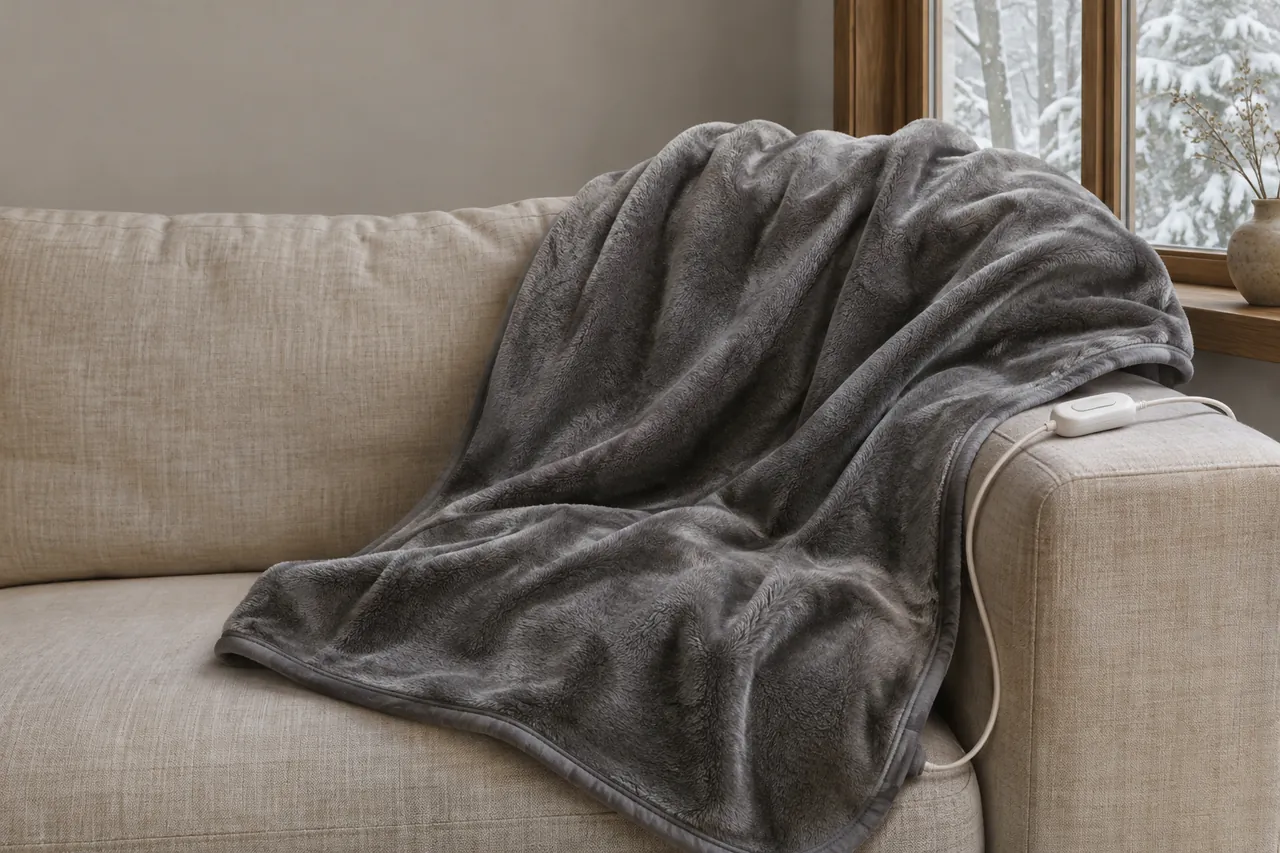
A low-EMF electric blanket may appeal to someone who wants more information about electromagnetic fields in their home. To compare listings meaningfully, look beyond the phrase on the label: identify the field measured, its units, the location of the measurement and the conditions in which the blanket was operating.
What to look for in a test result
Imagine two listings: one uses the words “low EMF” without a figure; another gives a magnetic-field result together with its measurement position and operating conditions. The second provides more information to interpret, but the result should still be read within those stated conditions. Neither description alone establishes a medical benefit or substitutes for the rest of the product information.
If a listing includes a test result, first identify the field and unit. The National Cancer Institute describes electric-field strength in volts per metre and magnetic-field strength in microteslas. A number without a field type or unit is difficult to interpret, and measurements expressed in different units cannot be compared directly.
Next look for the measurement position. Was the sensor placed at the surface, near the controller, or at a stated distance from the product? Was a single location measured or were several locations examined? Fields can vary across an appliance, so a single reading should not be assumed to represent every point on the blanket.
The operating state matters too. A report is more informative when it describes whether the product was connected to power, which setting was selected and when the reading was taken. Note the equipment and method if those details are provided, as well as any background reading. A comparison with another model is most useful when the products are measured in comparable ways.
Which field is the label talking about?
EMF stands for electric and magnetic fields. Electrical appliances are among the sources of these fields in a home. A product described as low EMF may be marketed with an emphasis on its field level or construction, but the wording itself is not a measurement. The useful details are the reported result and the conditions under which it was obtained.
Start with the exact model rather than the brand name alone. A product family can contain blankets of different sizes or designs, and a claim on one listing should not automatically be applied to another. Check whether the information describes the electric field, the magnetic field, or both; a result for one does not tell you the level of the other.
Electric fields are associated with voltage, while magnetic fields are associated with electric current. They are related concepts, but a description of one is not a complete description of the other. For a shopper comparing test reports, that distinction matters: a magnetic-field reading and an electric-field reading use different units and answer different questions.
A lower voltage listed on a product is not, by itself, a measurement of its magnetic field. The design and operating conditions matter as well. Treat “low voltage” and “low EMF” as separate descriptions and compare the information actually supplied for each.
The World Health Organization (WHO) notes that fields around household appliances vary with design and generally decrease with distance. That helps explain why two readings are difficult to compare if one was taken at the surface of a product and the other was taken farther away. An electric blanket is used close to the body, so the location and conditions of any measurement deserve particular attention.
What does the research actually say?
The US National Cancer Institute (NCI) describes electric blankets as one source of extremely low frequency electromagnetic fields, along with power lines, household wiring and other electrical appliances. These fields are in the non-ionizing part of the electromagnetic spectrum, unlike X-rays and gamma rays. NCI explains that non-ionizing fields are not known to damage DNA or cells directly in the way ionizing radiation can.
In its 2016 question-and-answer review, WHO reported that the evidence at that time did not confirm health consequences from exposure to low-level electromagnetic fields. WHO also discusses gaps in knowledge and the continuing study of possible long-term effects. Its discussion covers a range of sources and exposure conditions, so it should not be used as a test result for a particular electric blanket.
NCI’s fact sheet reviews studies of non-ionizing fields and cancer in children and adults. It reports no consistent evidence linking household appliance use with childhood leukaemia, while some studies of higher residential magnetic-field exposure have found an association. NCI also notes that an IARC expert group classified extremely low frequency magnetic fields as possibly carcinogenic to humans, based on limited evidence relating to childhood leukaemia. An association does not by itself establish that exposure caused an illness, and these findings are not a measurement of a particular blanket.
These findings concern different sources and exposure patterns. They do not establish that a particular blanket causes disease or that choosing a low-EMF model prevents it. A product measurement describes the tested item under the conditions reported; it is not a clinical outcome.
If the field information matters to you, put it alongside the everyday details of the product. Dimensions, reachable controls, intended placement and cleaning instructions all shape how a blanket works in your room.
Choose for the bed and the way you use it
Think first about the form of warmth you want. A heated top blanket and a heated mattress pad occupy different positions on a bed and may have different placement instructions. Check the intended use of the exact product, its dimensions and whether it fits your mattress or preferred seating area. Do not assume a throw designed for a sofa can be treated as a fitted underblanket.
Controls are another everyday detail. Consider whether the display is readable and reachable from your usual position, whether the available settings suit your preferences, and how the lead reaches the outlet. Some products offer separate controls; the listing and instructions will describe what a particular model actually does. Avoid pinching the lead under furniture or running it across a walkway.
Bedsure’s guide to warm-up time describes factors that can affect how a blanket warms. It is more useful to read the instructions for your model than to expect one fixed preheating time from every design. If the product has a preheat function, use it as directed and select a comfortable setting for its intended use.
The Sleep Foundation discusses bedroom temperature as one aspect of the sleep environment. Individual comfort differs, and a cooler room paired with an electric blanket is not a guarantee of faster sleep or a particular sleep stage. Adjust the room and bedding to your own comfort while respecting the appliance’s instructions.
A comparison is easier when you write down the same details for each item: its size, intended placement, controller arrangement, cleaning directions and the field information supplied with that particular model. The list gives the label a useful context without allowing one feature to stand in for the whole purchase.
Care and comfort after purchase
Follow the placement instructions for the blanket you choose. Do not operate it folded or bunched, and do not sit or lie on a top blanket unless the specific instructions permit that use. Heated mattress pads and top blankets can be designed differently. Check the instructions before placing anything over the appliance or leaving it on while sleeping; do not assume that every model is approved for overnight operation.
Healthline describes skin changes associated with prolonged exposure to heat. Use a comfortable setting, follow the directions for contact with skin, and stop using the blanket if your skin becomes irritated or the heat feels uncomfortable. The EMF description of a product does not replace attention to temperature and safe handling.
Before cleaning, switch off and unplug the blanket. Whether the controller detaches and whether the fabric can be washed or dried by machine depend on the model. Follow its care label and directions, keep electrical components dry, and wait until the blanket is completely dry before reconnecting it. Let it cool before storage, avoid sharp folds, and inspect the fabric, lead and controls for damage before returning it to use.
A thoughtful purchase weighs the full set of information: an interpretable field claim if that matters to you, a size and controller arrangement that fit your room, and instructions you can follow in everyday life. Together, those details are more useful than a single phrase on a label.
References
World Health Organization — Electromagnetic fields
National Cancer Institute — Electromagnetic fields and cancer
Bedsure — Electric blanket warm-up time