
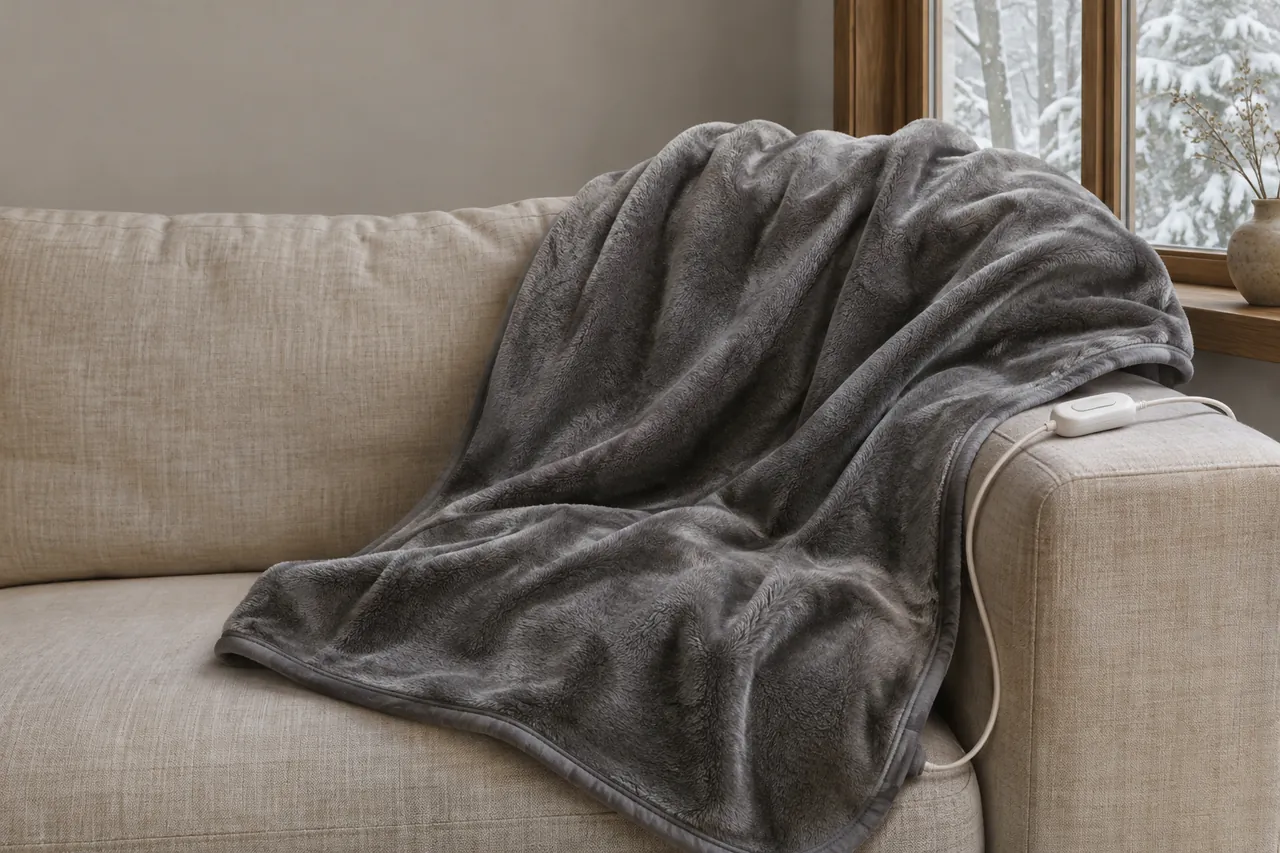
“Heated blanket” and “electric blanket” are often two names for an electrically warmed blanket. The more useful distinction is the product’s intended placement: a loose throw, a bed blanket and a fitted mattress pad are not necessarily used in the same way.
Introduction
A name alone does not tell you whether a particular item can be slept with, sat on, folded during use or washed in a machine. Look for those answers in the instructions for the exact model.
The name is less useful than the intended placement
Stores often group several heated products together. The important question is where each one is designed to go.
A heated blanket may be designed as a loose cover for a bed. Check the product’s instructions for where it belongs and whether it is suitable for use during sleep.
A heated throw is generally a loose cover. Compare its listed dimensions and intended use with the area you want to warm, and follow its placement instructions.
A heated mattress pad is designed for use on a mattress. Sunbeam describes its warming blankets as covers that go over the body and its mattress pads as providing warmth from underneath. The exact model’s instructions explain fitting and layering.
Heating pads are a separate category that often targets a smaller area, such as the neck or lower back. Follow the placement and use instructions for the specific pad.
Match the product to the placement described in its instructions. Do not assume a throw may be placed under the body or that a fitted mattress pad can be used as a loose cover.
Read a listing in five steps
Start with the product category and its dimensions. A retailer may place a heated throw and a fitted mattress pad in the same bedding section, but the photographs and fitting instructions should show whether the item is intended as a loose cover or placed on a mattress. Compare the size with your bed or seating area and check how the item is secured, if at all.
Next, look for the power arrangement. A plug-in blanket needs a suitable outlet and a cable route that does not cross a walkway or pass through moving furniture. Check where the controller sits and whether you can reach its buttons without pulling on the fabric. If a product is described as portable or wearable, inspect its power description rather than assuming it runs on a battery.
The setting names can also differ. One model may describe a preheat function while another lists only numbered heat levels. A shut-off timer describes a control feature; it does not answer every question about how the item should be positioned or whether it is intended to remain on during sleep. The instructions for that model bring those details together.
Care is another useful way to compare listings. Look for the cleaning instructions for the fabric, controller and cable separately. A removable cover, a detachable controller and a machine-washable blanket are different features. Check which components are removable and which cleaning method is actually permitted before making a decision.
Finally, consider what you need to do after use. Switch off and disconnect as directed, allow the product to cool, and store it according to the model’s instructions. A clear care label is useful long after the initial purchase, so keep the instructions with the product or save a copy where you can find it.
Sunbeam’s FAQ also uses the term “blanket shell” for a heated blanket with wiring but without controls or packaging. That is different from a removable fabric cover. When comparing a listing that uses the term, check the included components: the word “blanket” alone does not establish that a controller comes with it. Follow the model’s instructions for compatible components.
Where will you use it?
Start with the place you actually want to use the product: a bed, a sofa or another seat.
Your usual position can shape how you arrange the rest of the bed. Manta Sleep discusses side and back sleeping and suggests using pillows for support. Leave room for those pillows while keeping the heated item in the position specified by its own instructions.
Side sleeping: Check whether the bedding and its controls remain comfortable for your preferred position.
Back sleeping: Keep the chosen bedding in the position specified for that model.
Seated use: Check the throw’s size, cable route and controller placement.
A loose throw may suit a seated setting when used according to its directions. For a bed, compare a blanket and a fitted pad by their intended placement, size and care requirements.
The Sleep Foundation also considers room temperature as part of the sleep environment. Think about the bedding and room together, and choose layers that can be adjusted for comfort. The product’s directions determine whether and how that specific heated item can be used during sleep.
Why warm-up times differ
Heating speed differs between products and settings. Read the exact model’s directions for any pre-warming function.
Bedsure discusses factors that can affect how quickly an electric blanket warms. Compare product instructions and avoid applying one model’s timing to another.
Fabric: Material and construction are among the factors discussed in warm-up comparisons.
Size: Different products vary in dimensions and design.
Room conditions: Consider the environment described in the product guidance.
Controls: Use the setting and warm-up directions specified for the particular model.
There is no single preheat duration for all blankets. Follow the model’s instructions for placement and warming, and stop using a damaged or malfunctioning product.
What the controls and care label tell you
The control and care label answer different questions: how the product is operated and how it can be cleaned.
Controls vary: some products provide several settings or a timer, while others use a different interface.
Heat settings: Numbered levels let you select a setting on models that provide them. Check the instructions for how the controls work and which settings are permitted for your use.
Automatic shut-off: A timer is a device feature, not proof that a product is suitable for sleep or a recommended period of skin contact.
Cleaning directions vary. A detachable controller does not by itself establish that the whole blanket can be machine washed.
Before cleaning: Disconnect power as directed and keep controllers and plugs away from water.
Care label: Use the washing and drying method specified for the particular model.
Drying: Let cleaned parts dry fully before reconnecting, as directed.
Because care procedures differ by fabric blend and electrical design, users must follow their specific model manual rather than improvising cleaning methods.
Protecting the blanket and your skin
Check the product before use and follow its placement, operating and care instructions.
Watch for skin changes
Healthline describes toasted skin syndrome as a skin condition associated with repeated or prolonged heat exposure. Its article provides general health context, not a test of a specific blanket.
Stop using the product if it feels uncomfortable or your skin becomes irritated, and follow its directions for skin contact.
Inspect the product before use
Check placement, folds and condition before switching it on:
Placement: Do not assume a throw or top blanket can be sat or laid on; follow its instructions.
Folds: Follow the exact model’s instructions and do not assume it may be operated folded or bunched.
Visual inspection: Inspect the power cord, controller housing, and fabric shell before each use. Look for frayed wiring, cracked plastic sockets, loose plug pins, or scorched fabric.
Damage: If you discover physical damage, exposed copper wiring, or a persistent electrical odor during operation, switch off power at the wall outlet, unplug the appliance, and stop using it immediately.
Sleep: Never assume a heated throw or top blanket is approved for overnight sleep. Read the product instructions to see whether they permit use during sleep or require switching the appliance off before sleeping.
Compare intended placement, controls and care for the exact item, rather than choosing by its name alone.
Sources
Bedsure, Electric Blanket Heat-Up Time: https://bedsurehome.com/blogs/bedsure/electric-blanket-heating-time-factors-warm-up
Manta Sleep, Sleeping Positions: https://mantasleep.com/blogs/sleep/best-sleeping-position
Healthline, Toasted Skin Syndrome: https://www.healthline.com/health/toasted-skin-syndrome
Sleep Foundation, The Best Temperature for Sleep: https://www.sleepfoundation.org/bedroom-environment/best-temperature-for-sleep