
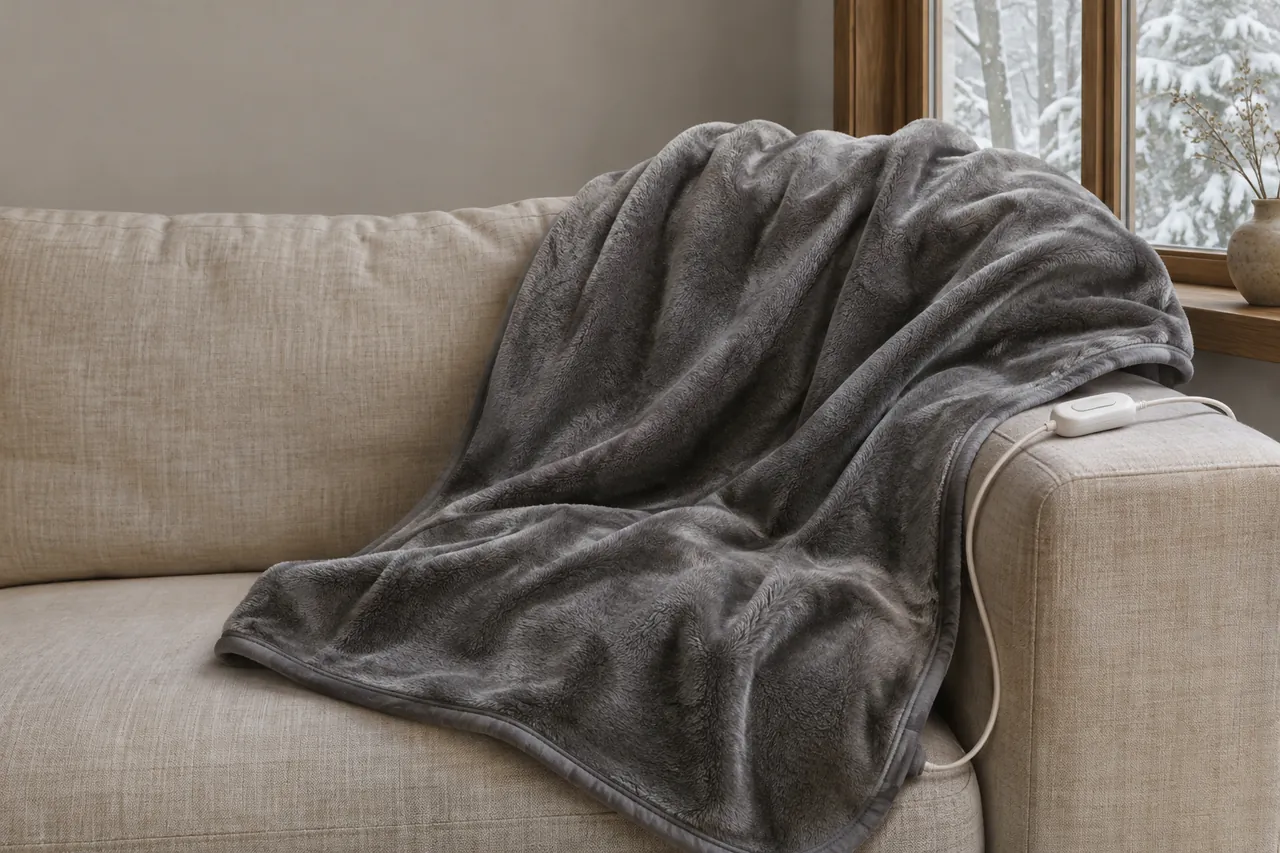
Start with the area you want to warm. A heated blanket or throw provides warmth close to the person it covers. A portable space heater is intended to warm an area of a room. They solve different problems, so the choice depends on who is using the space, where the appliance can be positioned and how long it will be needed.
Introduction
A blanket may suit someone sitting in one place with a book. A heater may suit an occupied area where people move around, provided the room has the required clearance and a suitable outlet. Neither choice should be made on a generic savings claim alone: compare the actual products and the way your household will use them.
Who needs warmth?
For one person on a sofa, a heated throw concentrates warmth around the covered area. Check its size against the coverage you want, and read the instructions for placement. A top blanket, a throw and a fitted heated mattress pad are separate categories; Bedsure’s bedding comparisons describe different constructions and intended positions.
For a shared living space, a portable heater can warm an area without requiring everyone to sit under the same cover. The effect depends on its design, the room and where people are positioned. A radiant model and a fan-driven model need not feel the same, even when both are described as space heaters.
If people have different comfort preferences, compare the controls on the exact models. Some blankets provide separate controls for different areas, while heaters may use a thermostat or adjustable settings. A feature on one product is not necessarily included in another size or version of the same range.
Consider the rest of the room too. A heated throw does not make a cold bathroom or kitchen warm while you move around, and a portable heater needs clear space around it. Decide what problem you are solving before comparing fabric colours, extra settings or timer displays.
Where can each appliance go?
The US Consumer Product Safety Commission advises keeping portable heaters at least three feet from combustible materials such as bedding, furniture and curtains. It also advises plugging electric space heaters directly into a wall outlet, never an extension cord or power strip, and turning them off while sleeping.
That clearance can decide the issue in a small or crowded room. Picture the heater in its operating position, with people able to walk past it and soft furnishings kept away. A convenient outlet behind a curtain or beside bedding does not remove the need for clearance. Keep the heater stable and follow its own placement instructions.
A blanket has a different set of placement instructions. Check whether the model is designed as a top cover or a mattress pad and whether its directions permit use during sleep. Do not assume a heated throw can be sat on, folded beneath a person or trapped under furniture. Inspect the fabric, cord and controller before use.
If a heater and a blanket are both in the room, keep the blanket and its cord outside the heater’s required clearance. Each appliance still needs to be used according to its own instructions. A heated blanket should not be draped over a portable heater to dry or warm it.
Estimate electricity use
Look at the power rating on each appliance and consider the time it will operate. Your electricity rate also affects cost. These are inputs to a comparison, not a promise that one product will save a particular amount in every home. A heater controlled by a thermostat may cycle, and a blanket’s operation depends on its own settings and controls.
Compare the same period for both appliances. The U.S. Department of Energy explains that energy use depends on power and time. A thermostat or controller may cycle the heating element, so multiplying the maximum rating by the entire elapsed time is a full-power estimate, not necessarily the energy actually consumed. If a blanket changes how another heating system is used, include that change in the household comparison.
The scope of warmth matters when interpreting the numbers. A heater may serve a larger area, while a blanket serves the person or bedding it covers. Lower consumption for a particular appliance does not mean it delivers the same amount or distribution of warmth as the other option. Compare cost alongside the actual job you need done.
For a full-power estimate, divide watts by 1,000, multiply by hours, and then multiply the kilowatt-hours by your electricity rate. Suppose a 100-watt throw and a 1,500-watt heater each draw that power for two hours: they use 0.2 kWh and 3 kWh respectively. At an assumed rate of $0.20 per kWh, that is $0.04 and $0.60. These are hypothetical figures, not measurements or a promise of savings; the appliances also warm different areas.
For a more representative figure, a suitable plug-in electricity meter can record the energy an individual appliance uses over the same period, subject to the meter’s rating and instructions. Compare those readings with the coverage each appliance provides; a whole-room heater and a personal throw are doing different jobs.
Check the exact product variant before using a rating in an estimate. A full-size blanket and a smaller throw may have different labels and controls, even when they share a collection name. For a heater, use the rating for the selected model and setting information from its instructions.
Match it to your routine
A space heater needs a clear location each time it is used. Its controls should be accessible, and the room should not be so confined that heat accumulates around someone unable to respond. CPSC warns against leaving portable heaters unattended in a confined space around infants or people with reduced physical, sensory or mental capabilities.
A heated blanket needs room to lie in the position allowed by its directions. Consider where the controller will rest, whether the cord can reach without crossing a walkway, and how the fabric will be stored. If you share the blanket, confirm that the size and controls suit both users.
Warm-up expectations also differ. Bedsure’s guide says electric-blanket heating time varies with the product, settings and surroundings. Follow the model’s preheat directions if it has them; do not assume every blanket reaches the same temperature in the same number of minutes.
Care looks different for each appliance
For a blanket, unplug it and remove detachable parts only as directed before cleaning. The care label should state whether and how the fabric can be washed and dried. Keep controls and plugs out of water and reconnect only after the required parts are completely dry. A removable controller alone does not make every blanket machine washable.
A heater has its own maintenance instructions. Switch it off and allow it to cool as directed before cleaning or moving it. Check the cord, plug and housing for damage. If an appliance is damaged, produces an unusual smell or shows scorching, stop using it. Store it where it is protected from impact and moisture.
Before the next cold season, inspect both types of equipment and check for recalls. The CPSC recommends stopping use of a recalled product and following the stated remedy. Keeping the model information and instructions makes that check easier.
Choose for the space you actually use
A heated throw is a focused option for a person sitting or resting in one place. A portable heater may be useful when an occupied area needs warmth and the required clearance and outlet are available. Compare coverage, safe placement, controls, operating time and care together; the most suitable option is the one that fits both the room and the people using it.
References
US CPSC: Portable heater and home-heating safety — https://www.cpsc.gov/Newsroom/News-Releases/2023/CPSC-Warns-Consumers-to-be-Cautious-When-Using-Space-Heaters-Furnaces-and-Fireplaces-This-Winter
Bedsure: Electric blanket vs. heated comforter — https://bedsurehome.com/blogs/bedsure/electric-blanket-vs-heated-comforter
Bedsure: Heating pad vs. electric blanket vs. heated mattress pad — https://bedsurehome.com/blogs/bedsure/heated-pad-vs-electric-blanket-comparison
Bedsure: Electric blanket heat-up time — https://bedsurehome.com/blogs/bedsure/electric-blanket-heating-time-factors-warm-up
Bedsure: Electric blanket safety — https://bedsurehome.com/blogs/bedsure/are-electric-blankets-safe-safety-guide
U.S. Department of Energy: Electrical energy, power and time