
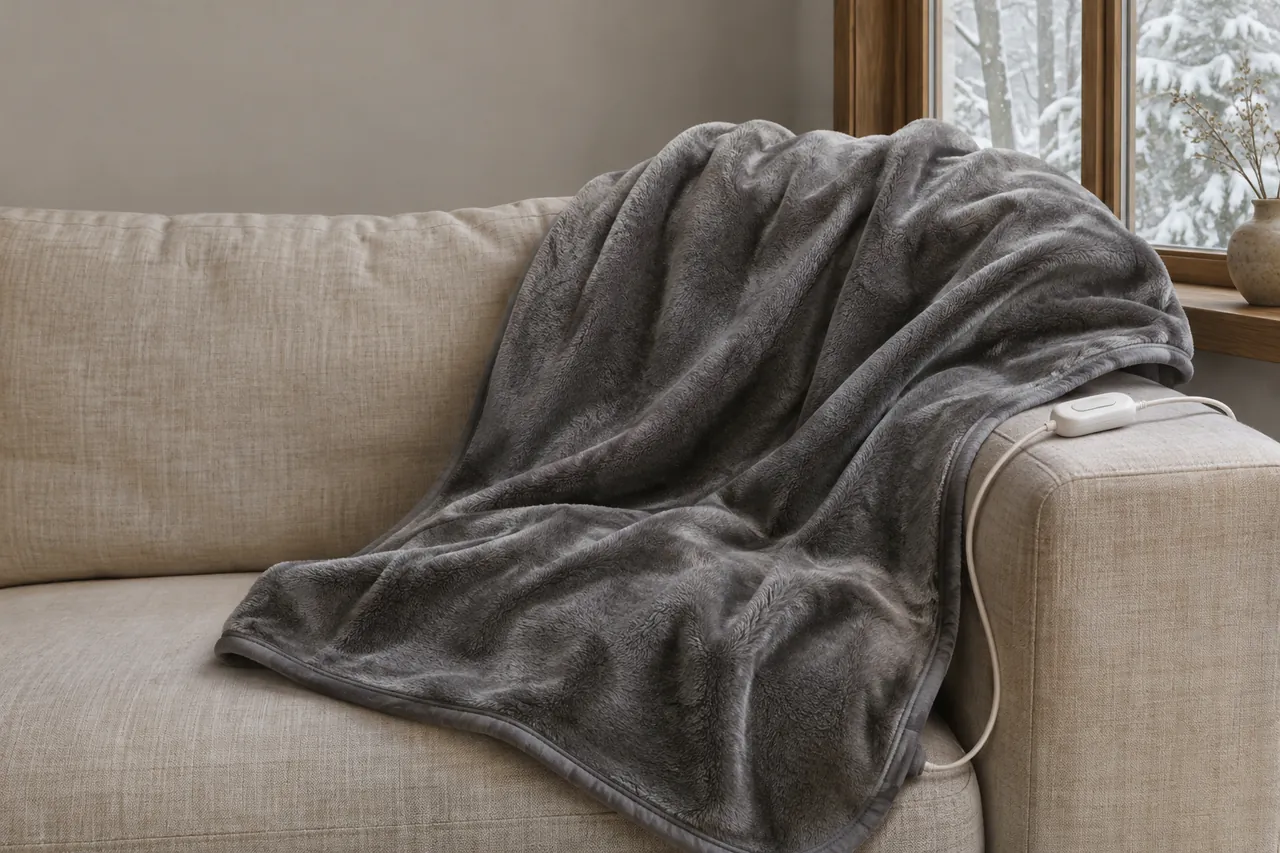
Before using a heated electric blanket on a sofa, decide where the lead and controller can sit without being pulled, pinched or exposed to a drink. Then check the throw’s placement instructions and its condition. Those small decisions make the blanket easier to use and help keep the setup clear of the sofa’s moving parts.
Set up the sofa and cord
Before connecting the blanket, sit in your usual spot and find the nearest suitable wall outlet. Follow the power instructions for your model. Plan a route that keeps the cord out of walkways and away from sofa feet, sharp edges, and the gaps between cushions. The controller should be easy to reach without tugging on the blanket or leaning across someone else.
If your sofa reclines, check the full path of the moving footrest and frame while the blanket is disconnected. A cord that looks clear when the chair is upright can become trapped when the mechanism moves. Keep it outside the mechanism and leave enough room for movement without pulling the plug. Rearrange the seat or outlet position if you cannot create a clear route.
Next, lay the blanket in the position its directions describe. Many throws are designed to cover the user, while a heated mattress pad is a separate product made for a different position. Bedsure’s comparison of heating pads, electric blankets, and mattress pads is a useful reminder that similar-sounding products do not all belong in the same place. Do not assume a throw can be placed underneath a person or wedged beneath cushions.
Check the fabric and cord for visible damage before use. Fraying, exposed wiring, scorch marks, or a damaged connector are reasons to stop using the blanket. Keep drinks away from the controller and electrical connections, and follow the instructions supplied with the specific item.
A slower warm-up does not tell the whole story
A blanket that does not feel hot to your hand is not necessarily faulty. Sunbeam says its heated bedding may not feel hot to the touch; Bedsure also identifies room temperature, fabric, size and setting as factors in warm-up. Those explanations are not a diagnosis for every model. Check the product’s directions and watch for damage, an unusual smell or controls that do not behave as expected.
Start with the basics. Switch off and unplug the blanket before checking a detachable connection, then follow the product instructions for reconnecting it. Check the controller and selected setting as directed. Give the blanket the time specified in its directions and keep it arranged as directed rather than folded into a tight bundle. Avoid treating a number reported for a different product as a guaranteed warm-up time for yours.
If the blanket fails to operate as its instructions describe, switch it off and unplug it. The same applies if you notice an unusual smell, damaged fabric, a discolored connector, or a controller that behaves abnormally. Do not keep using a damaged product while trying to make it heat faster.
Choose a comfortable setting, then make it easy to adjust
Some people prefer a little warmth over their knees while others use a larger covering over their legs and torso. The most useful setting is the one that feels comfortable to you and is permitted by your blanket’s instructions. You do not have to leave the controller at its highest setting throughout an evening simply because the room feels cool at the start.
Put the controller where you can read and reach it. Check how its buttons work before you settle in: some have several temperature settings, and some include an automatic shutoff. The features and timing vary by product. A timer can be convenient, but it does not replace the instructions for use, including any restrictions on sleeping with the blanket switched on.
Sunbeam advises against using its heated bedding for infants or children, people who are incapacitated or immobile, people with diabetes or reduced sensitivity to heat, and anyone unable to understand the instructions or operate the controls. Read the warnings for the particular product and do not use it where those warnings prohibit it.
Sofa-life scenarios: spills, pets, and shared seats
A drink tips over
Keep liquids away from controls and connectors, and arrange a side table so a cup is less likely to fall onto the blanket. If a spill reaches electrical parts, do not touch them while wet. Switch off the supply only if it is safe to do so, and leave the blanket out of use. Follow its cleaning instructions and do not reconnect it until the blanket and connections are completely dry. Stop using the item if a controller or connector is damaged.
A pet wants the same spot
Pets can make a sofa feel more inviting, but claws and chewing can damage a heated blanket or its cord. Keep the controller and cord out of reach and inspect the item for damage. Check the blanket’s stated restrictions about pets rather than assuming a general-purpose throw is intended to heat an animal. A separate unheated pet blanket can make sharing the room simpler.
Two people share one throw
Consider whether the blanket actually covers both people without pulling tight or slipping into the sofa mechanism. Keep the controller accessible to the person operating it and agree on a comfortable setting. A larger blanket is not automatically the best fit for a small couch: excess fabric still needs to sit safely and comfortably in the available space.
When the evening ends
Switch the blanket off and unplug it as directed. Let it cool before folding or storing it. A gentle fold or loose roll takes less planning than forcing the blanket into an overfilled basket; avoid pressing heavy objects on top of the stored blanket or sharply creasing the heating elements. Store it somewhere clean and dry.
For routine cleaning, start with the care label. Some electric blankets have detachable controllers and washable fabric, but the exact washing and drying method depends on the model. Disconnect components only as instructed, keep electrical parts out of water, and let the blanket and its connections dry completely before reconnecting them. Never assume that a heating pad has the same care requirements as a throw.
A quick check after cleaning is worthwhile: look for damage to the fabric, cord, or connector before the next use. If the blanket no longer looks or operates as it did before washing, stop using it rather than trying to repair internal wiring yourself. Good care is less about a complicated routine than about keeping water, wear, and storage pressure from becoming overlooked problems.
Before replacing an older sofa throw
If the existing blanket is damaged or no longer suits the room, compare replacement dimensions with the way you sit rather than relying only on a label such as “throw.” Measure from your preferred seat to the outlet and look at the location of the controller. A blanket can feel soft in a shop and still prove awkward if its cord crosses the room or its controls sit out of reach.
Compare fabric, weight, care requirements, and features together. A washable model can simplify everyday use, while a particular texture may matter if the blanket stays on display. Read the model’s placement and sleep instructions as well. A heated throw, a small heating pad, and a mattress pad solve different problems; the right choice begins with where the warmth is needed.
Frequently asked questions
Can I leave an electric throw on while I sleep on the sofa?
Do not assume every heated throw is intended for sleep. Follow the directions and warnings for your specific model, including its shutoff and placement instructions. If you are finishing your evening or expect to fall asleep, switch it off unless the product expressly permits the intended use.
Why does one side feel different from the other?
The blanket’s layout, position, fabric, and setting can affect how warmth is perceived. Check that it is spread as directed. Switch off and unplug it before checking a detachable connection, following the product instructions. Persistent uneven operation, damage, or unusual heat is a reason to switch it off and stop using it.
Can I use the same care routine for every heated blanket?
No. Care instructions vary. Follow the label for washing, drying, controller removal, and storage, and reconnect only when the item and its connections are completely dry.
Sources
Bedsure, Heating Pad vs. Electric Blanket vs. Heated Mattress Pad: https://bedsurehome.com/blogs/bedsure/heated-pad-vs-electric-blanket-comparison
Bedsure, Electric Blanket Heat-Up Time and What Affects It: https://bedsurehome.com/blogs/bedsure/electric-blanket-heating-time-factors-warm-up
Bedsure, Are Electric Blankets Safe?: https://bedsurehome.com/blogs/bedsure/are-electric-blankets-safe-safety-guide
Sunbeam Home, heated bedding troubleshooting FAQ: https://sunbeamhome.com/en-ca/pages/faqs