
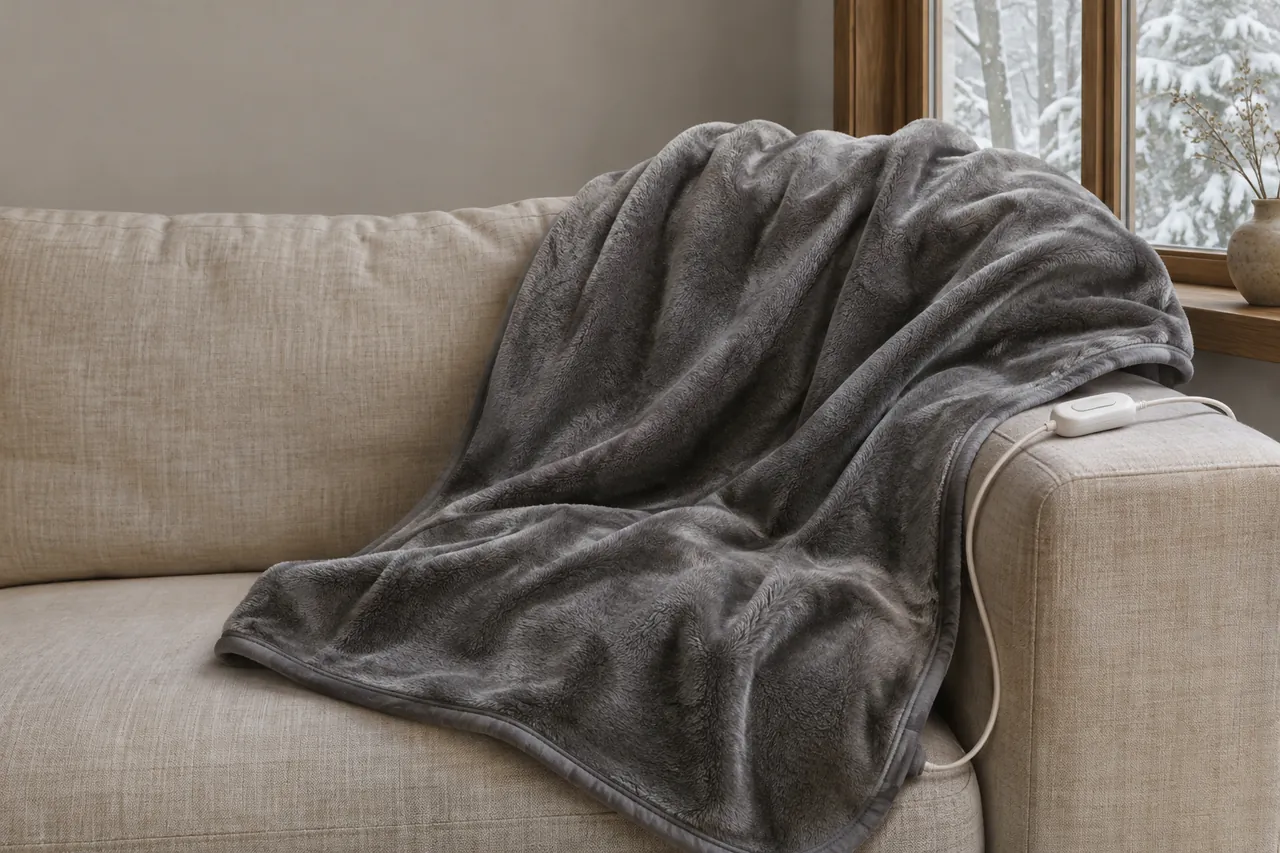
A “king size heated throw” can mean different things in a product listing. Before buying, check whether the item is a loose throw, a bed-sized electric blanket, a heated comforter or a fitted mattress pad. The measurements and instructions matter more than the label alone.
Introduction
This guide walks through the measurements that determine coverage, including a worked example, and explains when mattress depth matters. It also covers what to check when two people share the bed.
Measure and calculate the coverage you want
Choosing a top electric blanket or heated comforter for a large bed requires measuring your mattress dimensions and calculating how much fabric overhang (or side drop) you need.
Mattress Dimensions vs. Blanket Sizes
According to mattress dimension standards documented by the Sleep Foundation (California King vs. King Mattress Comparison 2025):
• A standard US King mattress measures 76 inches wide by 80 inches long (approximately 193 cm by 203 cm).
• A standard California King mattress measures 72 inches wide by 84 inches long (approximately 183 cm by 213 cm).
These figures describe mattress surfaces, not universal blanket measurements. Actual bedding dimensions vary by product. Measure your own mattress and read the dimensions in the listing instead of assuming a size label guarantees a particular drop.
A worked example using a king-size blanket
To visualize how a top blanket will drape over your bed, you can calculate the expected side drop using a simple formula.
For an example, Sunbeam lists the king size of its Heated Slate Gray Velvet Blanket as 100 by 90 inches. The mattress depth below is assumed for this calculation; your own bed may differ.
Example measurements:
• Mattress Type: Standard US King (76 inches wide × 80 inches long × 12 inches mattress thickness).
• Sunbeam king blanket: 100 inches wide × 90 inches long, according to its product listing.
Step-by-Step Coverage Calculation:
• Side drop: (100 inches of blanket width − 76 inches of mattress width) ÷ 2 = 12 inches on each side, if the blanket is centered. In this hypothetical example, that equals the assumed 12-inch mattress thickness. Actual drape depends on placement and bedding beneath it.
• Length difference: 90 inches of blanket length − 80 inches of mattress length = 10 inches. If the top edge is placed at the head of the mattress, the calculation leaves 10 inches beyond the foot. This describes geometry only, not permission to tuck the blanket.
This calculation treats the blanket as a flat rectangle centered on the mattress. Pillows, body shape and other bedding affect the way fabric actually falls, so use the numbers as a starting point. Follow the product’s placement directions rather than treating an estimated drop as permission to tuck it in.
King and California king: the difference in fit
A California king is longer and narrower than a standard king. That changes both the amount of side drop and the length left at the foot for the same blanket.
Comparing Mattress Footprints
As established in the Sleep Foundation's mattress comparison:
• Standard King (76" W × 80" L): Prioritizes lateral width. It is 4 inches wider than a California King, offering maximum personal space for couples or families sharing a bed.
• California King (72" W × 84" L): Prioritizes vertical length. It is 4 inches narrower but 4 inches longer than a standard King, making it popular for taller individuals who need extra legroom.
Use the same 100-by-90-inch blanket from the example above on a California king and the arithmetic changes. Centered across a 72-inch mattress, its flat width leaves 14 inches on each side: (100 − 72) ÷ 2. If its top edge is aligned with the head of an 84-inch mattress, the 90-inch length extends six inches past the foot. That is two inches more per side and four inches less at the foot than in the standard-king example. These figures describe flat fabric dimensions; actual drape depends on the bed and placement, and the product instructions govern how the blanket is used.
Fitted Skirt Depth for Heated Mattress Pads
For a fitted heated mattress pad, measure the mattress depth from its top surface to its bottom edge, including any topper the pad is intended to fit over. Compare that measurement and the mattress footprint with the product’s stated fitting range.
Check the pad’s skirt or anchoring instructions and the depth range listed for that specific model. A pad that does not fit properly may shift or bunch. Do not force an undersized fitted product onto the mattress, and follow its placement instructions.
Identify the kind of heated bedding
Each kind of heated bedding occupies a different place. A throw is a loose cover, while a fitted mattress pad is intended to fit around a mattress. A heated comforter and a top blanket are bed covers, but their construction and instructions can differ.
Throws and top blankets
A throw may be intended for personal use rather than full-bed coverage, but product sizes vary. Read the listing dimensions and intended use. Do not assume a throw is approved for sleeping, use underneath a person or tucking beneath a mattress.
Bed-sized electric blankets
A king-labelled electric blanket is generally sold as a top cover for a large bed. Check the actual width and length and follow the model’s directions for placement and other bedding layers. A size label alone does not establish sleep approval or where heating elements are located.
Heated comforters
Bedsure compares electric blankets with heated comforters as different bedding choices. A comforter may have a different construction and bulk from a blanket; compare the specific item’s dimensions, care instructions and intended placement.
Fitted mattress pads
A fitted heated mattress pad is a separate product designed for a mattress. Check how the model fits, where it belongs in the bedding arrangement and the range of mattress depths it is designed to accommodate.
Two different meanings of pocket
The word “pocket” can describe two unrelated features:
• Mattress pocket depth refers to the depth a fitted bedding product can accommodate.
• A foot pocket is a pouch on some throws where a user places their feet.
An ordinary throw does not need mattress pocket depth. For a fitted mattress pad, depth is part of fit; for a throw with a foot pouch, it describes a different feature altogether.
If two people share the bed
Some heated bedding has controls for two sides; other products have one. The size alone does not tell you which arrangement is included. Check the listing and instructions for the particular model.
How many controls are included?
Two controls let each sleeper make their own adjustment when the particular model supports independent sides. For example, Sunbeam’s Heated Slate Gray Velvet Blanket listing specifies dual controls for its king size. Keep both controls within reach and use the instructions to identify the side each operates.
What can each person adjust?
A model advertised with separate controls may allow each user to adjust a designated area. Use the product documentation to understand the functions. The term “dual control” does not establish the internal wiring layout or the features of another model.
Where will the cords run?
Look at the diagram and cord arrangement for the actual model. Both people should be able to reach the appropriate control, and cords should not be pinched by furniture or routed across walking paths.
• Controls: Identify which control operates which area using the product instructions.
• Cords: Keep them clear of walkways, bed-frame joints and places where they may be pinched.
• Adjustable beds: Use heated bedding on a moving or adjustable frame only if the specific product instructions permit that use.
Check placement, care, and condition
A measurement tells you whether fabric may cover the bed. It does not establish that the electrical product is appropriate for a particular mattress, layer or sleeping arrangement.
Read the heated product’s instructions and the mattress care directions before deciding how to place it. Do not assume that all memory foam, pillow-top or adjustable beds are compatible with every heated product.
Placement and tucking
Follow the model’s directions for drape and layers. Do not tuck an electrically heated blanket under a mattress unless its instructions explicitly allow it, and do not bunch the product while in use.
Weight and placement
Do not sit or lie on a loose heated throw or blanket unless its instructions explicitly permit that use. A fitted heated mattress pad is a different type of product and must be installed according to its own directions.
Mattress compatibility
Check the instructions for both the mattress and the heated item, especially with memory foam, specialty mattresses or adjustable bases. Do not assume a particular setting makes all combinations suitable.
Cleaning and storage
Care procedures vary. Check whether the fabric or a removable cover may be washed, how the control is detached, and how the product should be dried and stored.
• Disconnect power before cleaning, following the model’s instructions.
• Use only the laundering method stated on the item’s care label.
• Reconnect only when the product is completely dry and the instructions allow it.
• Store the item according to its directions and avoid damaging the cord or fabric.
Before use
Inspect the fabric, control and cord for visible damage. If the device is damaged, smells burnt or feels uncomfortably hot, stop use and disconnect it when safe.
Take the bed measurements to the product listing, check the intended use, then compare control and care details. That sequence makes the size label much easier to interpret.
Sources
Sleep Foundation, California King vs. King: https://www.sleepfoundation.org/mattress-sizes/california-king-vs-king
Bedsure, Electric Blanket vs. Heated Comforter: https://bedsurehome.com/blogs/bedsure/electric-blanket-vs-heated-comforter
Bedsure, Heating Pad vs. Electric Blanket: https://bedsurehome.com/blogs/bedsure/heated-pad-vs-electric-blanket-comparison
Bedsure, Electric Blanket Safety: https://bedsurehome.com/blogs/bedsure/are-electric-blankets-safe-safety-guide
Bedsure, Electric Blankets and Heated Throws: https://bedsurehome.com/blogs/bedsure/electric-blankets-heated-throws-warmth-value-2026