
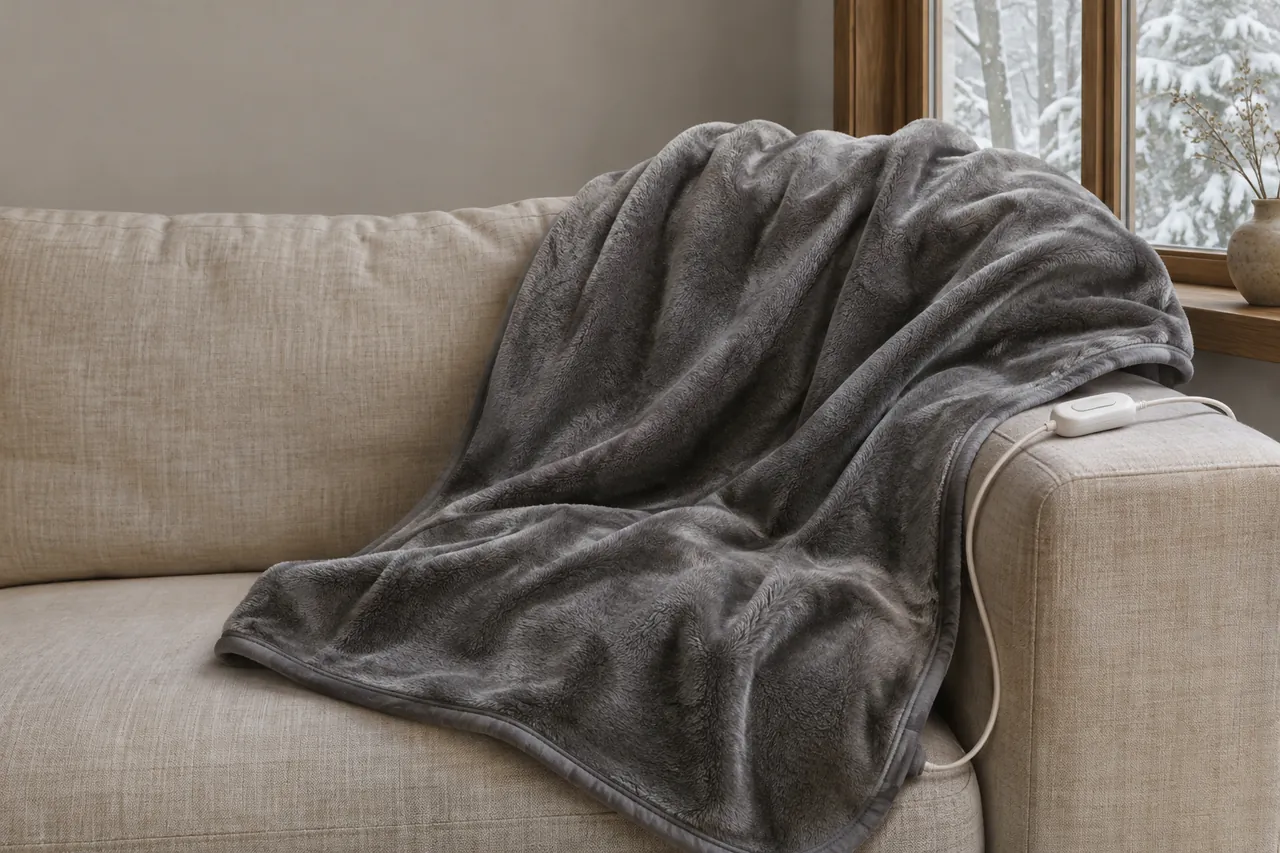
A heated throw is a kind of electric heated blanket. The difference in a listing often comes down to size and intended use: a throw may be marketed for personal coverage, while a bed-size blanket is sold for a bed. The names overlap, so the label alone does not settle where or how a particular model can be used.
Introduction
Instead of choosing by title, compare the dimensions and read the product’s instructions for placement, furniture, sleep and care. A few details in the listing can reveal whether the item fits the space you have in mind.
Two buyers, two different coverage needs
Consider two hypothetical buyers. One wants a cover for their lap in a fixed chair; the other wants a blanket sized for a bed shared by two adults. Neither buyer needs to assume a particular throw or blanket will fit until they compare its measurements and directions with their own space.
A chair and a personal cover
For the seated buyer, the useful measurement is the distance from the lap to the feet in the position they actually use. QVC lists one Sunbeam Extra-Long Microplush Heated Throw with foot pocket at 50 by 70 inches. QVC showed it as sold out on 11 November 2026; its measurements remain a useful comparison for the chair and available storage space. Availability can change.
Check whether the product permits use with the chosen furniture. One separate Sunbeam heated-throw manual prohibits use with recliners, rocking chairs and wheeled chairs. That manual is a separate example, not a verified match for the QVC item. Keep cords clear of walking paths and places where they can be pinched.
Look at the placement of the controller as well. The recipient should be able to reach it without pulling the cord. A photo of the blanket may not show the whole lead or how the control connects, so read the instructions for the model.
A bed and broader coverage
For the bed buyer, measure the mattress and compare it with the blanket’s length and width. Decide whether the goal is to cover one person or the surface of the bed. Actual drape depends on the product dimensions, its position and the bedding underneath.
For a shared bed, compare the controls as well as coverage. Sunbeam lists its Heated Slate Gray Velvet Blanket in a 100-by-90-inch king size with dual controls. This is one model’s specification; check the controller arrangement for the blanket you are considering.
The word “throw” does not imply one fixed size. Sunbeam also lists an oversized Greystone Microplush throw, SKU 14591, measuring 60 by 80 inches. That is ten inches wider and ten inches longer than the 50-by-70-inch QVC foot-pocket throw above, yet both are called throws. Compare those dimensions with the space you want to cover; neither size alone tells you the number of controllers or whether the product is intended for a particular use.
Read past the product name
“Electric blanket” is a broad description for an electrically heated cover. “Heated throw” commonly describes a loose cover intended for personal warmth. A manufacturer may use both terms for the same item, and sizes and directions vary.
A bed-size blanket can offer more coverage across a mattress; a personal throw may be easier to handle in a seating area. Neither name promises a particular number of controls, a fixed temperature, an automatic shutoff time or permission to sleep with the item switched on.
• Throw: Check its actual dimensions and the seating or placement described in its instructions.
• Bed blanket: Compare the stated dimensions with the bed and check the intended placement.
A product photograph is useful for seeing shape and control placement, but the dimensions let you compare two listings directly. For a seated cover, measure from shoulder or lap to feet; for a bed cover, measure the mattress width and length. Decide how much extra fabric you want before comparing the numbers.
The instruction manual supplies details a short title may omit. Look for it alongside the product description before you decide, especially if you intend to use the item on a bed or near furniture with moving parts.
Six details worth comparing
Before adding an item to the cart, find the information below in the listing or instructions. A clear title is useful, but it is not a substitute for model-specific details.
Dimensions and intended placement are the first checks. Then compare controls, care and any restrictions that matter for the intended user.
• Size: What are the actual length and width?
• Placement: Is it a loose cover, a bed blanket or a fitted mattress pad?
• Controls and lead: How many controls are included, and can they be reached in the intended setup?
• Furniture and sleep: Does the model permit the intended chair, bed and sleep use?
• Cleaning: What does the label say about washing, drying and removable parts?
• Warnings: Who should not use it, and what placement or layering is prohibited?
If the listing is brief, look for the exact product’s instructions. Keep the documentation with the item so the same information is available for care and storage later.
Keep fitted pads and loose throws distinct
A heated mattress pad and a loose heated throw sit in different places. Bedsure’s comparison discusses heating pads, electric blankets and heated mattress pads as distinct categories. The label “pad” needs context: it can refer to a small localized pad or a fitted product for a mattress.
A fitted mattress pad is intended to fit a mattress as its instructions specify. Compare its mattress size and depth range with the bed. A loose throw or top blanket follows its own placement directions and should not be treated as a fitted underlay.
Loose cover
Use a throw or top blanket in the position specified by its instructions. Do not assume it can be sat on, placed beneath a person or tucked under a mattress.
Fitted mattress product
Use a fitted pad only with a compatible mattress and install it according to its own directions. Check any restrictions on adjustable beds, specialty mattresses and additional layers.
A localized pad
A localized heating pad is another item again. It is intended for a smaller area and should not be substituted for a fitted mattress pad simply because both use the word “pad.”
These distinctions help prevent buying a product that cannot be used in the intended location. They also make comparison easier: judge each item against its actual purpose rather than a generic image of heated bedding.
• Top covers: Check whether the instructions permit pressure, tucking or sleep use.
• Fitted pads: Match the size and depth to the mattress and follow installation instructions.
Care and use belong in the same decision
A model’s daily use and its cleanup are part of the same purchase decision. A fabric that feels pleasant may come with a care routine that is inconvenient for the household, so check the label before buying.
Cleaning
Some products have removable controls or washable fabric; others have different care directions. Follow the actual label, disconnect power as instructed and make sure the item is completely dry before reconnecting it. Do not assume every controller detaches in the same way.
• Check the listed washing and drying method.
• Keep the care tag and instructions with the product.
Storage matters too. Follow the product’s instructions for folding and storing it, keep it dry and avoid putting heavy objects on top. Keep the correct controller with the blanket rather than mixing components from different products.
Warm-up expectations
Bedsure’s heat-up guide notes that many electric blankets take several minutes to feel noticeably warm, while the time varies with the product, settings, room and fabric. A smaller throw is not automatically faster than a larger cover: the heating design matters too. Use the settings and placement described for the item.
A controller setting is not a universal temperature across brands. Choose an item with controls that are clear to the intended user, and stop use if it feels uncomfortably hot.
Before use
Inspect the fabric, cord and control for visible damage. If the item is damaged or has an unusual burning smell, stop using it and disconnect it when safe.
• Follow the model’s instructions about folding, layering and tucking.
• Check furniture restrictions before using a throw in any moving chair.
• Do not stack an operating heating pad on an operating electric blanket.
• Check the cord and fabric for damage before use.
• Stop using a damaged item or one that feels uncomfortably hot.
Once you know the intended place, desired coverage and care requirements, the product label becomes easier to interpret. Choose the model whose measured size and instructions fit that use.
Sources
Bedsure, Heating Pad vs. Electric Blanket: https://bedsurehome.com/blogs/bedsure/heated-pad-vs-electric-blanket-comparison
Bedsure, Electric Blanket Safety: https://bedsurehome.com/blogs/bedsure/are-electric-blankets-safe-safety-guide
Bedsure, Electric Blanket Heat-Up Time: https://bedsurehome.com/blogs/bedsure/electric-blanket-heating-time-factors-warm-up
QVC, Sunbeam Extra-Long Heated Throw with Foot Pocket
Sunbeam, Heated Slate Gray Velvet Blanket